Day of the Triffids: Post-apocalypse made for TV

apocalypse bbc bump in the night movie adaptation sci-fi triffids

A while back I read The day of the triffids, a 1951 novel by John Wyndham. It’s a post-apocalyptic tale where one accident leads to another: A cosmic light blinds the majority of the worlds population, and the poisonous, ambulating, and possibly intelligent plants which are being harvested for oil — the eponymous triffids — escape from captivity. So let’s loose a bunch of murderous plants on a blind humanity, leaving the few remaining sighted to help or ignore the suffering. Aaaand, action!

The book starts with Bill Masen waking up in his hospital bed, where he’s been treated for a triffid sting to his eyes. His head is bandaged, so he is unable to see the global borealis which almost everyone else is watching. As luck would have it, this spares his vision, and when the next day neither nurse nor doctor check in on him, he removes his dressing and discovers that everyone is blind but he. In the book, the panic that our protagonist feels is overwhelming, and I found myself mirroring Masens fright at things going bump in the night.

Much like in a zombie story, the humans who have been afflicted walk with outstretched arms, grasping for the non-affected; Wyndham might not have enjoyed killing off civilisation as we know it, but he sure enjoys traumatising his characters:

What was going on was a grim business without chivalry, with no give, and all take, about it. A man bumping into another and feeling that he carried a parcel would snatch it and duck away, on the chance that it contained something to eat, while the loser clutched furiously at the air or hit out indiscriminately. Once I had to step hurriedly aside to avoid being knocked down by an elderly man who darted into the roadway with no care for possible obstacles. His expression was vastly cunning, and he clutched avariciously to his chest two cans of red paint. On a corner my way was blocked by a group almost weeping with frustration over a bewildered child who could see but was just too young to understand what they wanted of it.

As it happens, BBC chose to interpret the book in a two part miniseries, and I had the first episode with breakfast. So far, it’s not all that impressive; The cold war story has become one of nature striking back, and man’s inhumanity to man is business as usual with some people being douche bags. Most of the immense tragedy — millions of Londoners blinded, fighting for food, reassuring their children — is almost glossed over.

No problem in the adaptation seems so big that it can’t be reasoned about; The sense of despair which enthralls the reader is missing, substituted with interpersonal disputes. The actors are more or less convincing, but the script lets them down. Eddie Izzard plays the evil guy, who appears in the book as a fascist character late in the story, but here is an egotistic opportunist, and the main foil for our dislike. We are left not judging the everyday humans who try their best but fail, but Izzards character Terrance who is stopping them from doing their best for his own selfish ends. The triffids become a backdrop in front of which Terrance and Bill fight over the girl, the bereaved radio journalist Jo Playton. The apocalypse happened and the guys are comparing dicks.
The most surprising anti-hero is played by Jason Priestly of 90210 fame, as a brash American who kidnaps the sighted so that they can guide the blind. At the end of the first episode he is redeemed and the audience no longer has to wonder if he’s a good guy or a bad guy. So despite good acting, there’s so little faith in the audience that the story of disaster and new beginnings, becomes one of action and getting the girl.

Of course it’s much more difficult to show someone’s internal struggle on the screen, where you can’t supplement it with your own imagination, but lets draw comparisons with another post-apocalyptic movie: In 28 weeks later there’s a scene where a main character abandons his wife, believing that she’s lost to the zombies. We see him run away from the house where she’s trapped, and he’s sobbing until out of breath — from fright of the zombies, his impotence in the face of the threat, his guilt over the abandon, his grief at losing his wife — leaving us not only conflicted about the moral correctness of his actions, but also with an understanding that there’s a limit to the human reasoning we can marshal under extreme circumstances.

Also, if you’re partial to graphic novels, you might have already heard of Walking Dead, which captures human emotions far better than either 28 days/weeks later or this adaptation of Day of the triffids.

—————-

Update: Part two was crap. The story jumped in time, seemed to skip most of the character developement which might have explained what the hell people are doing — Hey, he’s alive! He’s dead! I don’t trust them! I trust them! —  and hopped from one action sequence to another, lest the audience lose interest. Even if you don’t compare it to the original story, this is just shit storytelling, despite some good acting. Booh!

The work of art in the age of mechanical reproduction. Part 11

animation art theory originality reproduction walter benjamin writing

Chapter nine of “The work of art in the age of mechanical reproduction” is somewhat longer than the previous one, so prepare for an hours worth of writing art theory! If you are just joining us, please start the course from the beginning; It will do you no good to drop in at this point.

We’re past the halfway mark of this tutorial series, and by now you ought to feel that writing like Walter Benjamin comes easier to you. If you’re still struggling, don’t worry about it — writing art theory is hard work and you might not get it right the first time. Revisit those episodes which give you grief, and you will soon find that studious attention will do wonders for your skill.

The work of art in the age of mechanical reproduction. Part 10

animation art theory originality reproduction walter benjamin writing

In part ten of our tutorial “How to write like Walter Benjamin” we’re going through chapter eight of the essay “The work of art in the age of mechanical reproduction.” As usual, we’re using the Andy Blunden translation, and since it’s a short chapter we’re done in less than twenty minutes.

Counting the chapters of the original essay, we’re half-way through it at this point. By now you ought to be so good at this that you’ll be coasting the rest of the series. If you have any questions or comments, please get in touch.

The work of art in the age of mechanical reproduction. Part 9

animation art theory originality reproduction walter benjamin writing

Welcome to part nine of our series How to write like Walter Benjamin where we’ve come to chapter seven of Benjamins 1935 essay The work of art in the age of mechanical reproduction.

With a slightly longer chapter, we’re clocking in at just under fifty minutes in this episode. Hopefully you’re getting the hang of the process by now, and perhaps you’re even feeling more confident about your writing. If you’ve come this far, you deserve it!

Fabbing. Now in real time. Or in China. Or at your place.

books DIY fabbing future making manufacturing mass industry production roadwork war

A couple of weeks ago The Pirate Factory in Malmö demonstrated their RepRap. There’s Flickr pool of the event up here with a shaky video at the end of it. They’re using a spruced up version from Bits from Bytes which looks slightly less dingy than the RepRap usually does (also, it uses a more powerful microcontroller for driving the printer independently of a computer — apparently an SD card is enough) and judging from the pictures there was a bunch of people present. I wonder which of the pictures are going to be used in Swedish school-books in the future, as illustrations of the fabbing revolution and micro-production…

Speaking of which, Wired has an article up on the current state of how manufacturing companies have become accessible to anyone with a credit card, lowering the cost of admission into mass production to more or less zero. Atoms are the new bits is worth your time if you’re the least interested in these matters, or the future in general. It’s full of interesting links, like the one to alibaba.com, an enormous portal of Chinese manufacturers.

I wonder what the environmental costs will be of bespoke production; To some extent you’ll have less hit-and-miss toys occupying landfills, but this gain might well be offset by increased packaging and shipping, or some other corollary. Also, I wonder if these long-tail manufacturing plants will go global or if China and such countries will retain their head start; We in the west will only ever manufacture wars.

If intellectual properties will become impossible to enforce — something which isn’t certain, given the oppressive laws which are passed to counter transparency and openness — this would indeed shift not only the knowledge of how to do something but also the rational for the existence of a specific company. If you can download the plans for a SAAB, you just need someone to manufacture it. In the end, just as globalization has killed the connection between brand and production — after all, the cheap manufacturing plants exist exactly because of the Export Processing Zones in Vietnam and China — it might well kill the last remnant of Company with a capital “c,” the brand with an address.

These realizations are not lost on industry folk, but no-one wants to admit their own obsolescence, thus there’s no hurry to come up with new business models. The exceptions are Threadless of the world, but those start from the bottom up and don’t have to reinvent themselves; Let’s see how well Apple handles the transition — if at all.

Joren De Wachter has written a summation of the coming upheavals — The Return of the Public Domain — and it’s a text targeting those in the manufacturing & design industry. Even though he’s hopeful, or rather, not fearful, of the technological changes which will change intellectual property as we understand it, his text is very thin on the details of how companies will cope, and focus rather on the knowledge workers themselves. (Proffesional Idea Generators, he calls us, which might actually go as an acronym on my next business card)

However, there is also a very clear positive side to the new developments described above for Professional Idea Generators. The new business models that become necessary will clearly provide them with significant competitive advantages for doing business in an environment where the Public Domain is important. Knowledge and expertise, cost effectiveness, continued innovation and networking are key competences of Professional Idea Generators. This puts them in a very strong position in respect of the new developments.

The sentiment seems to be that “someone will still make money, if they just figure out how to add their own knowledge as a value which can be commodified.” As things stand, only those who make stuff will be needed, those who actually have the tools and raw material to manufacture something. Everyone else is part of the Public Domain. And not only figuratively as someone who designs webpages or new pens, but they themselves become part of the commons, and last time I checked there was a tragedy involved in the commons under any scarcity-driven economic model.

You’re going to need a special secret sauce, armed guards keeping it safe for long enough to sell it. And even then you’re either competing for a nieche audience which wants the exclusive, or your elbowing for space with other companies, competing on price.

And here’s a narrative which might seem familiar: Over at The Millions, there’s an interview with a guy who pirates books, and in the comments section some people are upset over a lack of morals. In ten years time, when your kids are printing modified pirated Nikes, maybe the kneejerk debate will be different, but I wouldn’t hold my breath. Home fabbing is killing Nike!

Rocks about to punk ≠ Punks about to rock.

concert gif animation live music Photography rock the bang

A friend of a friend saw me run around with a camera the other day and asked if I wouldn’t take some pictures of him and his band as they were playing at Henriksberg yesterday. So in skinny jeans and with a leg pouch I climbed all over a small stage, trying to take pictures of The Bang. Usually only my mom asks me to play photographer — “and please don’t make them ‘arty,’ just make them good” — and I’m always nervous whenever I’m supposed to perform. It’s like peeing in public; I’m not a professional enough urinator to be comfortable doing it.

Reviewing the pictured I guess they’re good enough, especially when beaten into submission in post, but it’s so odd looking back at myself and not really remembering what it was I wanted to accomplish with the live shoot. Either you’re documenting live because 1) the light and set and so on are unique enough to warrant taking advantage of the situation, or 2) because you want to document the audience somehow, put the band there and then, bearing witness.

What with every other person in the audience watching the show through viewfinders or cellphone screens, I’d like to see some more effort put into making even concerts like this media friendly. Perhaps a live Bluetooth dump linked to a screen at the bar? Lighting that goes from almost pitch black to living-room, allowing the full range from fanboy to ironic girl to get their desired image. You know, like fenced hunting; The hippo might have nowhere to run, but you’ll still feel rather good about shooting it just so. (As long as you bring ear guards.)

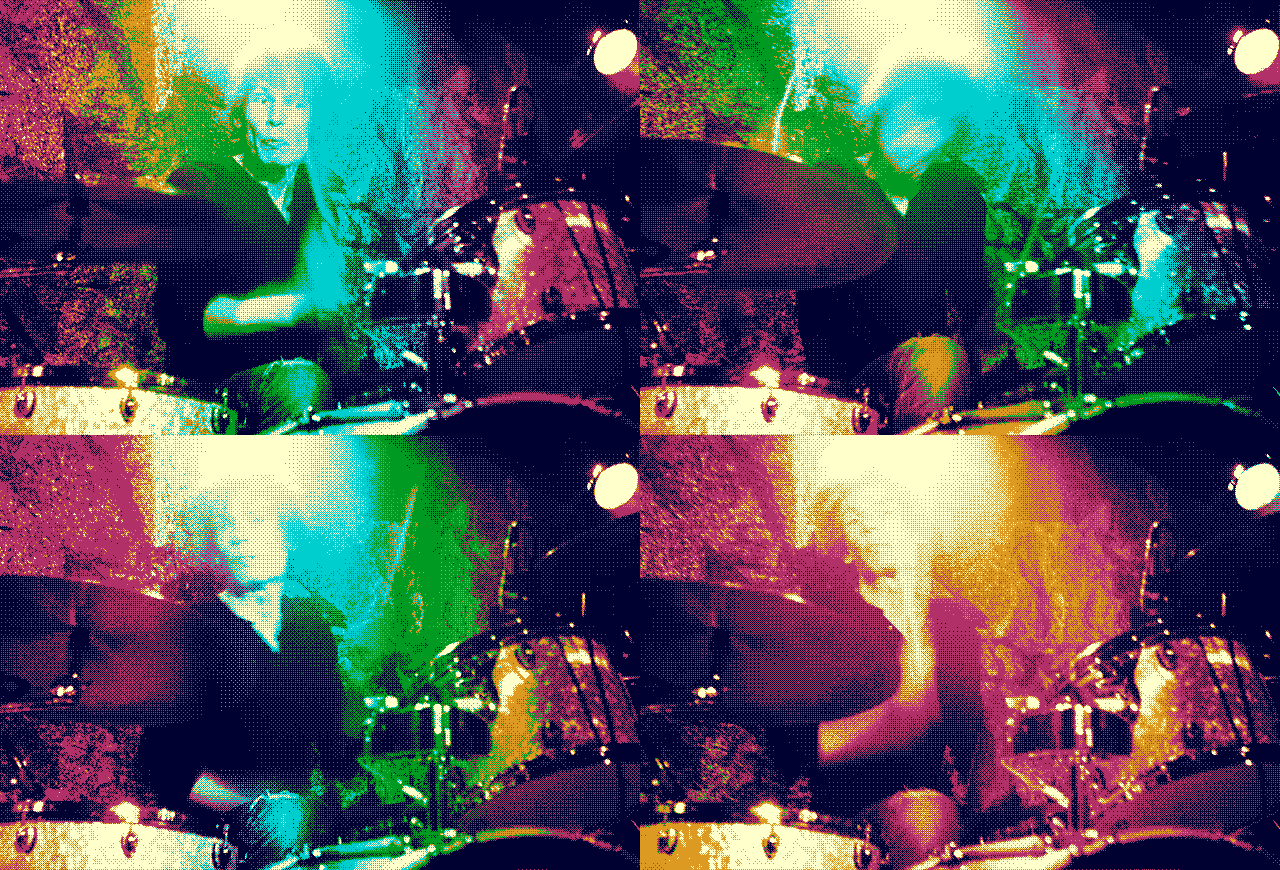
On a side note, I might be coming down with a fever and should go to bed now. Let’s start Monday on a really shiny happy note, shall we? Try not throwing an epileptic fit looking at Jon the drummer above.

The work of art in the age of mechanical reproduction. Part 8

animation art theory originality reproduction walter benjamin writing

Part eight of the series “Write like Walter Benjamin” where you’ll learn how to write art theory with the help of Benjamins essay “The work of art in the age of mechanical reproduction,” using Andy Blundens translation. For some reason I always misspeak Andys surname as “Bloomden” and I apologise for that. Sooner or later I’ll get it right.

Today, we’ll work through chapter six, which is a short one. If you’ve followed this course from the beginning (as I keep insisting that you do) you should be getting the hang of writing art theory by now, and I hope you are excited about it.

The work of art in the age of mechanical reproduction. Part 7

animation art theory originality reproduction walter benjamin writing

We’re now more than one third through the essay, and — if you’ve been diligent — you’re one third ready to write art theory! If you’ve followed the previous episodes — and I encourage you to check those out if you haven’t — you know that we’re at chapter five of the Andy Blunden translation of Benjamins classic essay. I hope you enjoy it!

The future! The future!

AI books future interview morals and politics radio reading sci-fi technology

The Singularity is no longer talked about as the geek rapture which will make people happy and good and content with life; Just as our capacity for rational and creative thought will be multiplied hundredfold in a short time, our capacity to act according to our own morals increases accordingly. No longer a world where anyone can build an atom bomb, but one in which each of us is a walking one. The will to power will out, and just because there’s no need to fight over oil or water doesn’t mean someone won’t want to kill us all.

Ray Kurzweils movie Trancendent Man seems like an interesting overview of the mans ideas, and h+ has an interview with him which you might want to read before the movie makes it onto the torrent sites; He is good at articulating the problems which might appear as a result of technological advances (eternal life, nano-tech, AI) and because of his technological background actually has numbers he can throw at you when it comes to the hard sci-fi predictions.

James Hughes over at Changesurfer Radio interviewed professor of philosphy Asher Seidel about his book, and it’s a good guide to the kinds of questions that might challenge our successors. I started listening to the transhumanist Changesurfer Radio ten years ago in Karlstad, and it’s a great source of interesting ideas and people. I heartily recommend it, if for no other reason than that James is a politically conscious person who doesn’t let his interviewees get away with just technological solutions to human problems; Humans are social and political beasts and use technology accordingly. Which, incidentally, also is the lesson that good science fiction can teach us.

bokrelease_suddigt_folk

Lately, between fattening myself on crisps and ramen, and watching The No. 1 Ladies Detective Agency, I’ve been reading. Since none of you heathens got me an ebook reader for the holidays, I’ve been perched in my comfy new fake leather armchair, reading off the screen or on paper.

Mostly I’ve been rekindling old flames: Iain M. Banks Matter as well as the abridged Transition; Peter F Hamiltons Starflyer books — Pandora’s Star and Judas Unchained — have sent me back to the first two parts of the Dreaming Void trilogy, and I can hardly wait for the last installment which is due out in fall of 2010, and where I’m guessing we’re going to see a fascist universe be created in the Void.

Matter is a Culture novel and as such it’s a fascinating read. More than in other novels there is intervention by the Culture — a futuristic, egalitarian galactic society which tries to nudge more primitive civilizations along —  into the life and society of a Victorian era feudal world which exists on a shell world; a spherical world within a world within a world, built for unknown purposes. The king is murdered and his daughter, who has gone off and joined the Culture, returns for his funeral, getting mixed up in a world she’d left behind. If you enjoy Iains style of prose, you’ll love this book — its imagery is powerful and the language just the right amount of funny.

Petter gave me Foreskins Lament by Shalom Auslander — known from This American Life as the Jew who hates God — and it’s a good read so far. If you need a reason for why religion might be more damaging to your mental health than a regular abusive home, look no further than to his description of how he was taught about God. Apatheism is the way to go, people. Trust me on this — just focus on an existential issue other than theism, and make that issue the cornerstone of your personal ontology and moral conviction.

I still haven’t slogged through 45 by Bill Drummond, a collection of essays which Olle lent me, but I’m getting there, although that has been delayed by my adorable mom, who just sent me a Polish account of two years spent in Tokyo. It being mom I have to prioritize that, even though it reads like a punny Lost in Translation. Never an endorsement.