Starting a biohacking lab in Gothenburg, looking back at Laborator

Back in 2016 I set out to start a biohacking lab in Gothenburg. I had read about biohacking for a couple of years, seen the interesting stuff that labs such as Genspace in Brooklyn were doing, and wanted to take part.

Biohacking as a term means different things to different people:

  • Quantified self: Humans as biological machines – optimize nutrition, supplements, exercise and mental practices, to achieve higher performance, improve quality of life, extend your lifespan, etc. A subset are grinders who do more extreme self-experimentation and invasive surgery or gene editing.
  • Citizen scientists: Folks who are generally interested in doing science – measure Ph changes in streams, find new wild antibiotics, map how pollution effects flora and fauna.
  • DIY medicine: Design of cheap medical and lab equipment from off-the-shelf components, DIY manufacture and protocols for generic medication, such as insulin.
  • Synthetical biologists: Create new organisms and biological systems, or modify and mapping existing ones, using tools such as Crispr Cas9.
  • Futorologists / transhumanist: Interested in ethics, morals, law and policy of biological issues – what will become of humans when we can become whatever we like; a very long view of humanity.
  • BioArt: Contemporary artists and fellow travellers who work with biological systems as material or area of enquiry.

The field of biohacking – if it’s coherent enough to be called that – is wide, and the lowest common denominator is that those involved are predominantly amateurs interested in biological systems of some sort. They might be specialists in other fields (data informatics lends itself to synthetic biology, hardware hacking to DIY medicine, etc) but they come to biohacking with agendas and interests different from a professional lab technician or university researcher.

This goes doubly for me: I’m not specialized in any field applicable to biohacking, and I most certainly don’t have any experience with lab work apart from dissecting a frog in seventh grade. But I do have a broad knowledge of all kinds of stuff, an unyielding fascination with how the world works, and experience with setting up a maker space and learning stuff as I go along. I figured that even though I wasn’t knowledgeable enough to do original research or design, I would be able to cobble together from what others had done, well enough that it would be worth the effort.

I scoured the net for similar groups in Sweden and/or Gothenburg, and reached out on mailing-lists and Facebooks and whatnots to see if there was interest, and over a course of a few months I had a newsletter, a homepage, and a couple of recurring faces at meetings. We founded Laborator, a non-profit association with a charter registered with Skatteverket, and – most importantly – I drew a logo and printed a bunch of calling cards. After six months we had five members and ten times as many on lists and in groups.

(Our meetings were open to anyone, which also attracted some interesting individuals with their own peculiar takes on what we ought to do and a tenuous grasp on social etiquette or reality)

The other members were all biologists of one stripe or another. We had a post-doc, a researcher, a synth-bio dropout and an undergrad. I was the only one without any formal training, and I thought the combination would be great – we’d complement each other and create an open platform for biohacking: The main goal of the association was to get a permanent lab going, equipped to run small workshops and lectures.

Around this time I’d attended the first biohacking conference in Sweden (writeup here), participated in a workshop at Bionyfiken in Stockholm (at the time the only lab in Sweden, since defunct) and started collecting consumables and equipment. I’d also started to build some equipment required for basic experiments (mainly thermocyclers for PCR and gel-plating for barcoding) – and I got in touch with labs around the world to see what they did to get off the ground, hoping to build on their experience, and compiled it all in a communal document. I interviewed the Bionyfiken folks as well as a few artists who work with BioArt, with the ambition to create a podcast which would serve as a platform for Laborator outreach (those recordings are still unrealeased).

Summer of 2017 we talked about doing a first workshop in the fall. It felt as make-or-break time; there are only so many meetings you can have before you run out of steam, and we needed to do something public which would give us a concrete goal as well as garner public interest (and potential investment or grants). We didn’t have a lab of our own, but if we could borrow and equip a space, we’d be able to run some simple workshops. After some discussion we decided that we’d do a simple DNA-barcoding workshop, identifying the fish in sushi (the idea taken from high-school students who’d done exactly this back in 2008 – although they outsourced the labwork) – as it checked most boxes: it’s relatively simple and cheap to do; it shows the applicability of biohacking; it concerns food, which people have strong opinions about; finally, should we discover mislabeled fish we’d have instant media attention.

But then we hit a bunch of stumbling blocks, as one does. Someone got a new job, someone moved – one planning meeting was cancelled and then another, and pretty soon the energy had drained out of the enterprise. As long as there’s a critical mass of people on a project it can survive a few dips. But if the project becomes a metaphorical empty room, stepping inside and sitting down at the table requires a lot of will and energy – it’s easier to turn at the threshold and move on to a more interesting discussion down the hall.

As project instigator, the responsibility and the outcome is all on me. I focused too much on minutiae and side projects, at the expense of keeping the group pulling towards a common goal. In my mind, the lab was already a given and I was eager to move on to the next stage of the project. And so we became spread thin and lost focus. Any communal project is a marathon rather than a sprint: It’s important to be able to step back and trust your collaborators to follow the plans you’ve agreed upon, but when stuff falls through you need to be there to pick up the slack – and plans always shift, since life happens – regardless if it’s you or someone else who dropped the ball.

What I did right, what I did wrong, what I’d do differently today.

I managed to inspire a bunch of folks to get together to start a lab. Even though we had different ideas, everyone was willing to pitch in to make a permanent physical lab a reality. The IT-infrastructure (Slack/homepage/mailing list) as well as coordination with other labs made it all feel as a serious and “real” organisation. We quickly pivoted to organizing a workshop and had clear goals both in the short and medium term, and there was interest and enthusiasm both from members and mailing lists / groups.

What I underestimated was the amount of energy it takes to keep everything going and to motivate people. I abandoned the motivational part too early because I assumed that we all had the same drive, so I stepped back into “process support” before there were processes in place. The big picture of the project was important – thinking about lab space, financing, marketing, collaborations – but at the start all my energy should have been on getting a public workshop or two off the ground, letting the team feel proud of the accomplishment, and build upon that.

Today I would have begun by organizing a workshop or lecture myself, rather than creating an organisation first. This would have limited me to events which I actually could’ve pull off, and it might not have been more than a lecture on “state of DIY biohacking” or “biohacking and the law” or some such – but it could have attracted more people and also gauged the level of public interest. This would also allow a future organisation to be shaped by the events and participants, rather than fiat by charter, as well as provided the motivation for an organisation to be created.

Before writing this up, I looked through the blog to see what I’ve published previously. The topic of biohacking has loomed large in my mind for a while, so I was surprised by the dearth of posts (I might have missed some, my tagging isn’t consistent). The first time I posted on the topic here was in 2009, with just a link-dump: Pasting is the new writing. DNA wants to be free! (some of the links have rotted since). There’s some loose thoughts and a link-dump in 2016 – Biohacking and the things humans do – the 2016 biohack conference linked above, and finally just a brief mention in 2017 when things were petering out.

A job, academia, dillettante

The last couple of months I’ve been reconsidering what I’m doing with my life. One concrete evidence of my confusion is that I have too many tabs open in my browsers and compulsively download too many books – I do this in lieu of actually reading or acting on the stuff, and then I berate myself when I fail to do so. It’s my old mental companion “knowing about what I could do is the same as actually doing it” – which means that as soon as I get an idea, it feels “done” and I move on to the next thing. On top of this, I’m lacking compatriots to do stuff with; I don’t have a network of people who seem interested in what I’m interested in, which adds to me desperately striking out into the void of the Internet to find something to attach myself to.

This is of course completely unproductive and sure-fire way of burning myself out. You don’t get full by reading a recipe book, you actually need to assemble the ingredients and cook and eat the food. I don’t know why I’m falling into this trap again and again, but I do.

The bikeshedding is real though. As an example, I just now spent half an hour learning how to change the look and colour of my zsh terminal prompt because the default look annoyed me when I tried downloading the Hugo theme “Creative portfolio” to try it out as the main page of monocultured.com. It’s a nested doll of procrastination, since I’m uncertain what I ought to put on the homepage to begin with, let alone what kind of homepage I want, etc. Why on earth do I feel that I need a portfolio homepage when I’m doing very little freelance or artistic work, other than for my own amusement?

Depressed people do need human company. For some reason, human company helps. In fact, it is the single thing that helps the most. But not the kind of company a sad person needs. What a depressed person needs is simply to talk to people, not about their problems or their negative thoughts or their depression, but about anything else – music, animals, science.

Noah Smith: A few thoughts on depression

Anywho. One of the avenues of changing shit up that I’m thinking about is going back to school and getting a doctorate. And then I remember all the complaints my academic friends make about being overworked, under-funded and forced to publish, and realise that perhaps I’m not cut out for that millieu.

The sad result is that, as a community, we have developed a collective blind-spot around a depressing reality: even at top conferences, the median published paper contains no truth or insight. Any attempts to highlight or remedy the situation are met with harsh resistance from those who benefit from the current state of affairs. The devil himself could not have designed a better impediment to humanity’s progression.

Jacob Buckman: Please commit more blatant academic fraud

This speaks to the weird incentives that appear whenever there’s a scarcity of resources, and even just my experiences as a guest tutor at Chalmers arkitektur & UMA gave me enough insight into the backstabbing skullduggery required for academic success that it scared me off. I know my limits, and I’m not Machiavellian enough to succeed in highly competetive settings.

But perhaps I should study something which might play to my strengths, instead of my ambitions? Design research seems to be an interesting field where you can actually make a living while doing stuff on the border of journalism and academia.

But even if I find something which seems like a good idea – let’s say that I get it into my head that Cultural Geography is a fine thing to study and master – I’ll need to keep at it, lest I again get distracted by my distracted stupid brain. Observe how good people are at fooling themselves into thinking a goal is achieved by using something else as a proxy:

I know it’s meaningless, but I see those rings every time I lift my wrist and it’s dagger to heart to see them incomplete. Most of the time it’s easy to fill them, but when I’m on a four hour train, there are fewer opportunities to stand. So here’s what I do: at one minute before the hour, I stand up for two minutes so I get “standing” credit for both hours. I can then sit easy for another 118 minutes before rousing myself once more.

Buttondown.com, Adrian: If You Can’t Win, Cheat

In the post above Adrian lists non-obvious activities as “gamification”, and in my case I’d list “downloading massive amounts of books” and “keeping track of the latest memes” as at least tangentially related – both allow me to demonstrate (superficial) knowledge, or appearance of knowledge, to my friends and family, accruing kudos and cementing my position on some demented “keeping-up-with-shit” scoreboard.

Life should contain novelty – experiences you haven’t encountered before, preferably teaching you something you didn’t already know. If there isn’t a sufficient supply of novelty (relative to the speed at which you generalize), you’ll get bored.

Lesswrong.org, Eliezer Yudkowsky: 31 Laws of Fun

I think the above listicle is supposed to be applied to games – or challenges for characters more broadly – but to me it reads in parts as an outline of a philosophy for an enjoyable life.

The pandemic made me realize that I do not care about working anymore. The software I build is useless. Time flies real fast and I have to focus on my passions (which are not monetizable). Unfortunately, I require shelter, calories and hobby materials. Thus the need for some kind of job.

Hacker News, lmueongoqx: What tech job would let me get away with the least real work possible?

Contrary to what I expected on a US-centric highly competetive venture capital message board, many of the comments on the post above were sympathetic to the poster. I don’t think I’m qualified enough to find a job and lifestyle which would allow me to have this approach – at heart, I still feel poor even though I’m not, really – but the clarity with which the poster pursues an answer is inspiring. A similar thought struck me the other day as we started to rewatch the 2013 series Hannibal: The reason why the titular character is so impressive is in part because he’s so clear on his objectives (reprehensible as they are) and acts controlled and rationallly to achieve them. I’m sure there are better role-models than cannibalistic serial killers, but still. Let’s consider Raos writing on The Loser as a category to aspire to:

The Losers like to feel good about their lives. They are the happiness seekers, rather than will-to-power players, and enter and exit reactively, in response to the meta-Darwinian trends in the economy. But they have no more loyalty to the firm than the Sociopaths. They do have a loyalty to individual people, and a commitment to finding fulfillment through work when they can, and coasting when they cannot. […]They mortgage their lives away, and hope to die before their money runs out. The good news is that Losers have two ways out, which we’ll get to later: turning Sociopath or turning into bare-minimum performers. The Losers destined for cluelessness do not have a choice.

Venkatesh Rao: The Gervais Principle, Or The Office According to “The Office”

Taking part in the Venice Bienniale

Korean Pavillion at Venice Biennale 2021

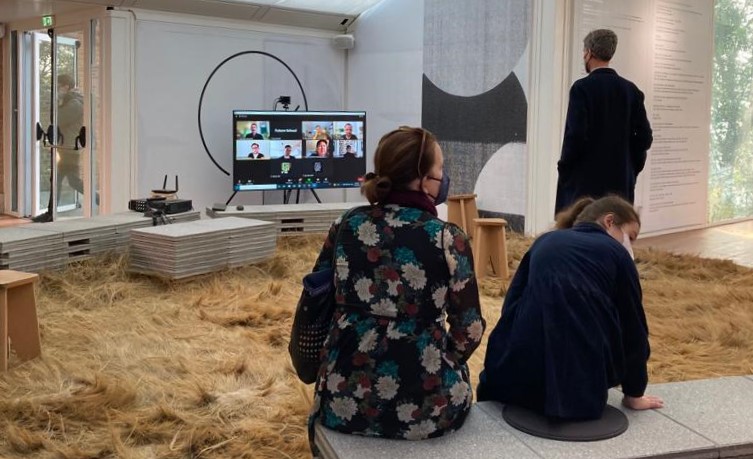
Thanks to Ana Betancour and Carl-Johan Vesterlund I got to participate in a roundtable at the Venice Biennale, through the Korean Pavilion & Future School. The topic for our roundtable group was An Atlas of Global and Local Imaginaries and our common denominator was different kinds of mapping, mostly geared towards socially responsible architecture and planning.

The discussion was streamed to the pavilion in Venice – we had initially talked about doing it live on site, but, well, Corona – and it was curious to see the pictures afterwards of my remote face talking at people. Of course, I would have loved to participate in person, but the benefit of sitting in front of a camera at home is that I’m more relaxed when I’m not blinded by stage lights or can hear people shuffling in their seats.

I presented my ongoing project What is this place / This is the place and the others were kind with their comments. The project is a mapping of a site in Gothenburg, and it’s at times like these that my proclivity towards obscure knowledge shines, and it was interesting to hear the others take on it – especially since they’re all practicing architects. I might be on to something with WITP/TITP and wonder how else to present the project in addition to the project page at mmm.page/monocultured.

Recording of the roundtable. Participants: Ana Betancour, Matthew Butcher, Killian Doherty, Oriana Eliçabe, Ahn Jae Woo, David Ortega Martinez, Mateusz Pozar & Carl-Johan Vesterlund.

Multiple personalities, meaning & will-to-power

Asher, however, is not part of a typical influencer collective. He is one of many members of a 29-person “system,” all of whom share a single body, brain, and life. Each person, or “alter,” in the system is a distinct form of consciousness. This group of identities live together in the body of a 31-year-old man diagnosed with dissociative identity disorder (DID), previously known as multiple personality disorder. The A System’s account — by far the biggest in the DID TikTok community — has amassed 1.1 million followers since February 2021.

Input: Inside TikTok’s booming dissociative identity disorder community

There’s a character in Doom Patrol with 64 personas / alters – Jane – and although her experience is partially supernational, the origins of her alters are in respons to trauma, which is the popular understanding of the phenomena. But is this something which instead might be cultivated or implanted, and how would that work socially? How would your family react if “you” decided to branch off an alter just for dealing with familial relations, along parameters that “you” have some initial control over – more caring, less truculent, prouder? The book A Memory called Empire touches on this, with lineages of implanted personas who inhabit sequential persons, providing knowledge and experience, but also forcing “the main” to come to terms with the voices in her head.

Over time, groups that drank together would have cohered and flourished, dominating smaller groups—much like the ones that prayed together. Moments of slightly buzzed creativity and subsequent innovation might have given them further advantage still. In the end, the theory goes, the drunk tribes beat the sober ones.But this rosy story about how alcohol made more friendships and advanced civilization comes with two enormous asterisks: All of that was before the advent of liquor, and before humans started regularly drinking alone.

The Atlantic, Kate Julian: America Has a Drinking Problem

As a teenager alcohol was not so much a door of perception as a a second story window you had to climb through to act in forbitten ways, but as an adult it’s clear that for many it’s the only legal way to selfmedicate out of a depression –  SSRI:s and the like notwithstanding. I’m not sure what the movie Druk / Another Round was trying to make about alcohol – it’s about four middle-aged men who experiment with being constantly buzzed to bring joy back into their lives – but getting stuck with addiction or bad habits because you’ve confused the means to happiness with happiness itself is a real thing; be it laziness or full blown substance abuse.

I was surprised to learn that Neville hadn’t attempted to interview Argento for the film. The lead-up to Bourdain’s suicide, he explained, is “like narrative quicksand. People think they want to know more, but you tell them one thing more, and they want to know ten more.

The New Yorker, Helen Rosner: A Haunting New Documentary About Anthony Bourdain

I only vaguely know of Bourdain as a darling media figure, but I didn’t know that he became famous at the same age that I’m at right now. Somehow famous people show up fully formed in my field of view, and I don’t reflect on where they came from or who they are beyond their public persona. I guess I’ll have to watch the documentary now.

This is a shorter summary of the Fun Theory Sequence with all the background theory left out – just the compressed advice to the would-be author or futurist who wishes to imagine a world where people might actually want to live: […] People should get smarter at a rate sufficient to integrate their old experiences, but not so much smarter so fast that they can’t integrate their new intelligence.  Being smarter means you get bored faster, but you can also tackle new challenges you couldn’t understand before.

Lesswrong.org, Eliezer Yudkowsky: 31 Ways of fun

I guess this is a list of questions you might ask yourself if you’re imagining the future – you’re writing a book say, or world building a computer game – but I found the questions existentially useful as well: how important is this point to me and what should I do to reach it? At the time of writing this, I’m fundamentally uncertain of where I’m heading in life, and questions such as these help me meditate on what I want vs what I think I ought to want.

Robert Lowell once said that if humans had access to a button that would kill us instantly and painlessly, we would all press it sooner or later. If there were a switch to flip—“some little switch in the arm”—we would inevitably flip it. At a moment of weakness or a moment of strength, depending on your understanding of the act, we would all make the decision to die, if it were convenient enough.

Harpers, Will Stephenson: The Undiscovered Country

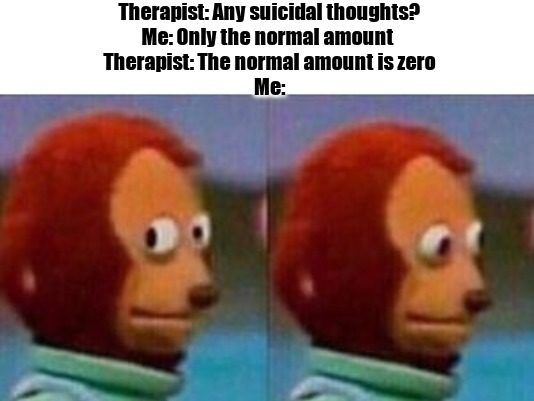
The state of research on the topic of suicide, 2021. From Swedish machines which can predict if you’re going to kill yourself, to the problem with reductionist analysis. My therapist was of the opinion that suicidal idolation was always a negative, while for me it’s been a constant companion – mind, those two suggestions don’t contradict each other – but recurring thoughts of suicide just feels like a social faux pas; like mentioning an infected boil at dinner table. The latter might actually be more constructive since your dinner guests can suggest a topical cream, but what the hell can they do about the former except expressing concern?

Our sessions on the topic reminded me of the awkward monkey meme.

Foreman and her colleagues at the American Association of Suicidology look forward to seeing the dialogue expand around suicide memes, however inelegantly. “I’ve never known a single problem that got better by not talking about it,” Foreman says. “Not a single public-health problem has gotten better by reducing conversation.”

The Atlantic, Elizabeth Anne Brown: Suicide Memes Might Actually Be Therapeutic

They were ‘always happy’, he says. And what did their happiness consist in? An endless round of feasting, drinking, hunting and love-making. Who would not sicken of such an existence after a few weeks? […] The inability of mankind to imagine happiness except in the form of relief, either from effort or pain, presents Socialists with a serious problem.

George Orwell: Why socialists don’t believe in fun

And here we’re back to what “31 laws of fun” touches upon – A Utopia, or a good place isn’t static. It’s not a set of stuff or things or events – it might be about relationships between persons, allowing an unending combination of ambitions and passions to be expressed with a minimal framework safeguarding “personal rights” – but regardless, it’s more difficult to point out what is good than what is bad. Avoiding bad stuff isn’t happiness but relief, or Utopia would be a place where bad things constantly happen just so that you then can mitigate them. Then again – that’s one of the 31 laws listed above: present challenges difficult enough that solving them feels rewarding.