The new and different you.

It dawned on me yesterday that I’m becoming that guy. I bike wherever I go and show up with a sweaty t-shirt, fanning myself and going “boy was that a climb! I’m all drenched here, phew-e!” not realizing that it’s the tenth time in a row that I arrive like that, and it has become the norm rather than the exception.

I’m the dude with a manic smile and rolled up pant leg, and even though I’m not wearing bike pants, an image of tights would show up on an aural image of me. If the country wasn’t so eager to promote a “healthy lifestyle” I would be beaten for showing up to work in this state long ago, and probably deserve it.

I would like to apologize in advance to those commuters whose personal space I will invade with au de wet dog and would you please let me know when the sweat dripping onto your blouse becomes annoying.

Incidentally, public announcements regarding my crotch have gone up dramatically, and I disperse the status of balls and ass freely and without prompting. Sorry about that, but that’s probably how things will be from now on. I’m really sorry.

Hi! I’m vegan!

We told the R&D guys they could come up with anything they wanted, as long as it could be thrown together from existing ingredients, cost less than 40 cents to make, and looked enough like dog shit that impressionable lardbutts like you would get a food boner the first time its commercial ran on whatever basic cable reality show keeps you from killing yourself for a week.

→ Kung Fu Grippe, Merlin Mann: A new brown thing you’ll totally eat

Crappy Taxidermy is a visual blog dedicated to exploring the bizarre world of taxidermy. The pictures within are exceptional examples of the strange, the grotesque, and the awful. Though our title may say “crappy” we respect the dedication and talent of the taxidermists who created the works pictured within.

→ About: Crappy Taxidermy

I would kindly like to inform you that I’ve been a vegan for ten years. Unless you count the Snickers bars I ate out of economic necessity when living on in Iceland (where vegetables are paid in installments) in which case I have one more year to go before reaching ten. Ok, let’s rephrase: I decided to switch to a vegan diet ten years ago, and initial Snickers bars notwithstanding, I’m doing well.

To recap: When studying in Karlstad I ran a weekly radio show modeled on Frispel (mentioned previously) where I’d put together a one hour show on a whatever topic I pulled out of my arse. I interviewed a dentist who did hypnosis, a priest about the onthological proof of Gods existence, and this one time I started doing one on milk.

I had spoken to a chef who mentioned that unless the lactal enzyme in our guts have a constant supply of lactose, they disappear and you’re left intolerant. This, he argued, explains why proportionally large number of people in parts of the world are lactose intolerant — milk and other dairy isn’t widely consumed and we producing the enzyme as a result

This is more of less accurate. The enzymes are developed by you own body when you’re young, but with age you stop producing them. Supposedly, this is so that we can be breast-fed as babes, but with the anticipation that we stop drinking milk after we’re weened off it. Historically, milk hasn’t been a staple of human diet so intolerance is common. A majority of all adults in the world are lactose intolerant as a result of the stuff just not being in the food chain.

The first dietician I tried to interview scolded me for not knowing the difference between allergy and intolerance, so I plowed through two books on nutrition and health and return two days later for the interview. I called the Swedish Milk Council (Mjölkfrämjanded, a pro-milk lobby. Originally, named “The Swedish Milk Propaganda” — Wikipedia: Mjölkpropagandan) as well as the National Food Administration and had them comment on a study of osteoporosis prevalence among a group of nurses. Seeing as the report was hosted on MilkSucks.com their reaction was predictably not favourable. (I think they criticized poor methodology)

I barely touched on the whole animal rights issue. As so many others I hadn’t given the question much thought, and found the environmental and health aspects of dairy more interesting. Somewhere in the process of doing the show I came to the conclusion that the only environmentally conscientious thing to do was to switch to a vegetable based diet, which also seemed to be a healthy way of eating.

Of course, now I know that “vegetable” doesn’t always equate “environmentally sound” nor necessarily “healthy” if you take processed foodstuffs into account — even skirting the necessity of B12 supplements. If you are an omnivore who eats with moderation you might not experience the adverse effects of cholesterol and whatnot, and locally raised beef might have a smaller environmental impact than a soybean transported halfway across the globe.
The question of food and where it comes from is very complex, and if you are so inclined I encourage you to read the The State of Food and Agriculture 2009, the yearly report from FAO (the Food and Agriculture Organisation of the United Nations) or why not just skim Wikipedia: Environmental effects of meat production. Of course, once these folks get in vitro meat going we might satisfy the tastes of everyone except those bent on organic food.

Having written that, today it’s the animal rights issue which is the deciding factor for me. There’s overwhelming proof that we’re causing suffering and pain to animals directly by using them for food or other products, and there’s secondary misery caused by the environmental impact of rearing animals. You could do worse than to read All animals are equal, by Peter Singer as a more well-put introduction to “animal rights” than I could give.

It took me 21 years before reaching the conclusion that veganism is a step in the right direction, and I don’t remember anyone else influencing me one way or another, so I try not to preach, but every once in a while I get into a debate on animal rights. It can be fun, but is more often a losing proposition, as illustrated by a thread over in Metafilter, where the subject usually turns into an anti-vegan dogpile for some reason: Operation Pancake.

Also, I have a standing bet with a chef friend that if he can make me a human steak out of someone who hasn’t suffered and the eating of which wouldn’t cause anyone grief, I’d eat it. Rather disgusting, but that’s what you get when debating veganism drunk.

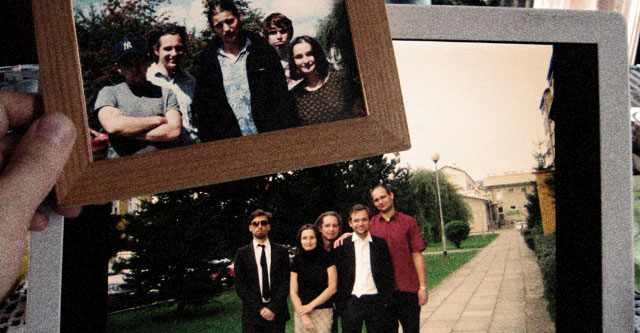
Come together. Right now. Over here.

Over at We Make Money Not Art, there’s a brief description of the work Hello Process which is being exhibited at the Process Becomes Paradigm show. In a related vein, Rhizome just published an editorial by Jacob Gaboury on the art collective JOGGING which are all about process instead of product. JOGGING are indeed mostly interesting in terms of process, as most of the documentation / made for net / performance, is undistinguishable from a Onion parody of art, or perhaps a Mcsweeneys piece.

While each piece may seem unimportant on its own, when viewed as part of a growing collection of work unconcerned with the materiality, permanence, or the importance of the individual piece, any insistence on the auratic quality of the object itself falls away. Indeed the content of each piece is doubly immaterial. Not only do they exist in passing, as documentation, or not at all, they are also unconcerned with the question of quality or importance, and are relevant as process rather than as product.

→ Rhizome, Jacob Gaboury: Immaterial Incoherence: Art Collective JOGGING

It’s through editing we make something beautiful appear. This Youtube choir, bringing together 185 individuals in a performance is inspiring — despite the slightly cheesy look of the stage and conductor Eric Whitacre — not because it resulted in this particular musical arrangement, but because there is a sense of universality to the participant’s ambitions. There’s a common denominator which becomes visible exactly because it’s mediated through a webcam, each video independently recorded. It’s the audience performing for itself.

The arrangement of the singers and panning over their individual videos in faux 3D also changes the interpretation of the piece; Compare the feeling of this version to the previous experiment he did, Sleep, in which all videos are arranged on a flat grid. The edit of Sleep creates a monumental feeling of the choir, whereas Lux Aurumque seems made up of individuals acting in concert. [Via The Technium]

As an aside, my name appears in an Excel file at one of the largest dairy producers in Sweden, Arla, since I sent in a bogus recipe containing cottage cheese to a competition. I don’t know if I’ve won anything, but judging from the other entries (all visible in the same document) I’m not the only one who’ve fibbed a love to that product. Twohundredandeightysix other people filled sent in their recipes to win whatever it was one could win. Imagine if you could get 287 people to spend those five minutes working doing some work for you, paying all of them fractionally more for their time than they stand to gain on average from a competition and thereby creating a win-win! What would you do with those 24 hours of labour? Or is an XLS-file with slogans enough?

Thanks for the memories and storage.

It’s odd what will make you sad.

Between 1998 and 2004 I ran Hotline and KDX servers, dedicated to political material and whatever else I fancied. In a time when online storage was expensive and legally risky, running a small server with files on your home computer felt safe, and if you managed it well you got to know people who would log on to your computer regularly and chat for a bit. I still have chat-logs of conversations ranging from trite bullshit to discussions on abortion and propaganda…

What sets places like a KDX server apart from cloud-hosted communities (Facebook, MySpace, Betapet) is that you actually feel like you’re at someone’s place when you log in. When I was running the Tiny Socialist Server I had a rule that you had to greet everyone who was logged on before downloading anything; It’s common courtesy to at least say “hi” when entering a house, even if all you want to do is to sit on the couch, so I started to kick people out if they logged on and downloaded stuff without greeting the other users. Anarchism requires you to have some fucking manners.

The other day I needed to transfer 7 GB of video so I brought the KDX server back from retirement.

While I was at it, I decided to find an old KDX hangout on which I knew some people, the Documentary Archives. This server was a giant in its time, with scores of users, many of whom I considered some sort of friend. My old bookmarks didn’t work, so I logged into another server — one of the few remaining — to ask if anyone knew where I could find DA or what had happened to it. The response I got was:

[netfreak] I’ve heard of that place but never was on it

I felt both excited and depressed at the same time. Excited because something which I had been a part of now was considered “history” by the newcomers, and depressed because I missed the place; I’ll never find the fragmented, reformatted, erased or mothballed harddrive sectors I remember hanging out at.

Is this how people felt when FidoNet servers started to drop out in favour of WWW, or when their favourite MUD/MUSH shut down? Considering the hundreds, if not thousands, of hours I put in to make my server run smoothly, chatting with people from all over the world, and nesting in general, I feel a personal sense of betrayal that there isn’t even a Wikipedia page dedicated to KDX, to say nothing of the Documentary Archives, only a mention in the Hotline article.

For a time I nourished the idea that I should be logged in somewhere at all times. By running my own server, I could be online and present at a place where others could see me, and often I would log in to servers or join an IRC channel just to be somewhere while I slept. Even though you are not conscious of your surroundings when you sleep, you still exist; And it felt important to think of myself as existing online, not only to me, but as a proof of the possibilities that the net embodied.

This wasn’t about being connected 24/7, but rather an acknowledgement of that you belong at one place at a time — that even if you’re jumping across continents from server to server, your attention is still mediated through a sense of place; Running servers and visiting others’ servers helped me establish who I was — and still am — online.

The feeling of sadness and loss is pure nostalgia though; Today, my presence online isn’t defined by a logged in piece of software, but rather though the ubiquitous connectivity afforded me by my cellphone — alas, the nerd I has merged with the physical me, and we’re once again meat and fat wrapped in a sack of skin, only with a smartphone stuck to the side of the head.

Compelling narratives.

Thomas Bey William Bailey over at Vague Terrain has an analysis of Modern Warfare 2. It’s a bit too uptight for my taste, but it balances the lavish superlatives I’ve heaped on the game quite nicely. His objection is that because of the extremely compelling narrative of games like these, we’re fed a bunch of propaganda and taught a manufactured history of the world. This is completely true. Thomas critiques isn’t limited to this game but rather highlights the possibilities for nefarious uses which the medium can be put to. The FPS Americas Army is in its third iteration, and they have spun it off into a graphic novel as well — the first story unironically entitled Knowledge is Power — but they get a free pass since it’s an obvious recruitment tool for the US army.

As Walter Benjamin mentions (in an essay you might have noticed lately) film, like architecture, is an art form which you learn to appreciate by habit and osmosis, rather than contemplation. Computer games have the grandiose scenarious of movies, as well as the tactility of architecture (since you’re able to navigate the world and develop an appreciation of the physics of the place.) so they really act as a multiplier of knowledge and narrative. (Regardless of their relationship to fact, mind you)

The exciting thing with photo-realistic games isn’t that we might end up with a Matrix-like scenario where we won’t be able to distinguish between ‘reality’ and ‘not-reality’ but that our memories of events will be messed up. Are you remembering something which you experienced in the ‘real world’ or the surreal world? We don’t have to mess up our physical perception of things for this technology to be scary, only our remembrance of things. Look at how much importance we place on photography as an external memory, and multiply that.

I know that I have created historical narratives based on nothing else than the tech tree in Civilization, so obviously I give more credence to a story than to static statements of fact; And since we experience the stories of computer games first hand, we might absorb the sentiments expressed even more readily. MW2 is a kick-ass game exactly because it fits within the narrative which the West has spun, and which countless action movies has reinforced — it’s “as close to reality as you get” exactly because it’s a narrative which is fictionalized from start to finish.

To paraphrase: Guns don’t kill people. People who live in a world where guns are seen as necessary responses to certain crises, kill people. Political action is necessary if we’d like to change the story, and it would be awesome if computer games could be a change for good, instead of only mirroring an already dominant narrative of how the world works and who we are as humans.

[flv:https://monocultured.com/blog/wp-content/uploads/2010/02/PBS_The_War_by_Ken_Burns.flv https://monocultured.com/blog/wp-content/uploads/2010/02/PBS_The_War_by_Ken_Burns.jpg 640 360]

A more upbeat rider to this story comes from the podcasting world, where fictional parallel universes are less flat and predictable than in MW2:

Myke Bartlet has continued writing and podcasting stories in the Salmon & Dusk universe. The latest short story, Yesterday came too soon, is a nice introduction to his stuff if you don’t feel like starting on a longer series. As previously mentioned, Mykes reading is half the enjoyment of his podcast, not cause the stories are so-so, but cause his tempo and timbre is excellent. Go listen.

Day of the Triffids: Post-apocalypse made for TV

A while back I read The day of the triffids, a 1951 novel by John Wyndham. It’s a post-apocalyptic tale where one accident leads to another: A cosmic light blinds the majority of the worlds population, and the poisonous, ambulating, and possibly intelligent plants which are being harvested for oil — the eponymous triffids — escape from captivity. So let’s loose a bunch of murderous plants on a blind humanity, leaving the few remaining sighted to help or ignore the suffering. Aaaand, action!

The book starts with Bill Masen waking up in his hospital bed, where he’s been treated for a triffid sting to his eyes. His head is bandaged, so he is unable to see the global borealis which almost everyone else is watching. As luck would have it, this spares his vision, and when the next day neither nurse nor doctor check in on him, he removes his dressing and discovers that everyone is blind but he. In the book, the panic that our protagonist feels is overwhelming, and I found myself mirroring Masens fright at things going bump in the night.

Much like in a zombie story, the humans who have been afflicted walk with outstretched arms, grasping for the non-affected; Wyndham might not have enjoyed killing off civilisation as we know it, but he sure enjoys traumatising his characters:

What was going on was a grim business without chivalry, with no give, and all take, about it. A man bumping into another and feeling that he carried a parcel would snatch it and duck away, on the chance that it contained something to eat, while the loser clutched furiously at the air or hit out indiscriminately. Once I had to step hurriedly aside to avoid being knocked down by an elderly man who darted into the roadway with no care for possible obstacles. His expression was vastly cunning, and he clutched avariciously to his chest two cans of red paint. On a corner my way was blocked by a group almost weeping with frustration over a bewildered child who could see but was just too young to understand what they wanted of it.

As it happens, BBC chose to interpret the book in a two part miniseries, and I had the first episode with breakfast. So far, it’s not all that impressive; The cold war story has become one of nature striking back, and man’s inhumanity to man is business as usual with some people being douche bags. Most of the immense tragedy — millions of Londoners blinded, fighting for food, reassuring their children — is almost glossed over.

No problem in the adaptation seems so big that it can’t be reasoned about; The sense of despair which enthralls the reader is missing, substituted with interpersonal disputes. The actors are more or less convincing, but the script lets them down. Eddie Izzard plays the evil guy, who appears in the book as a fascist character late in the story, but here is an egotistic opportunist, and the main foil for our dislike. We are left not judging the everyday humans who try their best but fail, but Izzards character Terrance who is stopping them from doing their best for his own selfish ends. The triffids become a backdrop in front of which Terrance and Bill fight over the girl, the bereaved radio journalist Jo Playton. The apocalypse happened and the guys are comparing dicks.

The most surprising anti-hero is played by Jason Priestly of 90210 fame, as a brash American who kidnaps the sighted so that they can guide the blind. At the end of the first episode he is redeemed and the audience no longer has to wonder if he’s a good guy or a bad guy. So despite good acting, there’s so little faith in the audience that the story of disaster and new beginnings, becomes one of action and getting the girl.

Of course it’s much more difficult to show someone’s internal struggle on the screen, where you can’t supplement it with your own imagination, but lets draw comparisons with another post-apocalyptic movie: In 28 weeks later there’s a scene where a main character abandons his wife, believing that she’s lost to the zombies. We see him run away from the house where she’s trapped, and he’s sobbing until out of breath — from fright of the zombies, his impotence in the face of the threat, his guilt over the abandon, his grief at losing his wife — leaving us not only conflicted about the moral correctness of his actions, but also with an understanding that there’s a limit to the human reasoning we can marshal under extreme circumstances.

Also, if you’re partial to graphic novels, you might have already heard of Walking Dead, which captures human emotions far better than either 28 days/weeks later or this adaptation of Day of the triffids.

—————-

Update: Part two was crap. The story jumped in time, seemed to skip most of the character developement which might have explained what the hell people are doing — Hey, he’s alive! He’s dead! I don’t trust them! I trust them! —  and hopped from one action sequence to another, lest the audience lose interest. Even if you don’t compare it to the original story, this is just shit storytelling, despite some good acting. Booh!

The future! The future!

The Singularity is no longer talked about as the geek rapture which will make people happy and good and content with life; Just as our capacity for rational and creative thought will be multiplied hundredfold in a short time, our capacity to act according to our own morals increases accordingly. No longer a world where anyone can build an atom bomb, but one in which each of us is a walking one. The will to power will out, and just because there’s no need to fight over oil or water doesn’t mean someone won’t want to kill us all.

Ray Kurzweils movie Trancendent Man seems like an interesting overview of the mans ideas, and h+ has an interview with him which you might want to read before the movie makes it onto the torrent sites; He is good at articulating the problems which might appear as a result of technological advances (eternal life, nano-tech, AI) and because of his technological background actually has numbers he can throw at you when it comes to the hard sci-fi predictions.

James Hughes over at Changesurfer Radio interviewed professor of philosphy Asher Seidel about his book, and it’s a good guide to the kinds of questions that might challenge our successors. I started listening to the transhumanist Changesurfer Radio ten years ago in Karlstad, and it’s a great source of interesting ideas and people. I heartily recommend it, if for no other reason than that James is a politically conscious person who doesn’t let his interviewees get away with just technological solutions to human problems; Humans are social and political beasts and use technology accordingly. Which, incidentally, also is the lesson that good science fiction can teach us.

bokrelease_suddigt_folk

Lately, between fattening myself on crisps and ramen, and watching The No. 1 Ladies Detective Agency, I’ve been reading. Since none of you heathens got me an ebook reader for the holidays, I’ve been perched in my comfy new fake leather armchair, reading off the screen or on paper.

Mostly I’ve been rekindling old flames: Iain M. Banks Matter as well as the abridged Transition; Peter F Hamiltons Starflyer books — Pandora’s Star and Judas Unchained — have sent me back to the first two parts of the Dreaming Void trilogy, and I can hardly wait for the last installment which is due out in fall of 2010, and where I’m guessing we’re going to see a fascist universe be created in the Void.

Matter is a Culture novel and as such it’s a fascinating read. More than in other novels there is intervention by the Culture — a futuristic, egalitarian galactic society which tries to nudge more primitive civilizations along —  into the life and society of a Victorian era feudal world which exists on a shell world; a spherical world within a world within a world, built for unknown purposes. The king is murdered and his daughter, who has gone off and joined the Culture, returns for his funeral, getting mixed up in a world she’d left behind. If you enjoy Iains style of prose, you’ll love this book — its imagery is powerful and the language just the right amount of funny.

Petter gave me Foreskins Lament by Shalom Auslander — known from This American Life as the Jew who hates God — and it’s a good read so far. If you need a reason for why religion might be more damaging to your mental health than a regular abusive home, look no further than to his description of how he was taught about God. Apatheism is the way to go, people. Trust me on this — just focus on an existential issue other than theism, and make that issue the cornerstone of your personal ontology and moral conviction.

I still haven’t slogged through 45 by Bill Drummond, a collection of essays which Olle lent me, but I’m getting there, although that has been delayed by my adorable mom, who just sent me a Polish account of two years spent in Tokyo. It being mom I have to prioritize that, even though it reads like a punny Lost in Translation. Never an endorsement.

On the gentle art of Winning.

For a whole month, a while back, I started my day by filling out every online-competition I could find. Using sites like Bli en vinnare [Become a winner] I’d suck their RSS dry, answering inane questions and coming up with slogans for crap I don’t really need. As a kid I used to do the same thing, and there’s something completist about filling out forms online.

Just like personality evaluations, IQ or EQ test, aptitude or Myers-Briggs analysis, there’s something rewarding with the feeling that this anonymous internet form cares about me. Also, there’s a bonus in that you’ll learn to rhyme on cue, incorporating brand names or explanations of why this shade of lipstick would make you feel glorious! It’s all about the gratification of winning — regardless of what the price might be — so in that regard it’s similar to kleptomania or any ADD condition; A completist competetive disorder.

IMG_0790

So about 100 competition later, an anonymous package arrived and I still don’t know what competition generated it. No accompanying letter explaining why I’m getting an iPhone charger and mount. The charger is actually rather nifty, with adapters for the whole world built into one rattling piece of plastic. The mount is of more use to someone with an actual window to affix it to, not to mention an iPod to put into it, so Jan got it for early Christmas and I kept the charger as an incentive to travel. Also, the cellphone which I disparaged about a while back arrived, with no dead fish in the package!

All is fine and well and then This American Life chimes in:

When a new Chick-Fil-A sandwich shop opens, people line up 24 hours in advance to be one of the hundred people to get a free year’s worth of chicken sandwiches. [Link to show here: In the middle of the night]

[audio:https://monocultured.com/blog/wp-content/uploads/2009/12/TAL_395_middle_of_the_night.mp3|titles=This American Life 395 – in the middle of the night|Artist=This American Life]

kensington_vinst

IMG_0791

The forum of blienvinnare.com has close to 19’000 members, and the pages are full of hints and pointers for how to compete, what company has put on the best competition, how to deal with cheaters — apparently it’s common practice to take all coupons from a store to hinder others, which is bad sport — and how to complain to the organizing body in case the competition isn’t fair or has some other fault.

Some people take this shit seriously indeed, and in comparison I’m a lightweight, a dilettante dillettante amongst people who’ve made slogan-writing into a noble pursuit which can land you one years supply of cheese. If you’re inclined to read Swedish, check out the post listing what people won during the Christmas calendar competitions and perhaps you’ll see the temptation. Or weep for humanity, whichever.

Terrorism in action. The first day is OK.

I say, the power of bloggery is intense! No sooner had the previous post gone up than someone took action and pulled the power to my whole neighbourhood. Microwaves, computers, fridges, lights, everything went silent and I was left fumbling for a lighter (sometimes smokers are better of) and candles.

For all twenty minutes while my circles were broken, I relaxed and made some tea, surrendered to the liberating feeling that I actually didn’t have to do anything. And then the power came back on, of course, and I’m now at the computer writing about it and photoshopping the images I took.

grona_vallen_i_morker

If this whole terrorism bit is to bear fruit, I hope whoever pulls off these kind of attacks has a long term strategy, or at least an idea of one, as to what would happen if the whole city would be without power for a week. I’m pretty certain that I’d like “hot water” at some point before Christmas, and would go to tire-burning lengths to acquire it.

Hey kids, let’s consider terrorism!

What with the climate summit in Copenhagen bringing back memories of my own trips to large meetings of important people, I’ve been thinking over the merits of action, and more particularly, the benefits of terrorism.

If we know with n% certainty that an 1°C rise in temperature would cause huge changes to our environment — causing human misery along with extinction of biotopes and what have you — and we are equally certain that it’s our own carbon emissions that are the main culprit behind the rise, there seems to be little room to wiggle out of actaully doing something. I don’t follow everyday politics, so very little noise has reached me about what action is being taken to remedy global warming, but let’s assume that it’s “not enough,” shall we?

So even thought there are humans who are affected now — or will likely be affected in the future — by changes in the temperature and subsequent changes in their living conditions, these changes are all mediated through the planet, and blame is easy to shift. When 6.5 billion people are shitting in the same river, it’s hard to tell whose corn you got stuck between your teeth.

mateusz_3D_biograf

Wakaba_studio_detalj

Maybe it would be simpler to see the environment as something with class interests but with no representation?

I’m depressingly convinced that positive change usually comes about only if there’s a threat of a popular uprising or other such change of power distribution. Power is never given, only taken by force — implied or otherwise. This force doesn’t have to be violent as such, but holding vigils and giving out flowers is what happens after the actual fight; It’s not that which initiates the struggle but that which kisses and makes up.

So what is a concerned citizen with a global pathos to do? Where can your limited energy and time be spent and still have an effect? Might I suggest that terrorism offers most bang for your buck? “Terrorism” is just another word for “non-governmental” after all, so besides having to carry the burden of proof you could have the moral high ground; Especially in the eyes of a hopefully grateful posterity.

But whom to terrorise, using what means and for what particular ends? No-one likes vehicles which run on petrol, but hydrogen cars aren’t much better, and who’s going to deliver the food to the store, not to mention drive me to the airport when I’m going on vacation and hey look I pooped in the river again!

Ought you to follow in the footsteps of ELF or Earth First! by burning urban sprawl or logging machinery, spiking and/or climbing trees? The slogan “No compromise in defence of Mother Earth” is alluring but doesn’t make much of a plan. The Unabomber had a plan, albeit a haphazard one, but I don’t know if he brought about any positive change; Does anyone remember much except that scraggly beard?

Perhaps we just ought to think more spectacularly: bigger, better, badder, boom; Chaïm Nissim gave the following reason for firing five rockets at a nuclear powerplant:

These terrorist attacks were part of a movement and each little piece has its importance. People fired rockets, myself for instance. We had found a bazooka by German terrorists and we fired it. We failed, as the closest rocket missed the important part that we targeted by one metre. It was nevertheless quite beautiful. And, symbolically, it was a token contribution to the larger movement. Via Wikipedia

As Chaïm writes, such spectacular action is mostly symbolic (except the actual damage to property, if you’re inclined to take offence at that) but might have a positive long term debate — setting the stage for diplomacy — but make it spectacular enough and the backlash will be awesome.

Wakaba_studio_profil

Humanity is treating this impending environmental doom as a fait accompli and our own future is suffering the Genovese syndrome. I don’t know what would entice me to stick my neck out even though I know it might be the right thing to do, so I can’t for the life of me come up with a plan of action here. Tell me, good people, what ten buildings or industries or people or symbols do we attack — with what force — to what good purpose? What would you be willing to do, to what cost to yourself or others? Do we puncture the tires of cars or give people bikes? Is knocking out powerplants a way forward or forcefully installing micro wind turbines better? Burn buildings to reduce sprawl or occupy land by force and start a new land distribution reform?