Generative art and its discontents.

For an inexplicable reason I love generative projects. Maybe it’s the appearance of magic that I like, or maybe the embodiment of an abstract idea seemingly discorporated from a human mover. A ghost in the machine for as long as you can suspend disbelief. The Perpetual Storyteller Apparatus by Julius von Bismarck & Benjamin Maus is one such project where the you could be forgiven for staring at the machine, trying to get some meaning out of its scribblings.

Because magic is about diverting your viewers attention, much of generative art leaves you trying to decipher how something is made or what the internal mechanism is. Once you realise that the stunning graphics that you see are pulsating in rhythm to a certain noise, there is little but aesthetics and perhaps admiration for the technical skill of the artist left. And while technical skills are important to have, we don’t make art to show them off but rather hope to tell a story or present information in a way or setting that is enlightening or amusing.
Tradgrenar_roda_gula

Polen_2009_moster_mateusz_kostym

Back when I lived in London, I saw Scott Draves in a pub where he presented a beta of what would become the famous Electric Sheep project. By having abstract patterns — “sheep” — swap genes with each other from one online computer to another, and having users pass judgement on which sheep they liked most, an ecology of sheep was formed, pretty and less so. It’s an excellent example of a generative project where the process (strings of software that communicate and mutate while your computer is “sleeping”) gives us a new take on computers and their relationship to each other, while the end product speaks leagues of the end users aesthetic sensibilities. (The individual sheep which we’ve voted up or down, thereby influencing their reproductive ability)

But this is an old project, epochs ago in Internet years, and I have a hard time finding interesting generative art made today. I’ve been poking a bit at Processing, a programming language geared towards artists and similar folk, which is perfectly suited to take any data and muck about with it. Since it’s relatively simple and accessible it has generated a lot of projects that are half baked and conceptually weak; This is fine as long as we view the projects as stepping stones, as experiments in visualisation. But it’s so easy to get stuck with fiddling the knobs of random parameters that you end up spending you time changing hues instead of a coming up with a reason for why you’re doing it in the first place.

In the time of Flash 1.0 I was in awe of what Joshua Davis was doing over at Praystation.com, and most of that was only him fiddling with autonomous processes and the possibilities of Actionscript. Today we have Flickrvision and We Feel Fine, which take their data from the cloud and present them in a new way. This is good stuff, but it’s the exception to most other art or “new media” projects that show up. Computer art too often lacks either in technology or theory, and it ages miserably.

(My mum stopped accepting “hand-made presents” some time ago, so one should hope that artists would be self-critical enough not to show every ashtray they’ve created.)
cheese_balls_on_ground (1 of 1)

But perhaps there is a truth to get at behind a generative, or random, process (not that the two are interchangable, but they are similar enough for this topic) if by a “controlled randomness” we utilise a background noise to decide the outcome. Maybe it reveals an underlying truth about the universe or somesuch. That would certainly be in line with numerology and astrology; Trying to discern a pattern. Perhaps the cosmic microwave background radiation is interferring with our world and by looking long enough at the noise of a tv showing static we discover the pattern of God. The movie Π comes to mind, as does the ramblings of any number of nutters who’ve stared into the sun long enough.

I’ve included this here mostly for completeness sake and because it’s an old and interesting sci-fi idea: If the universe is deterministic there can be no true randomness. The “real” that shines through, the almost invisible hand of the maker, will show in everything — why it should appear more in “beautiful” works of art is another matter — and there is a Truth in there. Thank Goodness for the uncertainty principle I say. There is randomness, so there doesn’t have to be a pattern for us to find, and maybe what we enjoy is randomness. Whatever.

What Duchamp did with his 3 Standard Stoppages was interesting because it spoke about our relationship to art. It’s not the result, nor the process in itself that was interesting, but audience going “oooh” at the audacity.

So a goal of using magic where you are allowed to see what the magician is doing could be that the end result is valuable, not the process itself. Someone mixing flour, yeast, water and salt will make a bread – itself an extraordinary transformation of the starting material – but they’re not doing it because the process is awesome but because bread is a good thing. And it’s not art, or at least not interesting art; The latter is a worse offence.

[flv:https://monocultured.com/blog/blog_video/Delinquest_sleep_logo.flv https://monocultured.com/blog/blog_video/Delinquest_sleep_logo.png 640 360]

In the above video, made for Delinquest, I dick around with After Effects: The horizontal blur reacting to the music. I haven’t made the effect, but I control the parameters. It’s a nonsensical example, but still an example of a generative process. It always starts with someone telling someone else to do the work, and then you end up with instructions being the work and suddenly you’re back at the screen, watching the iTunes visualizer, experiencing beauty like a child and patting yourself on the back for choosing this particular song.

I’m not saying the end product is irrelevant or – heaven forfend – isn’t art, but one has to realise that even though aesthetics can be appreciated as something good, they’re not a discreet phenomena but at one end of a sliding scale which has “abstract beauty” at the other end. Or maybe “being a smart-ass.”
Reflections on: Copenhagen & art.

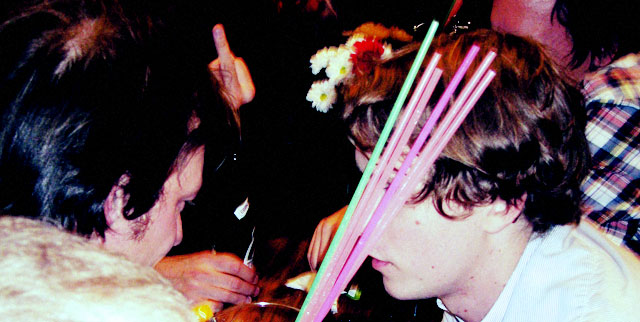
We just got back from the alternative Copenhagen art fair. It’s too early to say if we were a smashing hit, but at least some people got smashed so let’s call that a partial win. It’s not always obvious what you take away from a happening like this. You’re supposed to hobnob and get to know others in your field and get invited to co-operating with galleries and such. Etc. Some of us did get invited to other spaces, and Skup Palet is more corporeal now than it was before, which is a good thing.

Because Skup Palet is such a diverse group I guess we all had different ambitions with our presence. I for one wanted to see what this whole art fair business was about — never been to one more than five minutes — and watch performance art or at least talk to performance artists. As therapy, you understand. There was a flesh-and-blood dadaist doing his thing, which was so quaint it went to bad and back to good again. There is little avant-garde left when nonsense poetry is regarded as something “classic.” Goodiepal did a performance in the shape of a lecture, a form I used for my MA and which Olle thinks is awesome; I found it “cool and stuff.”

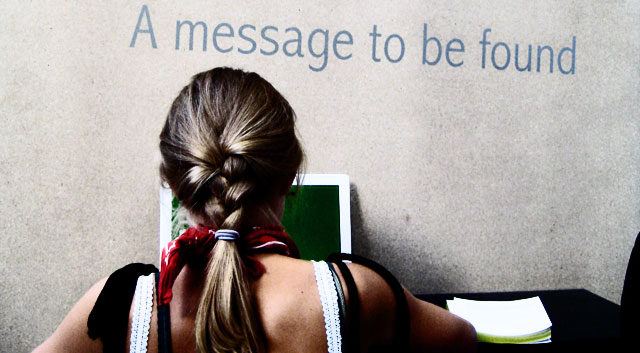
We represented with Frustration Canon and A Message To Be Found (the latter a project that Olle and I put together) and visitors and other artists seemed to enjoy both. Both were interactive; The former more ambitious and the other taking the shape of the ubiquitous “laptop with a webpage,” where all the relational aesthetics in the world can’t hide the fact that the my Macbook was incidental to the situation. (Much like a movie on slavery needs a person of colour, any colour.)

alt_cph_bar_sugror_par_finger

Frustration Canon is an idea based on something that I threw together some years ago. Ever since I put that thing up, Anna has urged me to do something more with it, to take it a step further as she puts it. Which sounds like a good idea but I have no inkling of what it implies. To me it was only ever about making a webpage where three people bang their heads on a desk. When I envisage “taking it further” I can only imagine variations on a theme, but not all that much new content. More banging, banging on other surfaces, banging in high definition.

It’s flattering when someone likes ones work, and the art fair was an opportunity to make something more of the idea; Anna and Jan took the original concept and ran with it. Together with Pär, who set up the video playback in PD, they attached a contact microphone underneath a table and invited people to bang their foreheads on the red X, a vinyl sticker taped to the surface. There are other details to the setup, but that’s basically it: Invite people to booth, promise them it won’t hurt too much and put them on the big 42″ screen mounted prominently on a wall.

As it turns out, people are quite happy to hit their heads in exchange for a pin and a smile. I don’t reveal it that often, but when I apply myself I can become an intolerably cheerful fucker. With a manic grin, flattery and a kind of friendliness you wouldn’t believe, I raked clients in one after another, all the while most others of our troop looked like undertakers annoyed with the living, doing little to dispel the image of artists as brooding and difficult.

What made Frustration Canon a good choice of work to show as an introduction to Skup Palet is the overly symbolic gesture of literally “banging ones head in frustration” as it applies both to an artistic “struggle” as to working in a group, with all the inherent difficulties of organisation and egos getting trampled. Ten artists pulling together is more often than not an exercise in futility – it’s like herding cats; Angry, philosophical, drunk, cats. It takes a great deal of work to make teamwork work, and if you take away nothing else from the video then perhaps use it as an illustration of your own life as a member of any given collective. Originally, we had talked about letting the “bang” synchronise once every half hour or so, but that was a bit too complicated to pull off at such short notice.

The version below is a more recent edit, with people from Enrico Pallazzo banging their heads, synched to make a melody. I think Robert might have done the edit, I’m not sure. The look and sound of the piece is different from what we presented in Copenhagen, but the individual framing of the shots are more or less the same. In Copenhagen the videos were shown in a 4×4 grid, randomly appearing and occasionally in a different pitch.

My and Olles work, A message to be found, has the shape of a website service; You write a message and then hide it for as long as you like. It’s a delay of a day, a week or tens of years. You can add an image to your message, and are encouraged to tag what you’ve written. If you write a love letter to your boyfriend, you might tag the message “John Doe, love letter, Bombay 2009, honeymoon” and those keywords would end up somewhere on the generated page. The idea being that the search engines (today that means “the Google”) will index the page based on the keywords in lieu of the content – since the content won’t be visible for another n years. Until the message is revealed you only see a countdown timer.

It’s a message to be found but we don’t know by whom or under what circumstances. In five years time pages might be indexed differently. HTML 4 might only be accessible by legacy browsers when the whole Internet moves into the next iteration of Second Life or Facebook or smell-o-vision. The project is based on Flash which looking back hasn’t been the most search-friendly format, although that might resolve itself with time and more computing power thrown on the ambition of a semantic web.

There are similar services, like Future Me which allows you to delay messages, as well as services that send out notices if you don’t ping their server for a while (the service, assuming that you have died, sends out your missives from beyond the grave) but A message to be found differentiates itself by being a delayed public publication. The distinction is small, but it’s an interesting enough experiment and it’ll be fun to see what indexes will pick up the messages, and what messages have been written. Every once in a while Olle checks in on how many messages have been written, and there’s a small but steady stream of them being entered.

As an aside, Radio Lab recently made en episode where some of the above mentioned services come into play. It’s the After Life episode and you could jump to the end of the show if you want to hear that segment, or listen from the start to an excellent hour of excellence.

Flicka_A_Message_to_be_found_alt_art

I would do anything for money, but I won’t do that. Well, ok I might.

Exactly! We don’t have answers to any of these questions. We are Googling “cockroach eggs maybe bed why? please no” currently. We might have to burn everything. EVERYTHING.

→ Manical Rage, Garrett Murray: One of the Worst Things Ever Happened to Shawn Last Night

Patrick McLean has finished podcasting How to Succeed in Evil and those of you who’ve held off on listening to this until the last episode would be available have to wait no longer. Go listen to his soothing voice and excellent story. You will enjoy it.

Here is a sound toy for you to make adorable 16 note loops on: Inudge.net. [Via Manical Rage]

I’m on my last to second life here!

When Second Life first got started it was lauded as the next step of the Internet – the bridge between 2D browser based networking and the glorious future which was going to be tactile smell-o-rama. With an economy that encouraged in-game innovation and entrepreneurial residents lots of stuff happened. Real money was invested.

In 2006 Warren Ellis got a gig writing Second Life Sketches for Reuters, which were interesting to follow since he’s rather clever and used to fringe culture well enough not to get phased by the bizarre. I wonder if Reuters got what they expected; The articles are no longer available on their server, nor can I find an easy Google cache.

I haven’t logged in for a year but just updated the client because of the video below, found on Boingboing Gadgets. It’s Kool Aid man in Second Life created by Jon Rafman and he’s offering tours of the virtual landscape. It reminds me of a world where a plague has killed off everybody and left only hedonistic crazies, or perhaps Earth after the rapture, with ungodly sinners fucking anything that is interestingly animated.

Look at the landscapes and architecture in the video. Millions of hours worth of user created content exists or has existed in SL, and although the graphics are poor compared to current generation of games, and much of what’s happening is mimicry of “real life,” there’s still something awe-inspiring about the scale and evident passion.

The Pirate eBay and other scenarios.

I’ve been trying to get my head around 3D printing. In the futuristic sense of the word it’s the manufacture of a hot dog complete with relish and mustard. It’s such a transformative technology that I’d like to get in on the game somehow, not only read about it. This is an attempt to put stuff onto paper. Pardon the rambling.

Let’s divide the making of things into five mechanical categories, and see if something useful comes of it: Additive, subtractive, shaping, combining. (Molding might be the fifth, or perhaps it’s of the combination order where the object that is being created is the mold, which combined with steel or what–have–you causes the negative object. Ignore for now.)

The combination of things requires things to combine, the shaping of things requires a material that is malleable besides whatever other qualities you need, the subtractive production (milling, cutting, etc.) need a hunk of material that is bigger than your end result. The additive model allows you to work in multiple materials, at once combining things for whatever function you need them to fill. Today this mostly means a working ball bearing or a surgical knee replacement. This is the technical side of things.

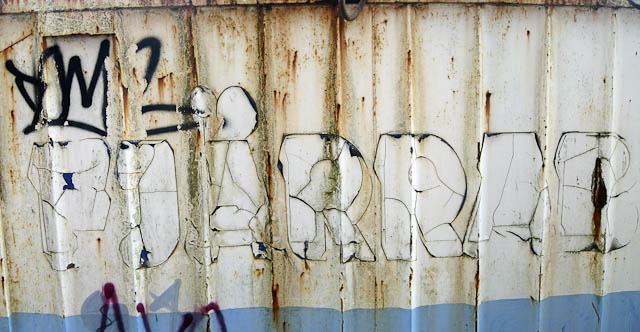
FJARR_AB_conteiner

Some are predicting wholesale piracy, and once the technology becomes cheap enough eBay will surely be flooded by original copies just as The Pirate Bay will be flooded by CAD/CNC program instructions. The joke isn’t lost on anyone that the name of The Pirate Bay will rub off on the auction site once everyone with a RepRap or MakerBot gets up to speed with replicating materials. And why not?

If the remix and DIY approach will hold true for personal fabrication (fabbing) then you’ll be forced to shift gears from “is it what it says it is?” when you relate to objects, to “is it what I want?” Trending and social constructions will still exist because we’re social critters, but they will have to take something else into account (another quality or justification, however arbitrary) and branding of objects might become less relevant.

Michelangelo’s David has been 3D scanned by Stanford and they’re limiting access to the the model, but how long before it’ll be pirated? Once you have an accurate replica next to your garden gnome, does the original matter at all? (If being original is the bees knees, why so afraid of copies? If it’s only a matter of making money by selling the reproduction rights, the losing battle that the music, film and game industries has fought the past ten years is on the doorstep of museums and industrial designers.) Home fabbing is killing IKEA!

We’ll manufacture and use stuff as if it was real but with no sense of “real” left. It’s the post-scarcity of technocrats combined with a corruption of the traditional understanding of materials. It’s a change in volume and sheer numbers, if not in the way we approach things. Material nihilism maybe?

[flv:https://www.monocultured.com/blog/blog_video/Bruce.flv https://www.monocultured.com/blog/blog_video/Bruce.png 640 360]

Above is the latter part of the end keynote that Bruce Sterling gave at the ReBoot conference. [via Warren Ellis] It’s his take on where we’re heading ideologically and how we can find value in life. He does sound like a whiny old fart part of the time, and there’s little love for his audience, but it’s an articulate rant and I’m not one to scoff at someone who thinks about these things for a living.

Sterlings notion that we ought to get a proper bed and a proper chair make sense if what is left of the objects are our use of them and if the value they provide are somehow measurable by us in a non-arbitrary way. (“Being well rested” is a concept we understand. Extend this to more arbitrary objects and you’ll notice that we have few things that actually carry meanining in the sense that an object in and of itself carries meaning.)

Jamais Cascio referenced the speech with specific regard to how Sterlings ideas relate to 3D printing. Cascio draws parallells to what Postscript and LaserWriter did for desktop publishing in the mid 80’s. (Hollow, bold, underline, cursive Chicago, anyone?) The article is The Desktop Manufacturing Revolution and it’s a good overview of the technology and some of it’s implications.

tvattmedel

We should stop saying ‘Is this a good thing or a bad thing?’ and start saying, ‘What’s going on?’. It’s a quote attributed to Marshall McLuhan by Liss Jeffrey and it’s a sensible suggestion.

While teaching future architects at Chalmers I was impressed by their approach to materials and created objects. It is as much a part of their problem as it’s a boon, but they all treated their models as incidental to the process of architecture. The objects didn’t hold any value except what they said of the overall project.

This is in line with how rapid prototyping has been used up to now, and also diametrically opposed to how many artists approach objects. Technically speaking, an artist can’t take a shit without creating an objet d’art, so we tend to guard whatever physical objects we produce. (Piece of art and piece of shit is interchangable in some peoples minds, but even for them it’s the piece that is important.)

But where an architect might view the printed 3D object as a stepping stone to a real object, fabbing offers a rejection of specificity of objects all together – i.e. a knife at your throat bears meaning on your life and well being, but it’s not really important what kind of knife it is. In this hyperbolic example you would do well to ask the McLuhan question: Is the thing at my throat sharp enough to harm me?

I’m being silly and perhaps these ideas don’t apply to all situations, so let’s focus on art and 3D printing. First of all, we’ll have the meta art: “Ooh, you’ve carved a small replica in wood of something that you randomly generated in your 3D printer to make a point about originality. Good for you!” It’s unavoidable and to a certain degree interesting for the debate and theory (I made my Virtual Photography series because I wanted to make a point about virtual worlds and photography) but it’s the next step that will be interesting: The abandon of material sacrament.

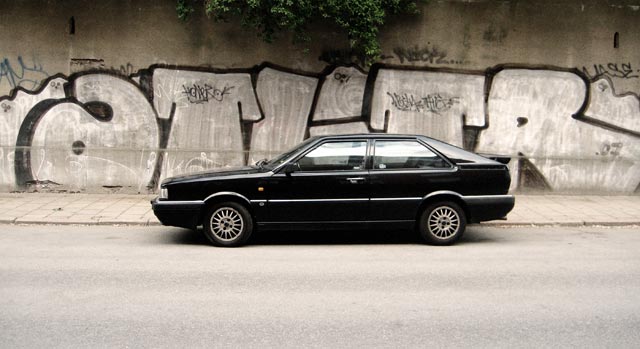
audi_hos_jonas

Artist scientists, spefically mathematicians, have experimented with rapid prototyping and sculpture. They are in the odd position of celebrating the pure æsthetics of mathematical shapes and concepts. Carlo H. Séquin is a physicist who has collaborated with artists and sculptors who work with pure form. His article – Rapid prototyping: a 3d visualization tool takes on sculpture and mathematical forms – is the only artistic reference Wikipedia has on 3D printers, and it has very little to do with modern art. The area seems ripe for experimentation.

What I recently wrote about ARGs (Alternative Reality Games) seems applicable to 3D printers. You get an excuse and a means to remake the world in your own imagination or buy into someone elses, literally. Interpretation and allegory – traditionally the priviledge of priests and artists – is now a technological issue, not a metaphysical one: If you can print anything that money can buy you might as well print money. Fake money buying fake things in a fake world; Truly a map on a 1:1 scale if there ever was one.

cyclist_road_tunisia

If it wasn’t for the inertia of societies the end of this process would find us in a copy of Second Life where we’re all pointing at colourful things and going “meh”. As it stands, this process of virtualising maybe isn’t about shifting the way we manufacture and appreciate things, but will help us remove the clutter – take away everything that isn’t interesting and special and super and reveal the social superstructure onto which the objects were fixed; That designer lamp you liked is only a Google Warehouse click away. (Much in line with what Sterling is suggesting, but not because of an appreciation of craftsmanship or purposeful living but because it’s meaningless in a literal sense.)

Besides the artisan or mundane stuff that we for one reason or another love, objects are deconstructed in a way we should recognise, that of Platonic idea and instance. (But here the idea of an idea isn’t a reductionist problem but the foundation for discussion, the new modernity as Nicolas Bourriaud put it in a recent lecture at Valand.) It’s as if the object becomes stretched out in two directions until you have the plastic, wood and metal in one hand, and an idea or social category in the other. Ceci n’est pas une pip and so on.

I might be lacking whatever gene it is that makes some of the bicycle people not as enthusiastic about my boom-bike as I am. I see it as an instance of a bike, an embodiment of features and designs and materials that under other cicumstanced would be a fancy Bianchi. So when I see the titanium rapid prototyping that Arcam offers I imagine that I could recreate my beater as it was built. The object is incidental, what we imbue it with is not.

You could argue that I am a vulgar person with no appreciation for workmanship. And you would be right.

RP: I thought the whole theft / not theft debate was settled?

Crossposted from Metafilter on the subject of todays court ruling against The Pirate Bay in the lower court. Let’s see how it all will play out. In the mean time, I tried to formulate a few thoughts – They’re mostly rehashings of what has been said again and again by people a lot smarter and visionary than I, but what the hell is a blog good for if not self publishing? Check out the mefi thread for the discussion.

Copyright infringement is a violation of someone elses monopoly on exploiting whatever it is that falls under “intellectual property” and isn’t covered by patents or similar legal devices.

If I download an unathorised copy of a book you’ve written, it doesn’t follow that I’m causing detriment to you. Of course that could be construed as a cop-out — “Oh, I wouldn’t have bought that anyway” — but it’s a valid argument. Also, I could maybe even profit from it, (one of the charges levelled against tbp) but this does not automatically constitute detriment to you, unfair thought it might seem. (Big corps fucking over small time artists is a familiar theme)

I might enjoy your book, but that is a weak argument since it’s about moral right more than financial or other damage to you or your ability to make a living as an author. It’s saying “only if you pay me are you allowed to enjoy my work” which seems reasonable but is about your feelings and convictions more than detriment caused.

There are technical aspect to consider in this as well; If I use Bittorrent and seed as much as I leech, I might aid someone else to your detriment (Oh I don’t know. It’s an unedited copy and it’ll garner you a negative review. Or that other person is someone who otherwise would have bought the book. Whatever.) which of course has a bearing on your argument. (Difficult to measure though.)

But you need to differentiate between purely moral arguments which are founded on your thoughts of authorship — originality, uniqueness and the “creators” right to his/her own “work” — and more practical and pragmatic convictions and policies (A majority of our population believes musicians should be able to make a living off of music) and the implementation thereof.

Regardless on what side you come down on, the very way the Internet works forces the issue of copyright infringement to come head to head with other interests. It’s not fair, but in this case I don’t see how you can imbue technology with morals or a material model of scarcity.

Every decision that has been made lately (In Sweden as elsewere) regarding laws online, have eroded the notions of right to privacy in favour of political and financial gain. As much as I like having such a plethora of music, books and film to choose from, I’d rather have my privacy.

But until the fear and shortsightedness is beaten out of people by one fifteen year old with time on her hands after another, let’s put the same broken record on once again, shall we?

Art. Bees. Wax

Waxweb had totally passed me by. It’s an online movie experiment that’s going on twenty years old. Most people didn’t know Internet from a hole in the ground when this was made, and it is still really good.

To speak with today’s terms, there’s a Matthew Barney + Lost feeling to the story of Jacob Maker as the beekeeper who works on flight simulators. I haven’t watched the whole thing, but there’s a hypertextual element to it (make your own adventure multiple choice type of thing) as well as a nonchalant appropriation of footage.

The everyday feeling of what is taking place makes it all seem so much more surreal but plausible – no-one would fake something this improbable. Atonal sounds help to reinforce the sense of unease and apprehension.

The Playstation and 3DO game Psychic Detective comes to mind as I’m watching Waxweb. It was a relative early attempt at interactive storytelling, and I was enthralled with it despite having to switch between a bunch of cd-s all the time. This link gives an inkling of how it might look, although the gameplay isn’t very obvious.

Narrative. Doing shit. Paper curtain.

I was talking to Jonas over a couple of drinks, complaining about the lack of narrative to my life. He countered saying that we should be writing our own stories rather than look for signs of what manner of tale we’re playing a part in.

As a young pup I loved books with quotes and aphorisms. Here’s one from Theodore Roosevelt:

“Criticism is necessary and useful; it is often indispensable; but it can never take the place of action, or be even a poor substitute for it. The function of the mere critic is of very subordinate usefulness. It is the doer of deeds who actually counts in the battle for life, and not the man who looks on and says how the fight ought to be fought, without himself sharing the stress and the danger.”

En gardin och en kanin. Gardinerna är gjorda av papper.

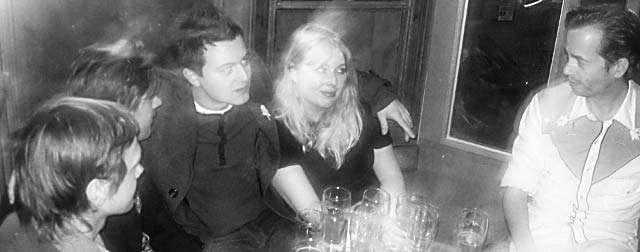
Laptop. Beers. Book. And art.

This is from the introduction to a book that covers the world of contemporary art quite well. In the making: Creative Options for Conemporary Art, edited by Linda Weintraub. Even though what is said is general and non-specific, it still describes the art world of today quite well as I understand it:

“Today’s artists typically meet in cafes and then return to their studios where one may plug into a bank of computers while the other sorts scavenged debris and a third sketches the origins of the universe. The work of one may ponder eternity, the other may instigate political protest, and the third may conjure futuristic fantasies. Art-making has become so inclusive that even the manners of being innovative have proliferated.

Only some precedent-defying artists expel cherished traditions. Others may innovate by rejecting the assumption that originality is a hallmark of great art.This assumption is so widespread that artists who preserve historic styles can also be labeled as rebels. Thus, contemporary art embraces the maverick and the traditionalist.

No topic, no medium, no process, no intention, no professional protocols, and no aesthetic principles are exempt from the field of art. Also missing are preexisting standards, predetermined measures of success, and ready-made definitions of art. Such artistic license grants to artists an exceptional opportunity.

They are free to originate new cultural possibilities. Indeed, they are uniquely unencumbered by methods, rules, and requirements. As such, they are our culture’s “free radicals,” constitutionally primed to disrupt states of equilibrium and initiate change.

This expanded domain of art production can be traced to a broader cultural circumstance. Local customs of all kinds are being pummeled by the incursions of competing traditions from around the globe and across the spans of time. Imported cultures pervade books, television, exhibitions, music, home furnishings, cuisines, advertisements, health care, college curricula, religious practices, and the Internet. Each augments the stockpile of artistic prototypes.

Some local artistic traditions are malleable and accommodate new influences. Others become hopeless misfits and succumb to obsolescence. Artistic responses to this mixing and matching of cultural traditions range from decrying the contamination of cultural pedigrees to welcoming the rich diversity they afford. Both responses demonstrate that the artistic models are no longer limited to artists’ ancestors and their places of birth.

Being a “traditional” artist now requires choosing from a profusion of cultural options, all available for adaptation in part, in combination, or in their entirety.”

The problem with art for me is a personal one rather than a conceptual: What the hell are you supposed to do if you can do whatever you want? The beauty of doing and working with art is that you can do literally anything you like and present it as art. This is a good thing™. You can use all the intellectual tools at your disposal to dissect any question you’d like, and if you appreciate your audiences’ knowledge you can be quite sublime about it. What you are doing is never understood as the whole work, but rather is seen in a context – a context that you as an artist are either supposed to be aware of, or one that you will be shoehorned into.

One useful thing that deconstruction brought to the surface was that art was forced to bring in everything into it’s description. Every tangential circumstance of what you are doing has a bearing on what you are doing. You are accountable for why you used a certain brush but not another – if you can’t explain that fact your ignorance is taken into account and the discussion moves back a step from the specifics of your work to your approach to it – account for why you don’t think that the brush doesn’t matter. This ideal of accountability is good thing™.

Art is the most fickle of markets. I am one of a multitude of people who try to somehow get some money and to command respect for how I see the world. We are trying to convince others that we are entitled to interpret their reality, that we somehow can tell others something that they didn’t already know, and all of this in a manner that is abstract most of the time, and self-serving all of the time. All of us working in the field are convincing our friends that what we are doing is a good thing™ in the sense of being attuned to what works. That we know what is beautiful; not in and of itself, but what is beautiful at the moment and will be understood as such by those we want to convince.

Those of us who did not already know it, realise somewhere along the way that most people don’t know what the hell we are doing. And time and again we have to choose if it matters. “Yes mom, I’m burning a whole bunch of flags. Yes it’s for work. Art work.

As I am constantly reminded of, both by artist friends and by the art world in general, my main problem is that I still differentiate between my artistic practice and everything else. To be an artist is to make art all the time – not in the sense of working a lot, but rather that there is nothing but work. You cannot breath without doing art. The job description of an artist is not necessarily to produce something for others to experience, but to be someone who is constantly aware of his or her role as an artist. To be the person who wills the world from moment to moment, to be the self-appointed titan of sorts who doesn’t necessarily carry the weight of the world on his shoulder, but is forced to think of it constantly. It’s a thankless job because there’s no discernable meaning to it other than the one you convince yourself and others of. Art is its’ own circular argument. Art for art’s sake has traditionally implied that there’s a necessity to it for outside observers, but today art for art’s sake has taken on it’s literal meaning: Since everything is art, we do art because there is nothing else. It is the place where we create meaning, it is as solid ground as we are likely to find.

But if I as an artist am the one who constructs meaning, and with one foot try to stand on my own construction of meaning, and with the other try to find purchase in something else, I feel like someone who takes one step too many walking up stairs – the unsettling feeling of knowing that I had something to stand on just a second ago, but finding myself falling forward because there is nothing but empty air where my weight is. Art is not a stepping stone to anything for me, it is an end to itself, and I have a hard time consolidating this understanding with whom I’ve grown up to be and still identify myself with. Maybe it’s just a question of maturity and, in my case, a lack of it.