Mateusz saved your life, remember?

The site for the lying project is now up and available on www.houseminor.org. You ought to check it out because it’s exactly the kind of thing you’d like! I’ve changed the mission statement a bit from the first post, but the main idea is still the same, as well as the goal: To print a magazine containing no facts whatsoever. I’ll document the progress here on the blog, but www.houseminor.org is the main resource for the project, so look to that.

It’s easy to get ahead of oneself, and even though it feels as if the hard part of the project is behind me, the actual task of collecting, editing and printing the magazine might prove to be more work than I’ve imagined. Also, I have to convince you to tell me a story, and I would have a hard time convincing a starving man to eat, let alone do something like this. Regardless, I’m looking forward to seeing what might come of it, and more importantly how other collaborative projects could be organised. I want to work with others but haven’t really found the setting or approach to doing it — but if you’d trust me with your time and effort I’ll do my best not to disappoint you. I have outlines for at least five more issues — on other topics, of course — and am open for ideas and suggestions. We can make really awesome ephemera here, people.

Of course, it all starts with this one issue, so this is what I’d like you to do: Tell me the story of how Mateusz saved your life. You can put any spin on it you’d like, as long as the central premise is the same. You don’t have to tell it in English, and you don’t have to have it perfectly memorised; You’re telling a story, and we’ll polish it before we’re done.

Call the project voicemail through Skype (user Mateusz_Saves) or on Swedish landline (+46 (0)31 799 90 97). If you prefer to send a finished recording or a text, use the address mateuszsaves@monocultured.com.

Thanks to Sara H, Anna G and Petter B for assistance and criticism.

Three Quarks for Master Mark; alt_cph 2010

I’m in Copenhagen at the alt_cph artfair. Unlike last year, I’m here on a technical assignment, as I and Jonas have been tasked to document the Skup Palet project with which Anna and Jan are participating. They’ve relocated 13 kids and two teachers from Hølstebro into the exhibition space, where they have daily classes. Read more about it on the alt_cph homepage as well as skuppalet.org.

It’s been great fun to see the project take off; just the logistics of transporting and housing all kids is daunting, but if you take into consideration that the parents had to be persuaded and the accompanying teachers are doing this on their own time, it’s bloody impressive. The kids have been extremely brave in the face of it all, and hardly flinch at all at being gawked at by the art-going public.

Jonas has been shooting video, I’m the sound guy which has had me wearing headphones and staring into space as if in a daze. I’m pretty sure that we’re visible in every picture anyone has taken so far, since we’re climbing all over the podium to get the awesome which Jonas keeps delivering. Should you want to see me looking confused, holding a microphone, you can do so in the video here: dagbladet-holstebro-struer.dk

Graphic artists deserve financial advisors.

I was invited to a group exhibition in Marstrand earlier this year, and last weekend I travelled there for the opening. Marstrand is an island a bit up the coast from Gothenburg, part of the northern archipelago, and in the summer its population of ≈1500 swells to include thousands of rich people who like to park their boats and buy expensive art. Or rather, they like to dock their yachts and buy expensive windbreakers.

We were ten artist from the KKV graphic workshop who’d put together a show, and the day after the opening I was guarding the exhibition. Having put on my most charming T-shirt and demeanor, I welcomed fifty or so visitors during the day, answering questions about techniques to the best of my ability (having to admit that I know nothing about photopolymers) and generally being pleasant and accommodating to all prospective patrons.

I was out of my element. Most of the others exhibiting had done this before, but besides their experience I found the lack of irony the oddest. Most people I know would balk at titling their works “Revenge” or “Woman” and would certainly not expect me to keep a straight face if they did. Having said that, the works represent a tremendous amount of labour, because heaven knows lithography isn’t a time-efficient way of creating images.

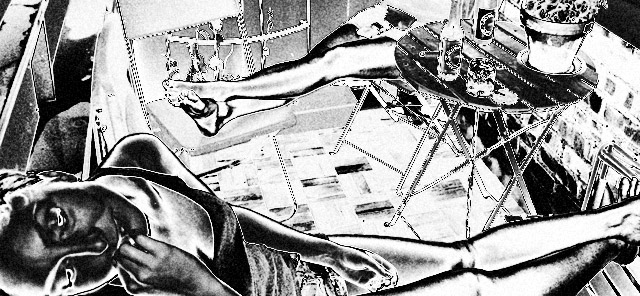
I’m mostly doing screen printing — when you do it as an artist you call it “serigraphy” — and it’s a messy process prone to failure and general fucking-upingness. Last time, the paint I was working with was giving me lip, and with the addition of a poorly cured screen I only got ten good copies out of 10 hours worth of printing, and close to fifty large sheets of shieet.

On the day I was guarding the exhibition, I had to compile a new list of works and their asking price since some changes had been made, and I started thinking about how the prices related to the works. People who are not used to buying art might dismiss pricing as a result of wishful thinking and whims of artists, but there is a pattern to the pricing which I’ve been trying to suss out. On recommendation of Jazzin over at Faas I started in on Why are artists poor?, a book by economist and artist Hans Abbing. I’m only through the first few chapters, but his discussion on the value and pricing of art mirrors what I’ve been thinking whenever I take a step back from the screenprinting vacuum table, surveying the value that I’ve somehow added.

Except what someone would expect to pay for the materials — paper, screen, chemicals, paint, studio rent — I’m adding my own time and labour, as well as whatever skills and knowledge I can verify or we can agree upon. This is measurable and would be quite easy to put a price on using the same model as you’d use for evaluating how much to pay your carpenter, for two differences. It’s difficult to estimate how much demand there is for art, and there’s also very little to judge a “proper” artist by, allowing for an unlimited supply of people who would consider themselves artist. “I could do that, and so could my dog and therefore it’s not proper art!” so to speak.
So that which sets the work of an artist in general apart from a carpenter — the aura using Benjamin — is not appraised by traditional supply & demand if we’re talking fine art, but rather a gray area of value embodied. What is the value added that isn’t measurable straight on? (This doesn’t necessarily apply when it’s a particular artist who is in demand, since per definition those who hold that specific artist in demand view an art object by that artist as having a value intrinsic to that relationship, and there’s only so many works one person can produce.)

Regardless of what in a work that we like, we might divide our way of arriving at the value in a few different ways, which will put us in different segments of art buyers.

1. The work is beautiful in itself, with as little reference to the notion of “art” as possible. (–Seurat-Le Bec du Hoc à Grandcamp renders the cliff and waters beautifully.)

2. The work is good because is comments on itself and gives an interesting understanding of what “art” is or could be. (–Georges Seurat demonstrates how by viewing we create a coherent image)

3. The artist’s story or oeuvre is interesting enough to confer value to the individual work.
(–Let’s hang this sucker next to Renoir just to piss Seurat off!)

As an example, lets say that I take fifteen of the twenty copies that exist of a certain print, and staple them up downtown as “regular posters.” What the weather doesn’t destroy, some kids take home, and I’m now left with five posters out of a set of 20. For all intents and purposes I might as well just have produced five copies to begin with, which would have merited a higher price per copy.

But since the 15 copies that weather and kids took were not bought at my set price — in fact, the audience for “taking a poster off a wall home” and “buying fine art” doesn’t overlap much — this would very likely be considered by prospective buyers as an indication that I myself don’t accept the face value of my own art and I’ve now sown distrust among graphic buyers regarding my artistic credibility and/or the merits of my work.

There’s of course a possible positive corollary to this destruction: My stapling of the 15 posters could be considered as an “artistic action in itself” and indirectly increase the value of my remaining five posters.

Actions such as the one above will affect your status among artists and buyers. But price seems to have a particular place in how some kinds of buyers value works, and it seems possible that if your prices are too high you are pricing yourself out of the market, but if your prices are too low, you are pricing yourself out of a market. In other words: If you’re too expensive, your patrons will wait until you lower your price — the demand is still there but it doesn’t agree or can’t meet your price. But if you price yourself below a certain level, you can’t easily hike your prices up again since you no longer have the same market available to you. Your “price slumming” has left you tainted, as it were.

[x_video_embed no_container=”true”][/x_video_embed]

Back again to the “creating value” part. If “art value” only is “social value” then we still should be able to agree on what exactly it is that we’re valuing. And here I guess that people have different understanding of what art is. Many people have an understanding of art as something that has to do with pure æsthetics. Ignore the notion that æsthetics are socially constructed, and you have people talking about beauty and form and colour and so on. Listening in on the conversations at the show, many people expressed their approval of certain works as being very “energetic” or “pleasing”, and having read over the descriptions of the work (someone wanted to express their interest in dancing, for example) they could judge a work on how closely the work aligned with their own ideas of how dancing might be represented.

I think my works failed on the expectation that proper graphic art shouldn’t be too funny. “Funny” means that there’s a joke that you have to get, and if you don’t get it you’d have to pretend-laugh and you don’t want to be found laughing at a fart joke, and so you don’t laugh and then the work’s not good. (I could be over-thinking a bowl of sour grapes here.)

No-one asked for prices on the three graphic works I participated with. No-one bought anything at all while I was there in fact, but did check out a few of the other works and asked for prices. No-one was thrown by the prices, and this could have three possibilities.

1. They agree to the worth of the work in itself. (This is worth 3000SEK to me)
2. They know the graphics market and know that the prices are within range of what could be expected. (This would usually cost around 3000SEK)
3. They don’t want to admit otherwise, for personal or social reasons. (I don’t want to seem uncultured, but Jeezus Christ on a crutch I wouldn’t take it if it was free)

I’m thinking of tiering some works as an experiment, and see that might work out. When you’re working with print you can do drastic changes in material without changing your matrix, so I’m thinking of doing a set of more expensive prints alongside cheaper ones, without losing any artistic aura in the process, but stratifying them socially.

The show was a learning experience, and I’m even more motivated than previously to make good work and let it find its market organically rather than shoehorning it into a pre-existing mold. And of course, if you’re interested in acquiring a poster, get in touch.

Work as progress.

— Mateusz, you handsome devil, what is it that you do for a living?

I get this question more often than you’d think, even though the phrasing might be slightly different. My mother, for example, might sigh “Have you got a proper job yet?”

Every once in a while I go through an identity reassessment, especially when sketching a new version of the blog or a business card, or when I stumble upon a piece of insight like Merlin Manns “Watching the Corners: On Future-Proofing Your Passion” — the premise of which is that we hang our identity on old merits long after those merits have ceased to be relevant.

What got me thinking was my first ever end-of-semester gift I received from the students at Chalmers.

I teach courses in photography at community collages in Gothenburg (Folkuniversitetet & Medborgarskolan), and I work as a guest tutor at the international Master of architecture and urban planning studios with Ana Betancour at Chalmers and KTH, teaching people how not to fuck up public presentations, discussing the value of film as an analytical tool in architectural practice and generally asking future architects stuff which I wouldn’t ask if I’ve had architectural schooling.

Many of them don’t seem to know why they want to be architects, nor is there any consensus regarding what an architect does, so the area is ripe for someone like me to come in and ask what they think they are doing — it’s great fun.

The photography courses present a rather mixed crowd, from people who’ve taken pictures their whole life and who just want to learn the digital end of it, to people who’ve become parents and want to document their toddlers with the shiny dSLR the friendly salesperson sold them. I draw diagrams of focal length and JPEG compression algorithms.

That’s the tofu and potatoes of my life, and it’s pretty awesome. Teaching keeps you on your toes and I’ve learned to draw on the eclectic knowledge I’ve amassed, working with people to reach interesting conclusion and alternative angles to problems. The work description could be “talking with people” but in my more interesting moments, and with enough caffeine pills, I become an apophenic Eliza, channeling the on/off-lined world.

I haven’t done freelance media work for a while, but should anyone want to give me money for recording their seminar, proofread their dissertation or photograph something I could give references and manage it. So the question of how I make money is easy enough to answer, but the problem arises when it bleeds into my understanding of who I am, especially when there’s a discrepancy.

For example: I’m not paid to do art. I occasionally apply for grants, which in a sense amounts to spec work, and I do art works and publish them on/off-line, but I’m not getting paid for it. I do it, and my formal art-education opens up related fields (e.g. the urban architecture courses) but it’s not my livelihood per se. I know that this shouldn’t bias me against seeing myself as an artist, but I have always had the notion that one is in part one’s job description, and ones job is the thing one does for money. So if you describe yourself as someone who does something for which you’re not getting paid, the jump to describing yourself as monetarily worthless isn’t big. It’s a way of thinking which is hard to shake.

All this doesn’t interfere with what I actually do, as I’m doing more art now than before, but it’s a shift in perspective which I’m adjusting to.

Come together. Right now. Over here.

Over at We Make Money Not Art, there’s a brief description of the work Hello Process which is being exhibited at the Process Becomes Paradigm show. In a related vein, Rhizome just published an editorial by Jacob Gaboury on the art collective JOGGING which are all about process instead of product. JOGGING are indeed mostly interesting in terms of process, as most of the documentation / made for net / performance, is undistinguishable from a Onion parody of art, or perhaps a Mcsweeneys piece.

While each piece may seem unimportant on its own, when viewed as part of a growing collection of work unconcerned with the materiality, permanence, or the importance of the individual piece, any insistence on the auratic quality of the object itself falls away. Indeed the content of each piece is doubly immaterial. Not only do they exist in passing, as documentation, or not at all, they are also unconcerned with the question of quality or importance, and are relevant as process rather than as product.

→ Rhizome, Jacob Gaboury: Immaterial Incoherence: Art Collective JOGGING

It’s through editing we make something beautiful appear. This Youtube choir, bringing together 185 individuals in a performance is inspiring — despite the slightly cheesy look of the stage and conductor Eric Whitacre — not because it resulted in this particular musical arrangement, but because there is a sense of universality to the participant’s ambitions. There’s a common denominator which becomes visible exactly because it’s mediated through a webcam, each video independently recorded. It’s the audience performing for itself.

The arrangement of the singers and panning over their individual videos in faux 3D also changes the interpretation of the piece; Compare the feeling of this version to the previous experiment he did, Sleep, in which all videos are arranged on a flat grid. The edit of Sleep creates a monumental feeling of the choir, whereas Lux Aurumque seems made up of individuals acting in concert. [Via The Technium]

As an aside, my name appears in an Excel file at one of the largest dairy producers in Sweden, Arla, since I sent in a bogus recipe containing cottage cheese to a competition. I don’t know if I’ve won anything, but judging from the other entries (all visible in the same document) I’m not the only one who’ve fibbed a love to that product. Twohundredandeightysix other people filled sent in their recipes to win whatever it was one could win. Imagine if you could get 287 people to spend those five minutes working doing some work for you, paying all of them fractionally more for their time than they stand to gain on average from a competition and thereby creating a win-win! What would you do with those 24 hours of labour? Or is an XLS-file with slogans enough?

Proof of value

I’m learning to do silkscreen printing again, and I’m making all the mistakes one would expect; I Overexpose the film, don’t dry the mask properly and forget to harden the emulsion. Too much paint or too little; Too much pressure or too little. And I’m ordering paper samples like there’s no tomorrow.

As much as I look away with poorly hidden mirth when Jan is espousing the merits of one balsamico over another, I’m at the moment hip deep in primers on paper, absorption and paint. So where he has discerning taste buds, I have rough fingertips and Wikipedia. Slave to the geek within.

A month or so ago I became a member of KKV, a workshop for artists doing craft. There are welders, carpenters, printers and potters, and most of them are seriously dedicated to doing stuff by hand. They make me nervous, because I feel like a self-conscious cynic among optimists. This whole thing with materiality, and the high value of craft, sneaks up on me every once in a while. People at KKV talk about stuff as if the stuff was what mattered and not the social interpretation of the stuff.

Because we’re such tactile and fundamentally primitive creatures, it’s easy to understand this drive to interpret ones surroundings directly, and project meaning (and value) onto them so literally. Feel the grain of the paper. Look at the pearl-like coating of the paint. Well. Smell the coffee of fucking post-materiality, you sack of neurons!

Almost immediately when I started printing, I was reminded by a dialogue by Banks in Look Windward, where a human composer and an A.I. discuss the merits of art and the value of labour, when the former is not a result of the latter:

— You have to think like a mountain climber.
— Oh, do I?
— Yes. Some people take days, sweat buckets, endure pain and cold and risk injury and — in some cases – permanent death to achieve the summit of a mountain only to discover there a party of their peers freshly arrived by aircraft and enjoying a light picnic.
— If I was one of those climbers I’d be pretty damned annoyed.
— Well, it is considered rather impolite to land an aircraft on a summit which people are at that moment struggling up to the hard way, but it can and does happen. Good manners indicate that the picnic ought to be shared and that those who arrived by aircraft express awe and respect for the accomplishment of the climbers.
— The point, of course, is that the people who spent days and sweated buckets could also have taken an aircraft to the summit if all they’d wanted was to absorb the view. It is the struggle that they crave. The sense of achievement is produced by the route to and from the peak, not by the peak itself. It is just the fold between the pages.[…]
— How far do I have to take this analogy, Cr Ziller?
— You’ve made your point, but this mountain climber still wonders if he ought to re-educate his soul to the joys of flight and stepping out onto someone else’s summit.

I’ve done three posters so far, all of which in connection with events which Skup Palet has organised. The exhibition Dip To Black with Jesper Norda and Sara Lännerström, a book launch with Signe Vad, and the Textival party this Saturday. We’ve hung original, one-of-a-kind, prints in the rain and sleet as we would any poster; The hand-craft and resources are treated as disposable, instead of being numbered and sold as signed graphic art.

I’m at KKV because I’d like to find a middle ground between worshipping the craft and the idea. What is the value added of me printing posters by hand which just as well have been printed in an inkjet printer? There must be something more to being an artist than just calling them giclée prints, right? Even if you take the errors into account — the diminutive differences between copies caused by human inaccuracy — this bastion of human expression can be substituted with a randomness generator, so what’s the point of doing it by hand?

I’d argue that what I’m adding to the finished object is the time and labour, and more specifically, the marketing of time and labour. You might buy my numbered and signed prints if you knew that there was 40 minutes worth of work behind it, as opposed to the non-effort an inkjet offers. You’re paying for my discomfort so that you can hang my 40 minutes on your wall.

Up to a certain point you can argue that some art is “better” than other, after which it really becomes a question of taste and trends. Beyond a certain limit the inherent value of all that work, the hours learning and thinking and planning, is not something which you see in the resulting object. But if you’re told that it’s the result of six months of suffering and planning and execution? Why, you’d have to be truly monstrous not to appreciate the artistry.

Speaking of objects of desire, two things I want: The Rauschen 4 album and the complete Bembo Book font face family. I just redesigned the Skup Palet business cards, and although the Bembo is nice, I wouldn’t mind the lower x-height; This is what craft has reduced me to, soiling myself over type before the computer at night…

Fabbing: Been there, done that, made a copy of the copy.

I’m putting together a project description of a workshop I’d like to run. The people I’ve pitched to are enthusiastic, but putting the course into academic-speak is difficult. It’s about 3D printing and other rapid manufacturing technologies, so I’m trying to get my bearings on the state of the art.

I don’t know how I missed the Rhizome article on the subject, Means of Production: Fabbing and Digital Art, as it’s a good primer on how radpid manufacturing is used in modern art. To sum it up: There isn’t much happening and what is happening is mostly concerned with sculptural works.

(Then again, there are trials with printing living cells, so your kids might soon be able to not only pull the legs off spiders, but design and manufacture better legs as replacement…)

Fabbaloo links to a 2001 presentation by Marshall Burns and James Howison which pretty well sums up what I tried to express in the pirate ebay post, when it comes to how our relationship to the object might change:

As in other cases where revenues are in doubt, designers and manufacturers will have to ask themselves what business they are in. In other words, what is it that people will pay them for, what will be their value proposition? Clearly, it will become harder to get paid for the physical arrangement of atoms in a product because that will be too easy for fabbers to make. Even the creative content (“intellectual property”) of a design fades in monetary value because it is too easily duplicated. Link

But now I do have to stop. I simply must. I must put away the Red Bull cans, and stop clicking and typing. I have to stop, so I can print my bed. I have to print my bed, so that I can lie in it.

→ IconEye, Bruce Sterling: The hypersurface of this decade (Via Fabbaloo)

Cornucopia is a concept design for a personal food factory that brings the versatility of the digital world to the realm of cooking. In essence, it is a three dimensional printer for food, which works by storing, precisely mixing, depositing and cooking layers of ingredients.

→ MIT, Fluid Interfaces Group: Cornucopia, Digital gastronomy (Via Shapeways)

On the moon, a research station is being constructed by robots.On top of a gantry, in place of the usual lifting hoist, an automatic arm extends downwards over the station. At the end of this arm, a nozzle squirts a concrete-like material onto the half-built walls like a mechanical hand icing an implausibly large cake. At the same time, computer-controlled trowels shape and smooth the concrete so that it’s flush with the wall below. The whole assembly moves back and forth to build up internal and external walls in layers. Further robotic arms are positioning services inside the building and lifting lintels onto the walls in order to make the roof. In just 24 hours, the house will be complete.

→ Craft, Lee Hasler: A giant leap for a brickie (pdf)

For some reason I start thinking about the space gel ant colony, where the hapless ants are allowed to burrow in 3D space, and out of a solid material create space. When diving last summer the thought struck me that we lack a model of envisioning architecture as a three dimensional space — not strange since we can’t fly, nor swim through the air — except maybe for the astronauts in space, for whom “up” is an arbitrary concept. (Or the IDF soldiers in Gaza, as BLDGBLOG pointed out recently)

Lets assume that 1) we’re extracting space out of matter, not building spaces, but extruding them out of something; destroying material. 2) And into this shapely void which we have made, we introduce objects that we desire – and we don’t build them, or assemble them, but rather extrude them. Need a table? Extrude it. Need somewhere to place the table? Extrude it.

Human will as a metaphor of a factory; Of a digging, burrowing animal, constantly crawling through strata, leaving tunnels behind, filled with the debris of time, want and need, manifested in ABS plastic.

Change begins with you and your cellphone.

Ring signals intended for cellphones capable of using mp3-files; Submit yourself and your surroundings to what I present to you here. Download, load up and get down, with the following sound:

Download all of the sounds in one, handy, 1.5 MB file: Ring signals 2 (Previously)

How would you like it?

[audio:https://monocultured.com/blog/wp-content/uploads/2010/01/How_would_you_like_it.mp3]

You shine… (hearing voices remix)

[audio:https://monocultured.com/blog/wp-content/uploads/2010/01/You_shine_multiple.mp3]

Pscha — guide to Polish pronounciation.

[audio:https://monocultured.com/blog/wp-content/uploads/2010/01/Pscha.mp3]

Vocabulary extension: Abash.

[audio:https://monocultured.com/blog/wp-content/uploads/2010/01/Abash.mp3]

P.M means after lunch.

[audio:https://monocultured.com/blog/wp-content/uploads/2010/01/PM_means.mp3]

20 second attack and fade.

[audio:https://monocultured.com/blog/wp-content/uploads/2010/01/20_sec_attack.mp3]

And he spake onto them: Readeth this!

In Grand Theft Auto, no misbehavior is so grievous that it can’t be washed away after a quick trip to the police station or the hospital. That conceit works well for gameplay, but it hinders the narrative by suggesting a world in which even the gravest actions have no meaning. How could we buy Lady Macbeth’s “Out, damn’d spot! Out, I say!” if she could have just headed to the nearest Pay’n’Spray?

→ Escapist magazine, Brendan Main: Fall of the house Bellic

We’re pleased to announce a new addition to our shop, in the shape of If Drawings Were photographs – the first ever zine published by It’s Nice That. The brainchild of designer Rob Matthews and Illustrator Tom Edwards, put simply – “Tom gave drawings to Rob and Rob tried to make them into photographs.”

→ It’s Nice That, Alex: If drawings were photographs Via Wakaba

Avatar Machine is a wearable system which replicates the aesthetics and visuals of third person gaming, allowing the user to view themselves as a virtual character in real space via a head mounted interface. The system potentially allows for a diminished sense of social responsibility, and could lead the user to demonstrate behaviors normally reserved for the gaming environment. Via Jonas

This product was originally designed to be: Impossible for child to suck the thumb while wearing, Unrestrictive and fun to wear, Extremely difficult for child to remove. The function of the Thumb Guard is to prevent the seal made around the thumb with the child’s lips. Without this seal, there can be no suction, which is the main source of pleasure in sucking the thumb.

→ Amazon.com: Stop Thumb Sucking with Thumb Guard Kit for One Hand

Let’s break things!

Before deciding on A message to be found me and Olle discussed the point of the project back and forth a couple of times. The postcard idea was something that Olle had had lying about for a while, and we thought it’d fit under the wide ambition of breaking the Internet. Email and other information technologies are instantanious by nature — or at least try to be — so that’s the easiest way of thinking about online communications. If you force a delay, be it random or deterministic, the idea is that you’ll think differently about emailing.

You could make the analogy to how if you stumble across a bus that won’t depart until it’s full, it’ll gives you a different take on how transport can be organised. It’s a tall order when it comes to restructuring how we communicate everyday, especially when the change isn’t necessary or mandated by great outside forces. (E.g. spam filters, central censorship, pay-per-priority-email or exceptionally slow connections.)

Speaking of the big G, a while back I did The Uncontested Order of Things – A Slideshow Curated by Google which I guess falls under the heading of generative art. The point was to see what bias we could deduct from the image search function, in an attempt to discover what we take for granted, or rather what Google takes for granted about us, stuck in loop of confirmation bias. It touches upon the same issues as A message to be found, but from a different angle, since we’re looking at the technologically neutral phenomenon of instantanious communications, rather than a service provided by the dominating company.

Mark_framfor_fonster_serpentin

gamla_soder_papperskorg

I haven’t written much about the trip to Copenhagen, so I thought I’d at least tell you of one of the more interesting pieces there: Relax, I’m just going to fuck with your mind by Stine Kvam. Wearing a helmet with a screen mounted inside of it you saw the world through a camera mounted somewhere in front, and Stine guided you through a few exercises which grew more disconcerting as time went by.

I might have missed part of it because my Danish isn’t what it ought to be, but the whole participatory performance is about the disconnect between what you see through the camera and what you feel and hear inside the helmet. What you see on the screen and what you get to feel with your hands becomes disjointed, and since you no longer can trust your senses you’re forced to trust your untrustworthy guide; She is your only guide here, and at least metaphorically you’re at her mercy.

Once you catch on to what is happening it becomes a riddle. At least I went from “What is happening, and why?” to “What will she try next?” Something is lost in the transition from thoughtprovoking to rebus.

Reminded me slightly of Avatar Machine by Marc Owen where you’re not as much being fooled by someone else but rather messing with your own head, using the learned habits from computer games to change your self image in real time. I wonder how his third person perspective would work on someone who hasn’t played those kinds of games. Here’s another video with the artist, courtesy of Boingboing.net.