Welcome to the fifth installment of How to write like Walter Benjamin, a series of videos which encourages you to learn how to write art theory. With just a minimum effort you will be writing art theory in no time! We’re using the 1935 essay “The work of art in the age of mechanical reproduction,” as translated by Andy Blunden. Here’s a link: Marxists.org
The run-time of this part is 40 minutes, and we cover all of chapter three. So sit down, grab a pen and paper, and follow along! As usual, if you have any questions, feel free to post them here or over at Vimeo. In case you’ve missed the previous episodes, please check those out before starting on this one.
Welcome back to the fourth installment of “How to write like Walter Benjamin,” where you are invited to learn how to write art theory — with a little effort on your part, you’ll be writing in no-time!
This tutorial, which clocks in at around one hour, contains chapter 2 of the essay, and since it’s a bit long you might want to take a break half-way through, or at least warm up your hand to minimize cramping.
We’re using the 1935 essay “The work of art in the age of mechanical reproduction,” as translated by Andy Blunden. (UCLA translation, on Wikipedia)
Some people have asked if they have to use the same setup as I when writing, and the answer is in one word “no.” You can write by hand on paper or on a computer, and you are welcome to type as well — the point is to teach you how to write art theory, not to do it in a particular way.
This is the third episode of the tutorial in which you’ll learn how to write like art theoretician Walter Benjamin. With just under an hour a week you will be able to write proper art theory in no-time. For this series, we’re using the 1935 essay “The work of art in the age of mechanical reproduction,” as translated by Andy Blunden.
Having previously written the introductory quote and the preface, we can finally start on the essay proper and its first chapter. Enjoy!
The goal of these video tutorials is to help those who otherwise struggle with writing theoretical texts, enabling anyone to learn to write like Walter Benjamin, and more specifically to write his 1936 essay “The work of art in the age of mechanical reproduction” which is a good starting point if one intends to write theory.
In this part, we’ll be writing the preface to essay, using the UCLA translation of the original German work. If you are serious about learning this skill I’d recommend that you’d download the English or German version and follow along. Learning by doing, as it were.
Pardon the clicking and hissing towards the end of the video — My computer threw a hissy fit when it had to open a new document, and this somehow affected only the audio.
In Grand Theft Auto, no misbehavior is so grievous that it can’t be washed away after a quick trip to the police station or the hospital. That conceit works well for gameplay, but it hinders the narrative by suggesting a world in which even the gravest actions have no meaning. How could we buy Lady Macbeth’s “Out, damn’d spot! Out, I say!” if she could have just headed to the nearest Pay’n’Spray?
We’re pleased to announce a new addition to our shop, in the shape of If Drawings Were photographs – the first ever zine published by It’s Nice That. The brainchild of designer Rob Matthews and Illustrator Tom Edwards, put simply – “Tom gave drawings to Rob and Rob tried to make them into photographs.”
Avatar Machine is a wearable system which replicates the aesthetics and visuals of third person gaming, allowing the user to view themselves as a virtual character in real space via a head mounted interface. The system potentially allows for a diminished sense of social responsibility, and could lead the user to demonstrate behaviors normally reserved for the gaming environment. Via Jonas
This product was originally designed to be: Impossible for child to suck the thumb while wearing, Unrestrictive and fun to wear, Extremely difficult for child to remove. The function of the Thumb Guard is to prevent the seal made around the thumb with the child’s lips. Without this seal, there can be no suction, which is the main source of pleasure in sucking the thumb.
Samsung, or their ad agency rather, threw a competition where you call a number of a phone to make it vibrate off of a plexiglas platform, onto concrete or into a tank with goldfish. The phones are of the rugged kind, so the competition killed two birds with one stone, providing both a neat online interactive experiment, as well as making the proof of the phones ruggedness conditional of winning it.
Naturally, I reported them to the animal rights people, as well as contacting Samsung directly. Had those fish instead been kittens — or if the phones literally were aimed for the previously mentioned birds — you wouldn’t have had to argue much before getting the animals removed from a stressful sitiation, but seeing as it’s much harder to sympathise with fish, it took a call from the department of agriculture for the fish to be removed.
I think it’s awesome that there are enough resources, and laws to direct said resources, to care even for the rights of really boring creatures. Having said that, I realise those fish might have been flushed down the crapper.
The other part of the story is concerned with the cellphone marked “00” in the video above — barely missing the tank — which is the one I won by ringing frantically, shouting excitedly in front of my computer. I’m only half expecting a dead fish in the mail. I’m sure there is a moral to be learned here, and perhaps there’s even a suitable biblical parable, but I think Petter put it best using the ancient art of rhetorical questioning:
“You won a cellphone and reported them using your own name? You did not win a cellphone.”
Konstnärsnämnden hade i onsdags en två timmar lång presentation om sin verksamhet, stipendier man kan söka och vanliga misstag folk gör. Jag spelade in den tillsammans med frågorna som dök upp och fotograferade den Powerpoint som Lars Olof Gustafson hade med sig. Man kan höra min kamera surra till ibland; Jag tror inte att jag missade någon projektion.
Lars röst hörs främst i höger kanal, emedan frågorna ligger på den vänstra. Hörlurar rekommenderas. Notera att detta är en slideshow, inte rörlig video, så samma bild ligger ibland kvar några minuter
Om du vill ladda ner presentationen så högerklicka på den här länken till flashversionen och välja “spara som…” Videon finns även på Vimeo, där du kan titta på den och ladda ner den i Quicktime-format: vimeo.com/7223127.
Upptäcker ni några fel i videon eller renskrivningen av frågorna, låt mig veta. Vill ni visa uppskattning för denna kulturgärning så kan ni gå ihop ett gäng och köpa mig en julklapp.
For our regular readers: This post only concerns Swedes (more or less) so you don’t have to worry your pretty heads about it. We’ll be back with the regularly scheduled programme presently.
Went to the doctor today to get my anual vegan probing. I get bloodwork done to determin if my morally correct habits have left me with crippling disabilities on the insides; B12 deficiencies, tumours, wheat penis, etc. As usual, I try to pack as many things into this meeting as possible, so I do my best to get sick just before I go.
I’ve had this stabbing pain in one ear for a month, but after much poking and peering, the young Dr. Benjamin folded his arms and did a meh, concluding that since he couldn’t find anything let’s wait until the symptoms become worse, or better. It will be a consolidation if I end up with half my head amputated because of his wait-and-see strategy, but then again maybe it would be even better if the pain would just leave me the fuck alone.
Also, I thought I’d get some theraphy out of it. As long as you get a remittal from a doctor, you can get theraphy (cognitive, psychodynamic, whatever) rather cheaply. So I figure since I have horrid mood swings during which I consider kicking dogs in the head (not that there’s anything morally wrong with disliking dogs, the filthy creatures) and often stare blankly into space at the slightest provocation, I might get some state sponsored theraphy to deal with it. No can do. The interview was short, and I’m way too normal to be cookoo.
— So, how long are these apathetic attacks that you get?
— Oh, a day or two. I just stare at the screen, worry about wasting my life away.
— Yeah, that’s perfectly normal. How about sleep, is it giving you any trouble?
— Oh yeah, I sleep very lightly and grind my teeth.
— How many hours of sleep do you get each night?
— Lately between four to eight hours.
— Yeah, perfectly normal.
— But can’t you put me on the list? I need some help here!
— Right, I’ll “put you on the list” right away.
Even though most people are at least as neurotic as I, and the fact that one in ten Swedes is on psychoactive drugs, it can’t possibly be good to feel this way. Goddammit, I want to concentrate my self-centeredness to one session every two weeks, not have it as my main hobby. There are no two ways to go about this I guess: Some dogs are going to wish they never barked in my direction…
We just got back from the alternative Copenhagen art fair. It’s too early to say if we were a smashing hit, but at least some people got smashed so let’s call that a partial win. It’s not always obvious what you take away from a happening like this. You’re supposed to hobnob and get to know others in your field and get invited to co-operating with galleries and such. Etc. Some of us did get invited to other spaces, and Skup Palet is more corporeal now than it was before, which is a good thing.
Because Skup Palet is such a diverse group I guess we all had different ambitions with our presence. I for one wanted to see what this whole art fair business was about — never been to one more than five minutes — and watch performance art or at least talk to performance artists. As therapy, you understand. There was a flesh-and-blood dadaist doing his thing, which was so quaint it went to bad and back to good again. There is little avant-garde left when nonsense poetry is regarded as something “classic.” Goodiepal did a performance in the shape of a lecture, a form I used for my MA and which Olle thinks is awesome; I found it “cool and stuff.”
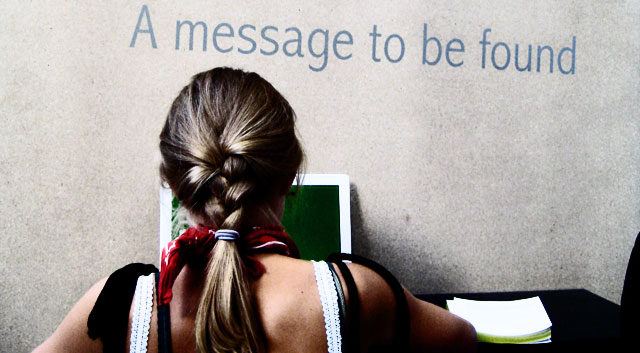
We represented with Frustration Canon and A Message To Be Found (the latter a project that Olle and I put together) and visitors and other artists seemed to enjoy both. Both were interactive; The former more ambitious and the other taking the shape of the ubiquitous “laptop with a webpage,” where all the relational aesthetics in the world can’t hide the fact that the my Macbook was incidental to the situation. (Much like a movie on slavery needs a person of colour, any colour.)
Frustration Canon is an idea based on something that I threw together some years ago. Ever since I put that thing up, Anna has urged me to do something more with it, to take it a step further as she puts it. Which sounds like a good idea but I have no inkling of what it implies. To me it was only ever about making a webpage where three people bang their heads on a desk. When I envisage “taking it further” I can only imagine variations on a theme, but not all that much new content. More banging, banging on other surfaces, banging in high definition.
It’s flattering when someone likes ones work, and the art fair was an opportunity to make something more of the idea; Anna and Jan took the original concept and ran with it. Together with Pär, who set up the video playback in PD, they attached a contact microphone underneath a table and invited people to bang their foreheads on the red X, a vinyl sticker taped to the surface. There are other details to the setup, but that’s basically it: Invite people to booth, promise them it won’t hurt too much and put them on the big 42″ screen mounted prominently on a wall.
As it turns out, people are quite happy to hit their heads in exchange for a pin and a smile. I don’t reveal it that often, but when I apply myself I can become an intolerably cheerful fucker. With a manic grin, flattery and a kind of friendliness you wouldn’t believe, I raked clients in one after another, all the while most others of our troop looked like undertakers annoyed with the living, doing little to dispel the image of artists as brooding and difficult.
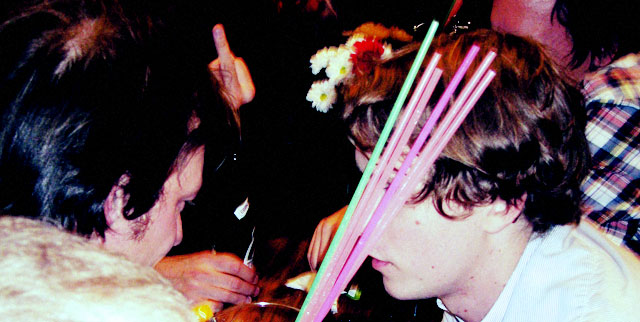
What made Frustration Canon a good choice of work to show as an introduction to Skup Palet is the overly symbolic gesture of literally “banging ones head in frustration” as it applies both to an artistic “struggle” as to working in a group, with all the inherent difficulties of organisation and egos getting trampled. Ten artists pulling together is more often than not an exercise in futility – it’s like herding cats; Angry, philosophical, drunk, cats. It takes a great deal of work to make teamwork work, and if you take away nothing else from the video then perhaps use it as an illustration of your own life as a member of any given collective. Originally, we had talked about letting the “bang” synchronise once every half hour or so, but that was a bit too complicated to pull off at such short notice.
The version below is a more recent edit, with people from Enrico Pallazzo banging their heads, synched to make a melody. I think Robert might have done the edit, I’m not sure. The look and sound of the piece is different from what we presented in Copenhagen, but the individual framing of the shots are more or less the same. In Copenhagen the videos were shown in a 4×4 grid, randomly appearing and occasionally in a different pitch.
My and Olles work, A message to be found, has the shape of a website service; You write a message and then hide it for as long as you like. It’s a delay of a day, a week or tens of years. You can add an image to your message, and are encouraged to tag what you’ve written. If you write a love letter to your boyfriend, you might tag the message “John Doe, love letter, Bombay 2009, honeymoon” and those keywords would end up somewhere on the generated page. The idea being that the search engines (today that means “the Google”) will index the page based on the keywords in lieu of the content – since the content won’t be visible for another n years. Until the message is revealed you only see a countdown timer.
It’s a message to be found but we don’t know by whom or under what circumstances. In five years time pages might be indexed differently. HTML 4 might only be accessible by legacy browsers when the whole Internet moves into the next iteration of Second Life or Facebook or smell-o-vision. The project is based on Flash which looking back hasn’t been the most search-friendly format, although that might resolve itself with time and more computing power thrown on the ambition of a semantic web.
There are similar services, like Future Me which allows you to delay messages, as well as services that send out notices if you don’t ping their server for a while (the service, assuming that you have died, sends out your missives from beyond the grave) but A message to be found differentiates itself by being a delayed public publication. The distinction is small, but it’s an interesting enough experiment and it’ll be fun to see what indexes will pick up the messages, and what messages have been written. Every once in a while Olle checks in on how many messages have been written, and there’s a small but steady stream of them being entered.
As an aside, Radio Lab recently made en episode where some of the above mentioned services come into play. It’s the After Life episode and you could jump to the end of the show if you want to hear that segment, or listen from the start to an excellent hour of excellence.