Music appreciation day in Gothenburg.

Petter has a taste in music. I’m not saying it’s always good, but he is a man of tastes. This taste brought us to the balcony of Henriksberg — a place for unpleasant young people, people who view of the harbor, and those who are there for the bands. We were there to watch the duo Civil Civic from Autralia, and I just noticed a writeup of their experience here: The Civil chronicle #6.

Somehow that blogpost forgot to mention the sauve and strapping young men who bought t-shirts after the excellent show, but perhaps they were thinking of other things. I look fetching in my t-shirt though. I recommend that you go to their MySpace and have a listen. You can buy their albums for any amount, which is neat since they’re a live act and not another guy with a laptop. (I’m not putting down people with laptops, just saying that a band with instruments and amps has more at stake than a midi-keyboard and a pirate copy of Cubase)

They’re an independent band and seem to put a lot of effort into the whole band experience thing which I understand the kids enjoy, as should you.

[audio:https://monocultured.com/blog/wp-content/uploads/2010/06/01-Less-Unless.mp3|titles=Less Unless|artists=Civil Civic]
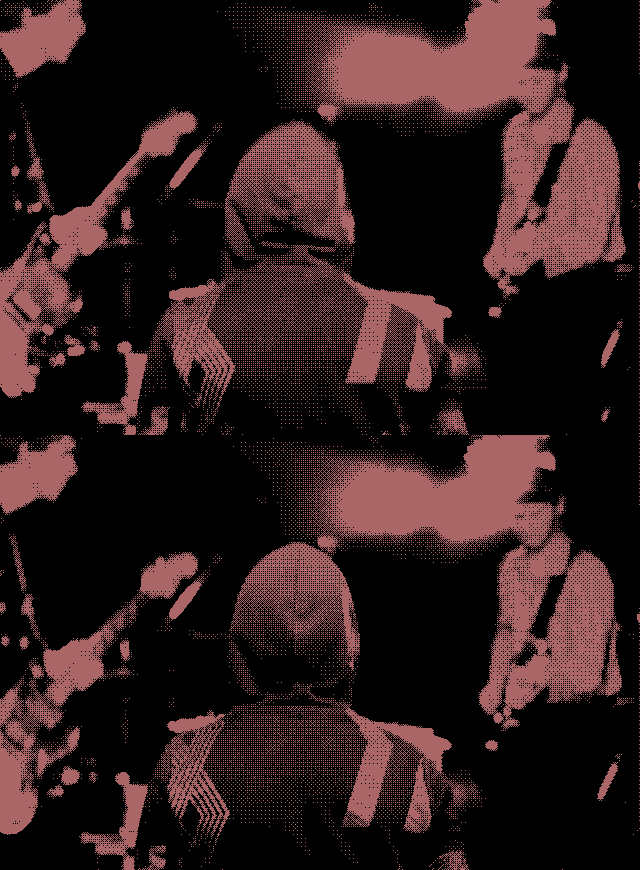
Following Civil Civic, an even more party hardy band came on. Their music doesn’t carry well in a non-live setting, but the duo Fucking Werewolf Asso from Gothenburg kicked an excellent amount of arse. A drummer was exacting revenge on his drums for some past transgressions by beating the fuck out of them, and the bespectacled singer with Eraserhead hair stod with hand on hip, spewing awesome into the microphone over chiptune loops. If you get a chance to hear them, I wholeheartedly encourage you to go.

The main act was another local band with a punny name: Fulmakten. It’s a very style-conscious ensamble, and that’s the extent of what they had to offer. They were mimicking Swedish 80’s music so well they sounded like a generic tribute band, and I don’t think that was intentional. What little personality they had was contained in the splendid afro and facial hair of the singer. Then again, if you’re ever organizing a live roleplaying event which takes place thirty years ago on a cruise ship between Sweden and Finland, and are looking for that special blend of blandness, you’ll squeal in delight.

As a side note. With my 32:nd birthday out of the way last Monday, I’m wiser, closer to death, and have an updated list over who will get Christmas cards. Some will regret their lackadaisical approach to important dates.

Happy midsummer celebration, be careful out there!
Technical support

For the benefit of the less technically inclined among you, I recorded a short video on how to recover lost data on a dead harddrive. When I tell you that I “need some supplies” before helping you out with your busted computer, it is likely beer, incense and occasionally a screwdriver.

With this insider information you can now go forth and repair any harddrive out there, and you’ll totally be the boss of anyone with hardware failure. You’re welcome! And in order not to be too snarky, below is an article on the fallibility of even technically competent people. Go read.

If there’s a niche, a parasite will fill it. There’s a reason the cells of the organisms that live in your body outnumber your own by 100 to one. And every complex system has unfilled niches. The only way to eliminate unfilled niches is to keep everything simple to the point of insignificance.

→ Locus online, Cory Doctorow: Persistence Pays Parasites

Come together. Right now. Over here.

Over at We Make Money Not Art, there’s a brief description of the work Hello Process which is being exhibited at the Process Becomes Paradigm show. In a related vein, Rhizome just published an editorial by Jacob Gaboury on the art collective JOGGING which are all about process instead of product. JOGGING are indeed mostly interesting in terms of process, as most of the documentation / made for net / performance, is undistinguishable from a Onion parody of art, or perhaps a Mcsweeneys piece.

While each piece may seem unimportant on its own, when viewed as part of a growing collection of work unconcerned with the materiality, permanence, or the importance of the individual piece, any insistence on the auratic quality of the object itself falls away. Indeed the content of each piece is doubly immaterial. Not only do they exist in passing, as documentation, or not at all, they are also unconcerned with the question of quality or importance, and are relevant as process rather than as product.

→ Rhizome, Jacob Gaboury: Immaterial Incoherence: Art Collective JOGGING

It’s through editing we make something beautiful appear. This Youtube choir, bringing together 185 individuals in a performance is inspiring — despite the slightly cheesy look of the stage and conductor Eric Whitacre — not because it resulted in this particular musical arrangement, but because there is a sense of universality to the participant’s ambitions. There’s a common denominator which becomes visible exactly because it’s mediated through a webcam, each video independently recorded. It’s the audience performing for itself.

The arrangement of the singers and panning over their individual videos in faux 3D also changes the interpretation of the piece; Compare the feeling of this version to the previous experiment he did, Sleep, in which all videos are arranged on a flat grid. The edit of Sleep creates a monumental feeling of the choir, whereas Lux Aurumque seems made up of individuals acting in concert. [Via The Technium]

As an aside, my name appears in an Excel file at one of the largest dairy producers in Sweden, Arla, since I sent in a bogus recipe containing cottage cheese to a competition. I don’t know if I’ve won anything, but judging from the other entries (all visible in the same document) I’m not the only one who’ve fibbed a love to that product. Twohundredandeightysix other people filled sent in their recipes to win whatever it was one could win. Imagine if you could get 287 people to spend those five minutes working doing some work for you, paying all of them fractionally more for their time than they stand to gain on average from a competition and thereby creating a win-win! What would you do with those 24 hours of labour? Or is an XLS-file with slogans enough?

Funeral. Photography as coping mechanism.

After four days of travel to and from the funeral, I’m back in Gothenburg. Playing chess in granmas room felt odd with her not present, and suddenly every medicin and picture on her dresser took on new meanings. The blanket I’d used as a backdrop for her portrait was on her bed, and our youngest half-brother was sitting on it, dispensing dubious chess advice.

Once in Sanok, seeing relatives I hadn’t seen for years was truly a memento mori moment — gray hairs, walking canes, half-serious comments of “it’s us next” over dinner and photo albums. The jovial uncle who used to tell dirty jokes now tells of the dirty jokes he told the nurses when recovering from surgery.

Below are all the pictures I took in chronological order. I don’t know what grandma would have thought of the video, but she might’ve asked if doing it hadn’t made me hungry, and perhaps I ought to have some dumplings.

Gay driving.

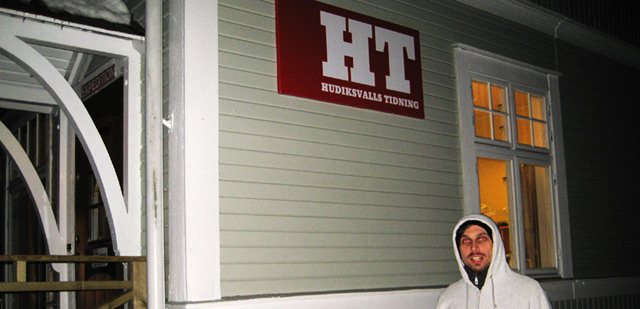
Almost ten years and a score ago, my family made landfall in Sweden and settled down in Hudiksvall. While dad worked at a concrete factory my mom was busy gestating what would become Tomasz. We stayed in Hudiksvall for two years and a week ago I briefly revisited the place.

Anna and Jan arranged for Markus Anteskog to show his work Virtual Waters with Skup Palet, and the cheapest way of getting the 1m×1m×1m works to Gothenburg was to rent a lorry and drive 1600 kilometers, returning with both art and artist properly secured.

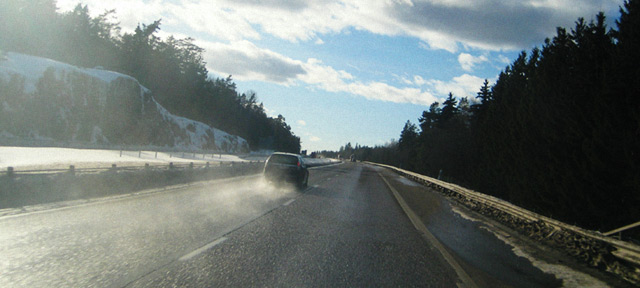
With a merry “Right ho,” me and Petter set out in a giant Renault early Monday morning. Not five minutes had passed before I was frantically ringing the rental establishment for instructions on how to operate the non-cooperative sound system. They weren’t able to offer any help in the matter, so we turned to the Internet. Using a combination cellphones, wireless broadband and laptops, I soon had a question up on Metafilter and after a couple stops I had wrangled the player into submission. The car rattled too much for my spoken word podcasts to be audible, but Petters supply of rock music tided us over.

After an uneventful journey we met with Markus in Hudiksvall, lifted the God-awfully heavy boxes onto the lorry, and left looking for our hotel. Anna, in a gesture of motherly affection, had found a place north of Hudiksvall which judging from the pictures looked like a manor. Its webpage boasted of a fitness center, sauna and beautiful surroundings. We were to have luxuriant Italian toiletries and designer towels.

Imagine my shock upon discovering that the internets are not always faithful to the truth! The house was big-ish, but a glorified bed-and-breakfast rather than a grand guesthouse; A hard toffee was the only concession to luxury afforded us. The wifi was excellent, but I would gladly have settled for a slower connection in exchange for something more extravagante than Italian soap (no shampoo) and a backed–up shower drain. The towels might have been designed, but as one who has occasionally employed dirty shirts in lieu of traditional devices of absorption, my taste can hardly be called discriminating.

Anna, who had felt that she needed to compensate for the previously mentioned “motherly affection,” had unbeknownst to us called ahead and asked the proprietors to spare no efforts in making our stay as romantic as possible, since I and Petter had been eyeing each other for months and this would be the first time we’d be able to express the gay. Apparently, homosexuality hasn’t been invented in Bergsjö (population 1 243) which would explain the resulting tiptoeing. Also, the mirth expressed at the request of an additional duvet to the king-sized bed was better understood in light of Annas preplanning.

We had dinner at the one pizzeria which was licensed to sell beer, and trudged home. We’d been shown neither sauna nor fitness centre, and soon we fell asleep, with nary a fondle or caress. Breakfast was a toast–and–yoghurt affair, and pretty soon we were off in the truck again. The stereo had regressed to it’s previous state of being a broken piece of crap, and no amount of poking would convince it to work. I tried to entertain with the speaker of my cellphone, but Jay-Z just doesn’t carry the necessary oomph at such meagre volumes. We picked up Markus in Hudiksvall and off we went.

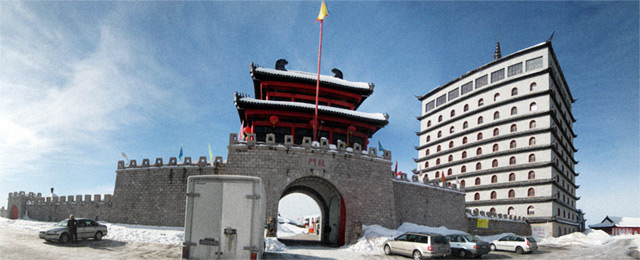
The highlight of the trip was having lunch at Dragon Gate, some twenty kilometres outside of Gävle. It’s an eight story Chinese pagoda with a surrounding wall, where you can eat lunch, get a massage or watch the largest collection of replica terracotta soldiers outside of China. We had spotted the place on our way up, and it was immensely gratifying to stop for a stir-fry, which we enjoyed in a dragon-shaped boat. Petter has already vowed to arrange any future wedding there, and I will most certainly recommend it to anyone going in that direction. The place is other-worldly; A mix of post-apocalyptic Chinese fortification combined with the concept of clave in Diamond Age.

With bellies full of tofu and rice, we continued the uneventful journey home. Long after dusk, with a lingering taste or french fries and coffee we’d picked up, and with lower backs bruised by unforgiving seats, we arrived in Gothenburg. Our precious content was delivered — art and artist in one piece, the latter only slightly worse for the wear — and we went our separate ways, sleeping the sleep of the well deserving. The show opened just the other day, and will be open until 28th March. Check out Skup Palet for more details on hours and so forth.

The work of art in the age of mechanical reproduction. Part 18: Epilogue

Part 18 covers the epilogue of Walter Benjamins 1935 essay “The work of art in the age of mechanical reproduction.” It’s the longest part of the text, so I encourage you to warm your wrist up, and maybe consider a short break in the middle. As usual, we’re using the Andy Blunden version of the essay which you can find through Wikipedia (Although you know this already, since you’ve done the previous tutorials, right?)

With this, this course on how to write art theory comes to an end. I’d like to thank you for your patience and perseverance, and I hope that you feel it has been time well spent. Hopefully you’re more confident in your ability to write art theory, and I wish you good look in your future endeavors, be they professional or private!

Don’t hesitate to get in touch if you have questions or comments regarding this or any other episode, or would like some advice on how to further hone your writing skills.

The work of art in the age of mechanical reproduction. Part 17

In this episode we’re writing the last chapter of Walter Benjamins 1935 essay “The work of art in the age of mechanical reproduction,” as translated by Andy Blunden. Once we’re done with this chapter, only the epilogue remains. This episode is rather long and clocks in at around one hour, so you might want to prepare for taking a break halfway.

By now you know the drill, and hopefully you’re feeling more confident of your ability to write art theory. Good on you! If you have any questions or comments, please get in touch.

Compelling narratives.

Thomas Bey William Bailey over at Vague Terrain has an analysis of Modern Warfare 2. It’s a bit too uptight for my taste, but it balances the lavish superlatives I’ve heaped on the game quite nicely. His objection is that because of the extremely compelling narrative of games like these, we’re fed a bunch of propaganda and taught a manufactured history of the world. This is completely true. Thomas critiques isn’t limited to this game but rather highlights the possibilities for nefarious uses which the medium can be put to. The FPS Americas Army is in its third iteration, and they have spun it off into a graphic novel as well — the first story unironically entitled Knowledge is Power — but they get a free pass since it’s an obvious recruitment tool for the US army.

As Walter Benjamin mentions (in an essay you might have noticed lately) film, like architecture, is an art form which you learn to appreciate by habit and osmosis, rather than contemplation. Computer games have the grandiose scenarious of movies, as well as the tactility of architecture (since you’re able to navigate the world and develop an appreciation of the physics of the place.) so they really act as a multiplier of knowledge and narrative. (Regardless of their relationship to fact, mind you)

The exciting thing with photo-realistic games isn’t that we might end up with a Matrix-like scenario where we won’t be able to distinguish between ‘reality’ and ‘not-reality’ but that our memories of events will be messed up. Are you remembering something which you experienced in the ‘real world’ or the surreal world? We don’t have to mess up our physical perception of things for this technology to be scary, only our remembrance of things. Look at how much importance we place on photography as an external memory, and multiply that.

I know that I have created historical narratives based on nothing else than the tech tree in Civilization, so obviously I give more credence to a story than to static statements of fact; And since we experience the stories of computer games first hand, we might absorb the sentiments expressed even more readily. MW2 is a kick-ass game exactly because it fits within the narrative which the West has spun, and which countless action movies has reinforced — it’s “as close to reality as you get” exactly because it’s a narrative which is fictionalized from start to finish.

To paraphrase: Guns don’t kill people. People who live in a world where guns are seen as necessary responses to certain crises, kill people. Political action is necessary if we’d like to change the story, and it would be awesome if computer games could be a change for good, instead of only mirroring an already dominant narrative of how the world works and who we are as humans.

[flv:https://monocultured.com/blog/wp-content/uploads/2010/02/PBS_The_War_by_Ken_Burns.flv https://monocultured.com/blog/wp-content/uploads/2010/02/PBS_The_War_by_Ken_Burns.jpg 640 360]

A more upbeat rider to this story comes from the podcasting world, where fictional parallel universes are less flat and predictable than in MW2:

Myke Bartlet has continued writing and podcasting stories in the Salmon & Dusk universe. The latest short story, Yesterday came too soon, is a nice introduction to his stuff if you don’t feel like starting on a longer series. As previously mentioned, Mykes reading is half the enjoyment of his podcast, not cause the stories are so-so, but cause his tempo and timbre is excellent. Go listen.

The work of art in the age of mechanical reproduction. Part 16

In this episode we write chapter 14 of Walter Benjamins essay “The work of art in the age of mechanical reproduction” as it’s translated by Andy Blunden. Your writing speed and confidence ought to have increased by now, and if you set out to learn how to write art theory I hope that you feel that our time together has been well spent so far. If you’re just joining us, I recommend that you stop this video and go to the first episode; Learning how to write art theory is hard work, and jumping in at the end will only frustrate you.

The work of art in the age of mechanical reproduction. Part 15

Welcome to the fifteenth episode of this series, where we try to learn how to write art theory using Walter Benjamins 1935 essay “The work of art in the age of mechanical reproduction,” translated by Andy Blunden.

In less than one hour we go through chapter thirteen of the essay. If this is the first episode that you watch, please go back and review the previous ones before embarking on this one. As usual, you might want to warm up your wrist. Questions and comment are welcome here.