On Ballard and trains

In J.G. Ballards Millennium People a neighbourhood rebells as a response to the trappings of middle class life and their inability to afford more than the image of it. Their grievances are not political to begin with but relate to maintenance and parking space, and only later turn to structures of indoctrination and politics. I’m not sure that the story applies to actual mass psychology of how revolutions start, but it’s a classical Marxist notion and interesting to see it artfully applied in fiction.

At some point, a critical mass of disillusioned middle class might set themselves to start a revolution, and it might even start over something trivial.
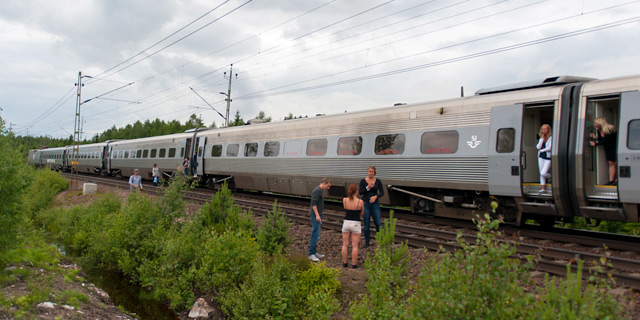

Unrelated to politics, but related to the trappings of comfort and our societies coating of polished civility, came to my mind when I was stranded on a train recently. I was on my way to Stockholm for work when there was a loud bang and we came to a halt. Both pantographs on the train set had snagged on something and had torn, leaving us without power in the middle of nowhere. The PA doesn’t work without power, leaving the crew to rush between trying to fix whatever had broken and walking from cart to cart shouting out what little they knew. They soon gave that up though, perhaps figuring that leaving 400 passengers steaming in a train with no articulated windows or ventilation or flushable toilets would pass for “a plan.”

The cafeteria kept selling food and drink until the power went out, after which they started writing IOUs instead. They gave this up after five minutes, seeing that the queue was growing in length and annoyance, allowing people to take food and drink (“–No alcohol!”) for free. Later, in the papers, SJ’s spokesperson put it in terms of that they “distributed food and drink to the passengers” which is an odd way of saying “allowed a disorganized free-for-all once the till didn’t work.” Apparently stuff got heated once people started looting the booze. There’s a tradeoff between offering disgruntled people alcohol to placate them, and the risk of suffering their poorer impulse control afterwards.

Once the diesel locomotive had arrived and hooked up, we were off again. disembarking an hour later at Hallsberg. Parents with kids, older folks with clumsy luggage, all dragging their charges and parcels in every which way, looking for bathrooms, someone to give them information on trains or missed connections. In the hustle for soda and pork sandwiches, the din drowned out any announcement coming over the PA for how to get to Stockholm, and mostly by chance I managed to get on a train heading in the right direction. When I finally arrive it’s night, and I’m more than six hours late on a three hour journey.

What has been lost now that we are constantly being treated as customers instead of individuals with agency, is that we’re reduced to objects with demands and criteria of contentment. We’re Sims in a very boring game of TrainVille which have to be clicked on every once in a while until the workday is over. We have demands and rights, but outside of the guidebook for consumer interaction there is no way to talk or meet in a shared interest or humanity. Which leads to four anxious crew members stressing out because they have four-hundred annoyed consumers who are not getting their moneys worth of travel experience, and no way to garner sympathy once they’ve “distributed food and drink for free.” Also, some of them were impolite asshats.

Things to remember:
* Keep people informed, even if you have nothing new to say.
* Don’t be an entitled customer asshole.
* Always bring extra water and energy dense food when you’re travelling with SJ.
* Acknowledge that people have the option of ignoring what you want them to do — offer arguments as to why they shouldn’t instead of getting indignant.

Image search, revisited

Over at feber.se I stumbled over the project Google. The work, created by Ben West and Felix Heyes, is based on taking 21000 common English words and parse them through Google image search, and then printing it all and binding it.

Quote from the creativeapplications.net website:

“Conceptually it’s whatever you make of it,” writes Ben. The sad reality of shrinking attention spans, collective media fatigue or how an expert reference book is no match for the convenience of Google, for example. “It’s really an unfiltered, uncritical record of the state of human culture in 2012,” concludes Ben. So, how are we faring? “I would estimate about half of the book is revolting medical photos, porn, racism or bad cartoons.”

[x_video_embed no_container=”true”][/x_video_embed]

[x_video_embed no_container=”true”][/x_video_embed]

The second video above is from a work I did at Valand back in 2006: The uncontested order of things: A slideshow curated by google. It’s in the same vein, although it used the letters of the alphabet to search for images. I downloaded the top 40 or so pictures of every letter, picked one at random and arranged them alphabetically in the video. The idea being pretty similar to Ben and Felix — how is our language and concept of images shaped by that which we take for granted or don’t reflect over.

In the introduction to the work I wrote:

The motivation for this process, of which the resulting slideshow is but one possible combination (let alone one possible way to present the combinations) is:
1) To see how many apparently random images we can fit into a narrative, and
2) Given the omnipresence of google, how easily received/understood/accepted the images are when
3) A qualitative analysis of the images (and search results in general) shows an (apparently) unproportional US/EU presence, which in turn should
4) Kick us in the nuts for too easily accepting the perceived “freedom of the internet”, and not reflecting enough on what our online behavior tells of ourselves, but also what actual and very manifest power we are supporting by our actions.

Which actually still holds I think. Google is as omnipresent as it’s ever been, and apart from occasionally switching to Duck Duck Go as my main search engine, I don’t actively thing about how I navigate the Internet as much as I used to, or how that shapes our collective understanding of what the world looks like.

Math: A tangent, derived. Malmö

I’ve finally signed up for math-class, and am struggling with the “Matematik C” curriculum. I need it to get into any course related to computers or natural sciences, but I’m not putting near enough effort into it. It’s been fifteen years since I last took math, and back then my antipathy to math was so strong I was actively trying to forget what little I learned.

Actually, the course is officially over but I’ve asked for a month extension to allow me to catch up, so we’ll see how that’ll go. I need to do the test the 18th at the latest to be sure that my uni application for fall goes through, but this requires a couple of hours of daily practice. And I’m out of practice.

I might be doing the same mistake I did when studying philosophy, assuming that as long as you put your mind to it you ought to be able to figure things out from first principles. So you start with an intuitive understanding of 1+1 and build on that. But at this level math is mostly about learning by rote, and because I’ve been out to the loop for so long, half the time I don’t even know what problem I’m tasked with answering. “Describe a function” is not an invitation to write an essay, but something with an actual answer, and as always when you’re learning something new, the glossary seems arbitrary and made up by a stupid-poopy-head.

The TI-82 graphing calculator Zenobia lent me has a 150 page manual, and having been spoiled by GUIs for so long it feels as if I’m learning Dwarf Fortress. But it’s fun in a PRESS SHIFT+Ln+min/max way and I’m scouring the second hand market for a calculator of my own. SMBC sums up my findings quite well so far.

On the upside, I designed and printed my own graphing paper, and had it bound. Each page has different colours, and the paper is watermarked and really nice to write on using the extra soft pencil leds I found in the third store I asked. My priorities are not what they ought to be, but at least my notebook is perty.

[x_video_embed no_container=”true”][/x_video_embed]

As a small vacation, I and Sara took a weekend in Malmö. I haven’t spent much time there, so we had three days walking about, taking pictures of her old haunts and apartments, gorging ourselves on vegan cake and whatnots. Nice city, and it would have been even better if we’d gotten ourselves bikes. Speaking of which, the Malmö initiative Cykelköket has a branch in Göteborg. They seem nice!

The pirate ebay: Fabbing

This can be interesting: The Pirate Bay is sharing 3D models for printing, so far only using the category Physibles on the original site. Right now there are mostly dupes of stuff from Thingiverse, and seeing as the interface is the usual forum link-dump there’s no preview or version control, but it’s still an interesting development for two reasons: For one, once 3D sharing sites will start to be harassed on IP-issues, there will be be a chilling effect on the distribution and usage of models, so we’ll need a safe haven for that. TPB has proved rather resilient.

(Further on, it’s easy to foresee 3D-printers which won’t print non-signed models, taxation on printing materials used privately, consumer protection laws which are stretched to encompass personal fabrication, etc, so there will have to be forums to discuss circumvention and open source practices)

Think about it this way: If piracy of IP today mostly is a concern for a few companies in the western world – regardless if it’s clothes, movies or medicine — what will happen when the manufacturing industries start to feel threatened by the infringement on their manufacturing prerogative? Previously, someone ordered 1000 Gucci bags from your factory and you spat them out, regardless if the person you ordered them from was a pirate or Gucci; either way, you had a business model – making stuff. If now the pirates are not only threatening the IP of some of your clients, but also the necessity of including you in their piracy, you’re suddenly standing with a factory without orders.

I think that fabbing can be a boon to humanity in many ways, but as always with disruptive technologies there will be a huge backlash, and the sooner we can build infrastructures for dealing with reactionary policies the better. Which ties in with the second reason this is interesting, which has to do with the development of a public discourse on the subject.

So far the ideas surrounding fabbing are best described in science fiction and by those in the field – Bruce Sterlings Shaping Things comes to mind — but they’re slowly gaining mainstream attention; Petter told me he saw 3D printing mentioned in a lifestyle & decoration magazine which usually is concerned with spring colours and feelgood food. Just as in art though, the debate will sooner or later come down to what we are printing, rather than that we are printing, and if TPB can be a platform to foster experimentation with fabbing, we’ll have another generation which is used to remix and copy and paste and mash things up, only now with physical objects rather than media. But for that to happen there needs to be practice and debate, and tpb putting it’s weight behind the issue can only accelerate that.

Turku: Presentation & summery

For the first time since I got back from Finland, I strapped on my tights, beanie and running shoes, and ventured into an absurdly warm november evening to frighten people by doing wheezing and shuffling noises. It went well. And to rekindle another positive habit I entertained in Turku, I’m posting another video from my residency; I finally have an edited version of the presentation I gave at the end of the project.

It’s just short of forty minutes, and it includes a short backstory of me and projects which seemed relevant to fabbing, a brief timeline and explanation of 3D printing in general and the RepRap specifically, and then an overview of how the project changed during in the process of realisation.

[x_video_embed no_container=”true”][/x_video_embed]

Doing the RepRap #14: Updates and upgrades

Here’s something that I didn’t think about. I had skipping on extruder as well as Y & X, but hadn’t thought that the pulley grub screw needed a flat surface to press against. Here I was thinking that the heat was melting the inner bore and allowing slippage (which might still be happening) but filing the motor shafts flat hadn’t occurred to me. Lucky me there’s an instructional video on the process, which seems straightforward enough.

→ Filing flat a motor shaft: http://www.youtube.com/watch?v=DBnKPEnt9a4

Regardless, I’m still getting metal pulleys, and having looked at how coarse the T5 belt is and how it’s jumping on my printed pulleys, I’m probably moving to T2.5 belts. Now if I could only find a local source of the stuff which didn’t cost a fortune, I’d be set. On IRC I spoke with some guy in Poland who was buying and shipping the stuff, but couldn’t get a quote from him. And the pulleys had to be hand drilled, which seems a bother if there are pre-drilled ones available. Suggestions are welcome; the ones I’ve found so far seem too expensive for what it is, I mean, how much can diecasting pulleys cost?

Someone is starting to assemble a guide for beginners into the art and magic of building a RepRap, and it’s off to a good start. If you want an overview of the build process, check out reprapbook.appspot.com. I wish that page had been live when I started out, but you know what? Back then we didn’t have fancy e-books but read the wiki and begged in chats, and we would count ourselves lucky!

Doing the RepRap #13 — Printer finished

It’s been a long road, but my Reprap Mendel Prusa 3D printer is finished and I’m printing stuff. There have been so many problems and fuckups along the way, that when I finally started printing stuff a week ago I didn’t think much of it, but with hindsight it was a Grand Moment™. I’ve joined the ranks of 3D printers. You may now commence the “oohing” and “aahing” I understand are my dues.

So far, with the exception of a frog and a replacement LM8UU Y axis holder, I’ve mostly been printing calibration cubes. These are shapes intended to troubleshoot your printer and give you an opportunity to get your Skeinforge/Sfact setting correct. As you can hear in the video there’s some rattling going on on the Z-axis, and I have some trouble with Y-alignment on some prints, but with lowered acceleration on Z and Y, and perhaps tightening of the belt on the latter, I think I’ll be able to print halfway decent parts.

Sara came over for a few days, and as any good boyfriend I set about making her feel comfortable helping out with the build. It was much appreciated as it often seems I have three hands too few to get something assembled. Making the print bed was slow going, and as I’m using plexiglass for print surface we broke off a couple of pieces before getting a more-or-less square one. The plexi is actually good for printing on cold, at least once the PLA starts sticking to it, but if your hotend gets too close the PLA fuses with the surface, and you’ll inadvertently run the head through the board which will create pockmarks in the surface, and possibly plug your nozzle with plexi — which is the reason I’m printing with the 0.5mm nozzle instead of the 0.35 I started with.

[x_video_embed no_container=”true”][/x_video_embed]

We were leveling the print table for a good two hours, and found that the design with springs between the lower and print bed wasn’t optimal, since the springs were unevenly springy. I had bought a whole kit with the suckers but none seem to fit well enough and give enough force to work. It’s a good design on paper, but we found that it was just easier to use two sets of nuts per fastener bolt. Protip: Get spanners which fit instead of fiddling with adjustable ones or pliers; it’ll save you so much time and temperament it’s worth the expense.

At this moment thanks might be in order. A great amount of those go out to Traumflug for design and massive help with the electronics, and Kliment, Triffid_Hunter, Action68 and everybody else who’s been quick to lend support in #RepRap on IRC or on the reprap.org forums. When you’re as ignorant of a subject as I was about the RepRap, you rely on the help and input of friends and strangers, and without the support of everyone from awesome girlfriend Sara to KKV electro to that guy who barely spoke English but cut me some metal rods, this project might have fallen over and not gotten up after any of innumerable stumbles.

Of course, thanks to the people here in Turku for providing an incentive to start this, as well as the means and time to finish it. Ultimately, bigup to Adrian Bowyer for getting the RepRap project started, as well as all those who keep improving upon it. I have a public presentation of the project on Thursday 6th October at 1800 in Gallery Titanik in Turku, and if you’re nearby I’d love to see you there.

Doing the Reprap #12 — First extrusion

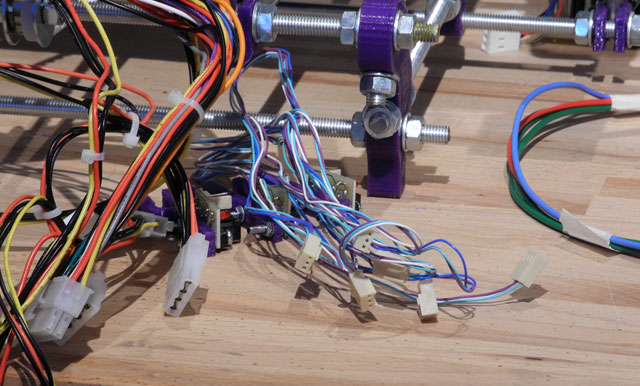
Last Friday, while Pilvari Pirtolas had his opening here at gallery Titanik, I was sitting in an adjacent room and fiddled with my machine. I had managed to get the extruder to heat up and the thermistor to register in Pronterface — a previous day of troubleshooting revealed that I’d connected the hotend to the wrong two pins of the Gen7 board — and now it was heating up with no problem and only a slightly worrying amount of smoke. Once it was mounted on the Accesible Wade’s extruder I was good to go for extrusion test.

I got some visitors from the opening next door, and it was fun to see some people react with curiosity and others with disinterest to the machine. To the uninitiated it looks mostly like a heap of metal and plastic, so the awesome disruptive power isn’t always readily apparent, so I got to practice my pedagogical skills on young and old, tipsy and wasted alike. Once I realized that all motors had the wrong polarity in relation to the Teacup firmware, I pressed “reverse” instead of “extrude” and lo! there was extrusion and much exaltation all around!

[x_video_embed no_container=”true”][/x_video_embed]

Turku: The art bit

For the past three weeks I’ve been in Turku, in the studio of Gallery Titanik, whacking away at the RepRap Mendel Prusa 3D printer. I’ve been kept so busy toiling with this that I’ve lost sight of the grander scheme of things, like why I’ve been building the printer in the first place. I’ve been putting off communicating what I’m doing not because I don’t think it’s worthwhile, but rather because the more immediate problems of finding screws or getting the electronics to work seemed so much more pressing; and besides, it ought to be obvious what I’m doing, no?

Then again, every once in a while it’s good to remind oneself that one of the few telling differences between an artist and a crazy person is that an artist at least nominally does her stuff for an audience, while the crazy keeps to herself or only occasionally performs for medical personnel.

If the Work of art in the age of reproduction spoke about the disappearance of aura, of authenticity and a direct interaction between any one artist and her audience, the means of reproduction through RepRaps and similar DIY machines reintroduce at least the authenticity of the machine — or its configuration, parts and calibration — into the object.

There are things about fabbing which sets it apart from traditional reproduction, as for example there is no original on which any copy is modeled but only a digital model created to exist in a different medium from that of any physical copy. Any artworks which are printed from a CAD file are originally only ever mathematical descriptions in a 3D-file format on computer storage. So although the printed object isn’t unrelated to the artwork, it certainly has a random element to it, a stutter in its materiality.

Historically art was about creating objects which based on esthetics and social function were considered “artistic,” then around the time of Fountain it became explicitly about an artistic aura, and then fluxus removed even the “work” part of “art work” which after post-modernism left us with the free-for-all shit buffet we’re at today. Perhaps fabbing could at least offer a lifesaver?

With fabbing, we have the possibility of having art which is highly conceptual, but which manifests itself physically not by the mediation of the initial artist, but rather through printers — machines and their operators — which exist in a DIY sphere and so are all different, temperamental, uneven; In another word, they are unique. But just as we don’t give artistic merit to the assembly-line worker who manufactures the printer with which we print our photographs, we are unlikely to attribute artistic merit to whomever assembled the printer which prints our CAD-models.

Rather, an actualized 3D-print might be the artwork of an artist, but it’ll have the aura of the machine, or rather the aura of the DIY home fabrication process of building and tuning the machines; If movements can impart aura, it’s an aura of industry dependent on craft, an inversion of industrialization, transforming engineers into cottage industry artisans churning out other peoples art objects.

nathan7: and I want a good print
nathan7: a really good print
nathan7: without overhangs ruining things
nathan7: it’s about the end result here

From a discussion on IRC #RepRap

The idea of personal fabrication is positioned to affect the manifestation and appreciation of art as soon as some critical mass and manufacturing capacity is reached: The result will be analogue objects bearing the likeness of art; not simulacrum or simulation, but a second order relation to the artwork, twinned with the aura of machine. Perhaps fabbing can be a disruptive enough technology to change the artists role into something new, something interesting, something other than making artworks.

Doing the RepRap #11 – Frame & motors

I got the frame of the Prusa more or less assembled, even though I still need to make sure that it’s straight and so forth. The motors are mounted and connected to the correct rods or belts, and they are stepping at 1/16 nicely, although the LM8UU bearings don’t seem as smooth as I’d like them to be; I will probably re-assemble the Y-carriage whenever I add the hotbed, seeing as that might be cause for some misalignment and grinding.

Robin from the forums popped by the studio and we compared builds and I got some advice which is always welcome; where to source materials, in what order to assemble specific parts, why patience usually pays off better than a flamethrower, etc.

The long M3×60 screws for the adjustable extruder have proved elusive, so I’ve gone for an M3 rod I’ll put wingnuts on. Once you get warmed up and understand how things are supposed to fit together and what functions they perform, you relax enough to improvise. It’s a good feeling. The Makergear hotend shipped with a mounting plate which doesn’t fit my Accessible Wade’s Extruder so I schlepped the studio bike around looking for 4mm plywood to drill a replacement. Once that’s done and the hotend built, I’m pretty close to testing to print.

Perhaps I’ll be able to melt som plastic into a horrible blob in time for tomorrows opening of the new show here at Titanik and impress Sara who’s coming over for a few days. That would be most excellent.

[x_video_embed no_container=”true”][/x_video_embed]