For the past couple of years I’ve intermittently tried to acquire a proper microscope, but those I’ve found have either been too expensive or too crappy. Apparently medical researchers have money for equipment, which is priced accordingly. Also, I guess there might be more to it than throwing glass and cast iron together
Since I’m nowadays working as a technician at Akademin Valand, I occasionally hunt the basement to see if there aren’t any technical treasures lurking somewhere. I’d heard that the uni used to have a hologram creation machine, and once I found it there was a microscope right next to it. How neat! It’s a Nikon Optiphot, and I’ve been spending after-work hours trying to get it assembled.
As far as I can tell, it’s more or less complete, but lacking any adapter for a digital camera. Since I have a bunch of dead laptops lying about I’m thinking of stripping the built-in camera out and 3d-print an adapter to stick on top of the scope. Ideally I’d use a DSLR or even one of the Hasselblad bodies on top, so the past week I’ve done an inventory of all the accessories I could find to see if I have anything useful.
For now the only thing for my troubles are two blurry cellphone photos. In the name of science I cut myself and looked at blood; the larger image below are my red blood cells! How cool is that? In addition to a proper camera mount, I need to learn how to calibrate and use the microscope — all manuals I’ve found are geared towards people who know what result they ought to get, so I’m floundering even when I try to follow along. Luckily, it turns out that a colleague at work has a physics doctorate and knows a lot about microscopes, so there’s a chance I’ll get to learn how to use it properly!
Concurrent with my minuscule tinkering, I’m taking an astronomy course at the university (free higher education, hell yeah!) which is likewise rooted in an ambition to find out how things work. Not until now did I realise that all heavy elements in the universe have been created in stars long gone, and having a broad understanding of earths history makes looking at things in the microscope so much more rewarding; You sort of get a bigger perspective, and it’s fascinating.
Also, the Foldscope seems like an worthwhile endevour, and in addition to using the “proper” microscope, this might be a good project to try out. It really goes to the core of what’s driving my ambition regarding microscopy — let’s see if it delivers.
Our intent is to engage a broad group of people to collectively generate the “world’s most awesome biology manual” which is written from the context of open questions instead of historical discoveries. The goal is to bring together a broad range of members from different communities, context, countries and skill level. To participate in the experiment, you will commit to documenting one single experiment (or series) which can be replicated by anybody in the world with access to a Foldscope or other microscopy platform.
Two weeks past without me doing a Sunday project. So in the quilt of productivity those were two dropped stitches. The first week was a diseased week, with wheezing and snotting and whining, and the second week was spent on Lanzarote, one of the Canary islands, with Sara. It was based entirely on a “oh my god I need sun” line of reasoning, and we found a cheap trip to Puerto del Carmen.
It’s a beautiful landscape, and if only we’d have activities planned, we wouldn’t have noticed that the island is a soulless limbo (or purgatory, we couldn’t agree). My thoughts returned again and again to J.G.Ballard and the many incarnations of Vermilion Sands in his short stories. Even though it’s not a carbon copy of the place, the ambiance of the island is one of a movie backdrop, with very little reality propping it up.
On our last evening we ate at a Polish-Irish restaurant (with North African and Indian cuisine) and the proprietor had moved there 13 years earlier. How she likes it? “It’s very easy living.” The roads are good, landscape beautiful, and the streets very clean. It’s also vacuous and streamlined for handling 5.5 milion tourist a year.
The video was actually edited and posted to Vimeo in time for the deadline, but I just didn’t have it in me to do a writeup. Next Sunday is still on though, and I’m working on another sound work based on the noises recorded from Lanzarote, similar to the three-sound doodle I use in the intro here. Perhaps on the theme of being a windblown traveller.
Fortunately, the sun continued to shine through the numerous ozone windows and the hottest summer of the century was widely forecast. The determination of the exiles never to return to their offices and factories was underpinned by a new philosophy of leisure and a sense of what constituted a worthwhile life. The logic of the annual beach holiday, which had sustained Europe since the Second World War, had merely been taken to its conclusion. Crime and delinquency were nonexistent and the social and racial tolerance of those reclining in adjacent poolside chairs was virtually infinite.
→ Ballard, J. G: “The Largest Theme Park in the World”
As a teenager I would listen to Frispel, which was broadcasted on P3 Sunday evenings. It was a pre-taped one hour experimental show, mixing fact and fiction, and focused a lot on creating an interesting atmosphere. Once it was cancelled, I wouldn’t find anything like it until Radiolab many years later, or perhaps some of the odder This American Life episodes. I still have a soft spot for radio turntablism stuff – and the movie Lucky People Center International is one I revisit every couple of years because of the tight editing and rhythm — so this weeks project was a short attempt to create an atmospheric clicky ambient thing, on the subject of suffering.
The music is all fiddled in Reason and the samples are from a lecture with Yo Hoon, available here. The track is finished as it is now; but I hope to return to the topic. Many years ago I did an ambient sound work called Appropriate Christmas which combined 2400 christmas songs into one long meditation, and in keeping with doing things for holidays, I’ll try to look into the nature of suffering and do a longer piece on it in time for easter.
Being a lapsed catholic the subject matter might not surprise anyone, but at least I’m not doing “guilt.” Yet.
Delinquest: And then gone
[audio:https://monocultured.com/blog/wp-content/uploads/2014/02/And-then-gone.mp3][/audio]
[gap size=”5px”]
What with all the surveillance-state bonanza going on, and a general feeling of unease and fear of shadows, I figure that now would be a good time to finish the video below. It’s a monologue on my experience as a doorman at various events. The premise is that I take a few minutes out of every hour and pretend to be a doorman. Very meta, but there are some valid points there; the main one is “don’t trust your instincts to obey”.
The original HD source files are lost — or they’re just hiding on one of the drives somewhere — but with the 2000-isch look I thought the SD video looks fine. Seeing as “good taste” is so easily acquired and/or faked, we might as well go for the “æsthetics of arbitrariness” as a valid expression.
Since I’m writing this in English, you’d think that I’d taken the time to subtitle the video, but as always I’m doing this at the last second and so the subtitling will have to wait. I’ll still count this as a win on the “do one thing a week” list though!
Ok, so this week might be a bit of a cop-out. What free time I’ve had has been spent re-painting the hallway at home. We’ve talked about doing something there for a while, and even though the shelving isn’t cut to size yet, we figured that painting the space would be a good start. Unless you’d argue that the white paint is meant to symbolise the white box of modern art galleries, it’s nowhere nere anything creative. But it’s done, and it took long enough, so I’m putting that up on my list of “getting one thing done a week” list. Hey ho, next week will be more fun, promise!
Oh, and an update on last weeks pin-project: I’ve heard back from three of the five manufacturers I contacted for making the pin, and once they’re back from Chinese New Years, I’m hoping to have enough information to order a sample mold. It might be cheaper to manufacture over there than here, but it’s still a bit of money, so I’m trying to vet the companies with what little China-slothing I command…
Saturday evening was spent at Gabriels cabin, where five of us sat in a sauna for three hours and intermittently bathed in a 4°C stream. After a couple of times it didn’t feel as dying anymore. Haven’t done winter bathing since Turku, and it was brilliant. The steam fogged up the camera and killed the flash though; Next time I’ll rig something to better capture the expression of turning into an ice lolly.
It’s so tempting to see the proliferation of drones as a linear progression of sci-fi predictions, and on the surface of it it’s not difficult to imagine that drones will be as omnipresent as CCTV cameras, but what is lacking in that image is how it feels to live under such conditions. We can get a certain notion of the feeling by reading reports from war zones. There, drones are a constant presence with utterly opaque behaviour and motivations which causes enormous stress on everyone, since you never know if you’re being observed or potentially targeted for a killing, Or if you’re neighbour is.
In a non-military settings, I imagine that one might develop a habit of not looking into the sky as often, lest you be reminded of something looking back.
So this weeks project is an idea concocted in mirth but earnest in intent. “Ha ha only serious” as it were. Over beers I and Gabriel started laughing over my suggestion of a paraphrase of the “SOS Racisme” badge, which in Swedish had the text “Rör inte min kompis!” – “Don’t touch my friend!” I proposed a version for our modern times, adapted to the surveillance state as it’s embodied through drones. The text invents a new Swedish verb, and translates loosely to “don’t drone my friend!” Behold:
What the verb “dröna” in this sentence means could refer to raising awareness of the ubiquitous drone killings, as well as the panopticon-like surveillance they’re a part of, or perhaps it’s an appeal: —Friend, don’t drone! The enamel pin will be slightly wider than 5 centimeters, and depending on the colours I can get I’m leaning towards the red-cross red in the image above. Once they’re manufactured I’ll probably setup a subdomain and sell those, or something. What does one do with 200 pins anyway? I’m open for suggestions.
I’ve sent off requests to three manufacturers to get a quote on production, and this is my first venture into ordering to spec through alibaba.com, which is an OEM broker dealing mostly with Chinese manufacturers. Seeing as artists are supposed to be free agents in a free market, this way my Factory is an actual factory. It’s an odd world.
Strictly speaking, this project doesn’t fulfil the “finish by Sunday evening” criteria I set up last week since I don’t have the pins yet. But in my mind it’s finished enough that I can let it go; there’s nothing in the project awaiting my input until I get the quotes and technical specifications on how to deliver the original model. It’s happening, so I’ll count this as a partial success as far as my work ethic goes, awaiting the results once the pins are done and delivered. Their distribution will most likely bloat into a project of it’s own.
Regardless, next week there’ll be another project, perhaps more modest in scale…
Our ancestors could spot natural predators from far by their silhouettes. Are we equally aware of the predators in the present-day? […] This document contains the silhouettes of the most common drone species used today and in the near future. Each indicating nationality and whether they are used for surveillance only or for deadly force. All drones are drawn in scale for size indication. From the smallest consumer drones measuring less than 1 meter, up to the Global Hawk measuring 39,9 meter in length.
Welcome to Global Drones Watch. The purpose of this site is to provide useful information about drones, and to encourage people to become active in efforts to stop killer drones overseas and stop domestic drones from violating our privacy and safety.
In the United States, the dominant narrative about the use of drones in Pakistan is of a surgically precise and effective tool that makes the US safer by enabling “targeted killing” of terrorists, with minimal downsides or collateral impacts. This narrative is false.[…] Based on extensive interviews with Pakistanis living in the regions directly affected, as well as humanitarian and medical workers, this report provides new and firsthand testimony about the negative impacts US policies are having on the civilians living under drones.
Schmitt saw with prescient clarity that air war would not only create an “intensification of the technical means of destruction” and the “disorientation of space,” but also intensify the problem of unequal sides, and allow the dominant side to re-label enemies as criminals. Schmitt understood that air power would create a world in which those who command the sky could police and punish those who do not.
The drones were terrifying. From the ground, it is impossible to determine who or what they are tracking as they circle overhead. The buzz of a distant propeller is a constant reminder of imminent death. Drones fire missiles that travel faster than the speed of sound. A drone’s victim never hears the missile that kills him.
“I arrived to the site and there were bodies scattered all over the place. The people told me that my son Aref had died.” When he returned to the village, Al Shafe-ee was quoted as saying, “I saw the women of the village gathered crying and screaming.”
“After an engagement, we have to conduct surveillance for quite a long time. Yes, we may only be seeing it, but sometimes, we’re seeing it for hours on end, and that is part of the traumatic impact of the mission. It’s a definite form of stress on the operator in and of itself.”
“[Depicted on the shield of Agamemnon:] And he took up the man-enclosing elaborate stark shield, a thing of splendour. There were ten circles of bronze upon it, and set about it were twenty knobs of tin, pale-shining, and in the very centre another knob of dark cobalt. And circled in the midst of all was the blank-eyed face of the Gorgo with her stare of horror, and Deimos (Fear) was inscribed upon it, and Phobos (Terror).”
Another part of the arsenal are drones that will be, for the first time, monitoring the Games from above, as well as robotic bomb detectors that will prowl the Olympic grounds below.[…]”You can’t use drones to prevent suicide bombers … But they’re very good things to prevent [protests] because it might spot people trying to gather.”
If you’re going to develop secret airplanes, you’re going to need to figure out how to fund them. Now, how do you fund an airplane in secret when the constitution states that all federal funding needs to be accounted for? The point being that there are enormous economic, social and political infrastructures that need to be in place to create and sustain something like classified flight testing. Over time, when you build these types of infrastructures, you end up developing a state within the state that has very different rules and different ways of operating than what we would think of as a kind of democratic state.
I like to think
(it has to be!)
of a cybernetic ecology
where we are free of our labors
and joined back to nature,
returned to our mammal
brothers and sisters,
and all watched over
by machines of loving grace.
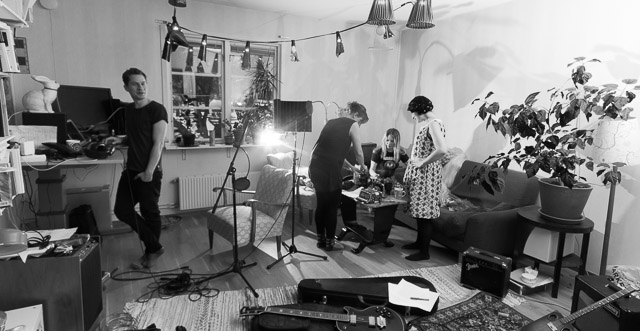
It’s that time of year, in the life of slightly bored 30-somethings with a bit too much free time on their hands, that we drink wine and say: “Gosh darn it, but wouldn’t it be awfully nice to get together and do something? Like, I don’t know, music?” And lo! They made a mark in their calendar, and once the date came closer and the convictions grew flaky, a battlecry summoned the frail dilettantes — “Wine! At least there will be wine, surely!”
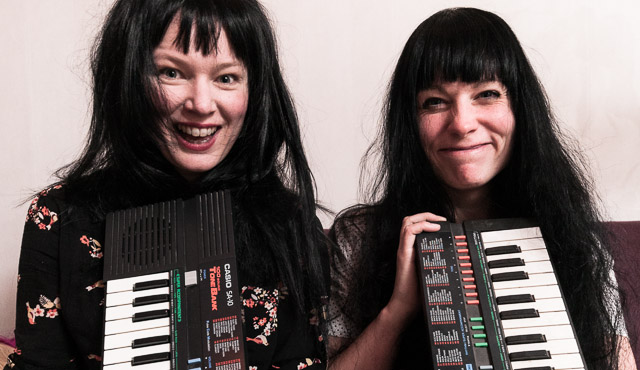
The jokes about drinking too much wore thin by the end of day two, but despite some wear and tear on livers and brains we somehow kept the process up for the whole weekend — much thanks to Petter and Sara, who had some sort of “idea” of what this might end up being — and by the end of it all we had two songs, a bandcamp site, portraits, and importantly a name: VECKA7.
The songs are made for driving, but could also serve other purposes, possibly. Sara, Erika and Jeanette on song and various instruments, Petter & Sara on guitars and bass, and I’m the reason there are drums and some plinky noises in the background. Go listen and download: VECKA7.bandcamp.com
A while back Daniel Josefsson of The Immaterial asked me to do a writeup of a project or an idea, and he suggested that I’d expound on the video project How to write like Walter Benjamin i did back in 2009-2010. I finally got around to writing the short essay, and it’s now up his blog.
Edit 2021.07: As The Immaterial seems defunct, I’m posting my essay here instead. I’m clearing up the text a bit, adding quotes and such where needed.
Let me explain how to write like Walter Benjamin
A while back I transcribed Walter Benjamin’s seminal 1936 essay The work of art in the age of mechanical reproduction by hand. I recorded it in real-time and published it on my blog and elsewhere to be used as an introduction to writing art theory. It was titled How to write like Walter Benjamin. The whole series spans 18 episodes, and makes for about 13 hours of video. I don’t know that anyone has seen the whole thing.
Hindsight is a mixed bag when it comes to explaining ones earlier motivations, so I won’t try to explain how I came up with the idea or why I thought it was worth to carry through. But the two years that have passed since, make a dispassionate analysis easier and I think I can see three ways to read the work — not mutually exclusive — which present it as a stop along a path rather than the final destination.
Perhaps it’s telling that the version of the essay that I used for the project was chosen based on accessibility — It’s certainly something which Benjamin might have found interesting — and you don’t get much more convenient than Wikipedia, where I found the original link to the essay transcribed by Andy Blunden.
As a preamble to the explanations below, let’s agree that doing no research at all on a text before embarking on a two month long art project — one of the core tenets of which is the bearing of authenticity on an artwork — is lazy in a stupid way. Benjamin is throughout the text concerned with how the “aura” of an actor is lost in the translation from stage to film, while my approach is to not even bother to check if the actors are switched out in the middle of the movie and their voices dubbed over.
With that in mind, let me offer three readings of How to write like Walter Benjamin:
First as humour
When it comes to artists doing theory or framing themselves within an academic discourse, it’s easy to point to the Post-modern essay generator and have a laugh at the convoluted language, never-ending name-dropping, and the discourse by way of apophenia that is too often accepted for publication. But there are texts which actually say something about the state of the world or how we perceive it, and Benjamin’s is one of them. Therefore, everyone aspiring to write coherent, well-understood and reasoned art theory would do well to mimic his style and reasoning. And what better way than to transcribe it whole cloth?
Above all other considerations, the first thing, which strikes me about the project, is the deadpan seriousness of both the pretence and the execution. On the face of it, it’s an instructional video much like any other you might find on Youtube or Vimeo, made by someone who takes their work seriously and has already accepted the framework of what they are offering as legitimate. There is no question in our presenters mind that what he is offering is a reasonable approach to learning how to write art theory.
The instructor conflates the two meanings of “writer” (as in “author” and someone who sets letters to paper) and sees himself as setting an example by showing you that he’s actually “writing” the text, and to emphasise that it’s “writing” and not “copying,” he’s doing it by hand no less!
It’s not meant to be a parody of actual theory instructions or criticisms; it’s much more fun to view it as a documentation of an absurdist performance than a pisstake on the teaching of art theory to artists. Repeat a sentence enough times and the repetition takes on a meaning of itself, be it for humorous effect, as a means to extinguish meaning as in Alvin Luciers “I’m sitting in a room” or to make technology visible, as in Patrick Lidells take on Luciers original.
Perhaps the monotonous instructions can persuade you for at least a moment and actually say — yeah, this might totally be a thing I could do. That would be fun.
Secondly, we can perhaps use this work to try the premise of Benjamin’s work — to see what happens with the aura of the text, or of him as writer, when someone else writes it verbatim.
One would have to assume that a text itself has aura, which is not something Benjamin mentions in the essay. The absence of references to classical literature in his analysis allows us to speculate freely — surely there is an aura of authenticity in a book, or does it merely exist in the act of writing? If it only exists in the act, how then understand the following quote, on the role of the author:
“Thus, the distinction between author and public is about to lose its basic character. The difference becomes merely functional; it may vary from case to case. At any moment the reader is ready to turn into a writer.”
This observation, combined with the assumption of the act of writing as being the moment where “aura” can be understood, would leave us with an understanding that any writing could be understood as containing more aura, more authenticity, than any printed — mass reproduced — book might convey.
Perhaps it’s here that our instructor can be found — someone writing for the sake of the aura which writing bestows on him.
Should we assume the obverse, that the text itself is a “medium-free” object, having a self-contained aura or authenticity quite apart from it’s means of dissemination, we would need to give reason to the special status of text which sets it’s “aural worth” apart from other works of art.
By his own words, text might almost take the place of a natural phenomena — perhaps one might assume “thinking on paper” — when he categorically says of aura that:
“In the case of the art object, a most sensitive nucleus —namely, its authenticity —is interfered with whereas no natural object is vulnerable on that score.”
In Borges short story Pierre Menard, Author of the Quixote, he describes how the eponymous writer word by word rewrites parts of Don Quixote, but “[…]doesn’t contemplate a mechanical transcription of the original: he did not propose to copy it. His admirable intention was to produce a few pages which would coincide — word for word and line for line — with those of Miquel de Cervantes.” Menard goes on to write parts of the original text, but even though the resulting text is exactly the same, Borges comments that it has different qualities, which sets it apart from the “original.”
In Borges, a writer on the edge, Beatriz Sarlo focuses on what Borges is actually suggesting in the somewhat absurdist description of Menards works, and writes that:
The process of enunciation modifies any statement. As a study of linguistics in the twentieth century has emphasised, this principle destroys and at the same time guarantees originality as a paradoxical value which is related to the ‘enunciation’: it comes from the activity of writing and reading, not tied to words but to words in a context.”
And this understanding of context is much the same as what Benjamin writes about an object of art having a certain position within society based on the societal norms.
“It is significant that the existence of the work of art with reference to its aura is never entirely separated from its ritual function. […] This ritualistic basis, however remote, is still recognizable as secularized ritual even in the most profane forms of the cult of beauty.”
If aura is created in the ritual of thinking on paper — writing — we confer aura when writing; but if reading is a creative endeavour, one where our approach and understanding of the text and the conditions under which it was created shape its meaning, the ritual we celebrate is the creative one, and each moment we reflect is a moment of creation. In this latter interpretation, an art object is imbued with aura at the time of “consumption” (viewing, listening, reading, etc.) rather than at the time of creation. I.e. we can’t help but to be creators of aura most all of the time.
Or as Benjamin somewhat dramatically puts it:
“This image makes it easy to comprehend the social bases of the contemporary decay of the aura. It rests on two circumstances, both of which are related to the increasing significance of the masses in contemporary life. Namely, the desire of contemporary masses to bring things “closer” spatially and humanly, which is just as ardent as their bent toward overcoming the uniqueness of every reality by accepting its reproduction. […] To pry an object from its shell, to destroy its aura, is the mark of a perception whose “sense of the universal equality of things” has increased to such a degree that it extracts it even from a unique object by means of reproduction.”
Thirdly, it’s a presentation of art production as drudgery.
One way of reading the work is as a metaphor for what artistic work is, or could be, or ought to be understood as. The western celebration of the individual as a “free agent” in combination with the lingering societal understanding of an artist as a “free spirit,” has built a cherished altar for the gods of creativity. Coupled with a competitive scene comprising millions and millions of creators of all strand, each vying for attention, novelty takes the lead.
If Benjamin complained about print transforming us all to writers, I would lament that global communications and the eyeball business-models are promoting the “barely-unconventional,” and this has found willing adherents among artists who in this approach actually find a metric by which they can justify themselves as “useful.”
The more mundane and boring we can make art, the more we will provoke a discussion on why we do it, and under what conditions it’s most valuable to us. Ten years ago I had a notion that it would be interesting to cover a full grown pine tree with potato peelings — branch by branch, carefully minding the needles and peeling it all by hand — for no other reason than as a gesture of futility and human defiance in the face of death meaning. As art works go it wasn’t much of an idea, but the sense of doing art work has stuck, and there’s a sense that if I only put in my dues, I’ll actually be an artist, and will in the process be judged on the merits of what role I have in society rather than the novelty of my work.
That is, if I do more boring art, perhaps people might leave me alone.
A couple of days ago I’m standing in the kitchen rinsing the monthly batch of beans under cold water, and Sara is making tea next by me, absentmindedly singing “the thrill is gone.” I believe it’s called “the good life” as everything is mellow and comfortable at the moment.
But in order to mix it up it was a blast to go for another alleycat Saturday: Svartkatt 2012. We donned some makeup — Saras and Zenobias more elaborate than most — and biked around for a couple of hours, looking for clues to riddles, counting stuff in dark places and generally running around suspiciously with headlamps. As a sidenote, this was the first time ever that I’ve used a headlamp, and it’s so bloody useful that I’ll be using one at the slightest pretence — my God, I could actually see stuff without chipping my teeth on a soggy flashlight. What times we live in when this is possible!
Just as last year, I solemnly swear that until the next time I will actually exercise and have more than illusory muscles. Because of an organisational snafu we rode the second part of the race first, and once that was over my thighs were melting fillets of glue and painfully painy pain, so I called it a night and had a beer. Sara and Zenobia only rode the second part, swearing over the too big borrowed bikes. As of now they’re looking for race or road single speed bikes, so if you have one lying around get in touch.
Also, perhaps there is a gadget which could help Zenobia not to be half an hour late to the start of the race? Like a watch, but perhaps with an electric shock function?
In other news, I got a grant to do some outreach work with 3D printers. This is excellent since much other work has dried up, and I get to spend some time and effort to see what all this fabbing can lead to. I’ve taken the plan of cutting back on the number of projects too far and do hardly anything; certainly not my intention. So back up into the saddles, etc, which will be easier with the grant money. And this here brand new laptop I’m using.
With only three weeks left of the math course, I gave up on it. And five minutes later I thought I’d give it a shot anyway. Shortly after which I threw up my hands in disgust at my indecision and decided to put away the calculator. A minute later I picked it up again with a “fuck it all to fuck, let’s do this thing and take it to the next level” etc. And what do you know, in ten days time I managed to scrape through. This was done with the smallest of margins, and with the pitter-patter of a TI-82 haunting my dreams, but I passed Math C. So with a “yay me” I applied to the introductory course to natural sciences, and ended up way back in the reserve line — apparently because I’d forgotten to send in the grades from high-school. So two steps forward and a stumble backwards. Regardless, I’m glad I got it done, as I now can apply for computer courses and other such things which my mom is hopeful will “perhaps one day land you a job — a real one, I mean”.
Seeing as I need to make more money than I am, and that what little ambition I have is spread very thinly over too many half-assed ideas and projects, I’ve made a resolution not to have more than four things running at the same time. It’s time to reassess if what I’m doing is out of habit or if it’s actually moving a “career” in a “direction.” As so many other “previously ambitious” people, I’m way under-stimulated and seem to lack the drive to do anything specific. It’s people in my position who I imagine are snatched up by cults and set to typeset Glorious Masters Bowel Cleansing Guide to sell at the airport.
I used to say that I was interested in communication, in how meaning is created and in turn creates more communication. Driving that interest is the hope that it’s not all arbitrary – that there’s actually something developing, evolving, in this collective exchange – but my lack of communication, and actually lack of interest in doing art work lately, might stem from me not having anything important to say at the moment and not trusting that the process will generate something. For all the talk of the wonderful things happening online, I haven’t found new homes there to replace those that I’ve lost; old KDX servers and homepages which didn’t tie into a Facebook infrastructure of likes and accessibility. Also, I don’t hang out with as many artists as I used to, so there’s that as well – I’m a wide object with little mass, so the friction of everyday life slows me down tremendously and I come to rest at the shallowest of indentations.
This is a roundabout way of saying that I’m bored and need to get a project of the ground, into the air, and either crash it spectacularly into a mountainside or land it successfully, applauded by relieved passengers.