Hi! I’m vegan!

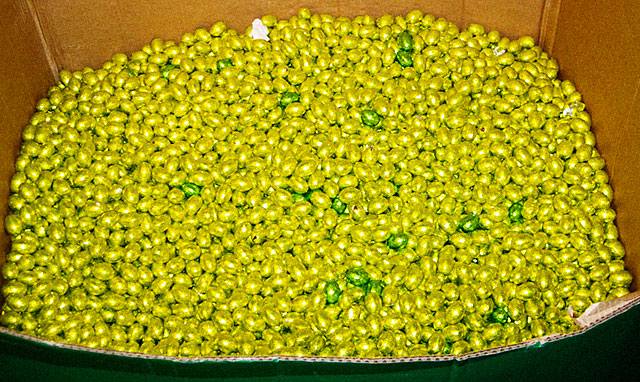
We told the R&D guys they could come up with anything they wanted, as long as it could be thrown together from existing ingredients, cost less than 40 cents to make, and looked enough like dog shit that impressionable lardbutts like you would get a food boner the first time its commercial ran on whatever basic cable reality show keeps you from killing yourself for a week.

→ Kung Fu Grippe, Merlin Mann: A new brown thing you’ll totally eat

Crappy Taxidermy is a visual blog dedicated to exploring the bizarre world of taxidermy. The pictures within are exceptional examples of the strange, the grotesque, and the awful. Though our title may say “crappy” we respect the dedication and talent of the taxidermists who created the works pictured within.

→ About: Crappy Taxidermy
I would kindly like to inform you that I’ve been a vegan for ten years. Unless you count the Snickers bars I ate out of economic necessity when living on in Iceland (where vegetables are paid in installments) in which case I have one more year to go before reaching ten. Ok, let’s rephrase: I decided to switch to a vegan diet ten years ago, and initial Snickers bars notwithstanding, I’m doing well.

To recap: When studying in Karlstad I ran a weekly radio show modeled on Frispel (mentioned previously) where I’d put together a one hour show on a whatever topic I pulled out of my arse. I interviewed a dentist who did hypnosis, a priest about the onthological proof of Gods existence, and this one time I started doing one on milk.

I had spoken to a chef who mentioned that unless the lactal enzyme in our guts have a constant supply of lactose, they disappear and you’re left intolerant. This, he argued, explains why proportionally large number of people in parts of the world are lactose intolerant — milk and other dairy isn’t widely consumed and we producing the enzyme as a result

This is more of less accurate. The enzymes are developed by you own body when you’re young, but with age you stop producing them. Supposedly, this is so that we can be breast-fed as babes, but with the anticipation that we stop drinking milk after we’re weened off it. Historically, milk hasn’t been a staple of human diet so intolerance is common. A majority of all adults in the world are lactose intolerant as a result of the stuff just not being in the food chain.
The first dietician I tried to interview scolded me for not knowing the difference between allergy and intolerance, so I plowed through two books on nutrition and health and return two days later for the interview. I called the Swedish Milk Council (Mjölkfrämjanded, a pro-milk lobby. Originally, named “The Swedish Milk Propaganda” — Wikipedia: Mjölkpropagandan) as well as the National Food Administration and had them comment on a study of osteoporosis prevalence among a group of nurses. Seeing as the report was hosted on MilkSucks.com their reaction was predictably not favourable. (I think they criticized poor methodology)

I barely touched on the whole animal rights issue. As so many others I hadn’t given the question much thought, and found the environmental and health aspects of dairy more interesting. Somewhere in the process of doing the show I came to the conclusion that the only environmentally conscientious thing to do was to switch to a vegetable based diet, which also seemed to be a healthy way of eating.

Of course, now I know that “vegetable” doesn’t always equate “environmentally sound” nor necessarily “healthy” if you take processed foodstuffs into account — even skirting the necessity of B12 supplements. If you are an omnivore who eats with moderation you might not experience the adverse effects of cholesterol and whatnot, and locally raised beef might have a smaller environmental impact than a soybean transported halfway across the globe.
The question of food and where it comes from is very complex, and if you are so inclined I encourage you to read the The State of Food and Agriculture 2009, the yearly report from FAO (the Food and Agriculture Organisation of the United Nations) or why not just skim Wikipedia: Environmental effects of meat production. Of course, once these folks get in vitro meat going we might satisfy the tastes of everyone except those bent on organic food.

Having written that, today it’s the animal rights issue which is the deciding factor for me. There’s overwhelming proof that we’re causing suffering and pain to animals directly by using them for food or other products, and there’s secondary misery caused by the environmental impact of rearing animals. You could do worse than to read All animals are equal, by Peter Singer as a more well-put introduction to “animal rights” than I could give.

It took me 21 years before reaching the conclusion that veganism is a step in the right direction, and I don’t remember anyone else influencing me one way or another, so I try not to preach, but every once in a while I get into a debate on animal rights. It can be fun, but is more often a losing proposition, as illustrated by a thread over in Metafilter, where the subject usually turns into an anti-vegan dogpile for some reason: Operation Pancake.

Also, I have a standing bet with a chef friend that if he can make me a human steak out of someone who hasn’t suffered and the eating of which wouldn’t cause anyone grief, I’d eat it. Rather disgusting, but that’s what you get when debating veganism drunk.

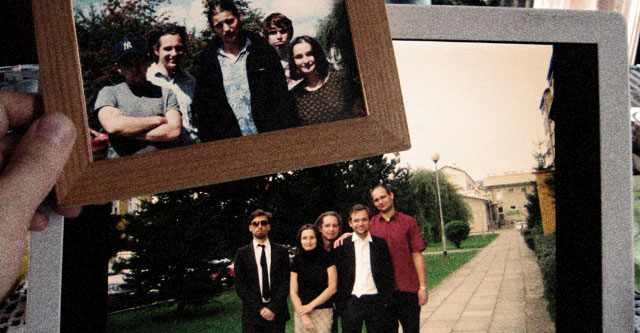
Well fuck. Again.

When I visited Poland with Anna and Andreas a couple of years ago, my paternal grandmother delighted in having new guests for dinner, especially since my veganism interfered with her understanding of proper food. At one point she cried when I asked her to not feed my friends because they were in a hurry to another dinner.

When my maternal grandmother died last fall I stopped by my dads place, and she was bedridden and ill. She’d been on the go for most of her life, but despite the radiation therapy, the cancers were making her worse. Her prediction that it would be the last time we’d meet proved right, and she died Friday morning.

Tomasz is better at keeping in touch with the family, and after a recent visit he mentioned that she only had few months to live. I called her on her birthday afterwards; She was tired and sad. I was planning on visiting in May, when work will ease up a bit; Now that I’m leaving for her funeral, shuffling a few appointments around doesn’t seem like such a big deal that I couldn’t have done it earlier. Odd how ones priorities change.

As far back as I remember her, I remember granma as worrying and caring. Caring often came down to a question of food, as it often seems to do with people who have seen war and scarcity. She would rise early to make dumplings or tenderize pork, and eat either standing up or sitting near the kitchen so that whoever seemed to run out of something would get a refill. Dinner was always a three course affiar.

She worried about her extended family and did her best to accomodate everyone. She’d offer you the clothes off her back, and did so literally — I once complimented her scarf, and later found it packed in my suitcase, next to a container of jam pastries and sandwiches.

She worked as a waitress at a diner in Dalarna when my dad had some business up north, and between running a bed & breadfast in Polanczyk and caring for her son’s families, her work ethic was beyond reproach. She used to sell Amway to do something with her spare time. She would enjoy coffee and cigarettes, promising to quit but laugh when taking up smoking again an hour later.

The last three years she’d become progressively worse, and the last six months, as so often is the case, sucked. For someone who always worked and never wanted to be a bother, her illness added insult to injury. We don’t get to choose, but it would be nice if we could die doing what we love, or that which gives us purpose. It seems unfair that she saw herself become unable to work, then move, and finally even to breath.

End-stage pain is the price the sufferer pays for the survivors to be able to see death as something other than only tragedy, and that helps people to move on, but regardless of how it ends we’re one person short.

Thanks for the memories and storage.

It’s odd what will make you sad.

Between 1998 and 2004 I ran Hotline and KDX servers, dedicated to political material and whatever else I fancied. In a time when online storage was expensive and legally risky, running a small server with files on your home computer felt safe, and if you managed it well you got to know people who would log on to your computer regularly and chat for a bit. I still have chat-logs of conversations ranging from trite bullshit to discussions on abortion and propaganda…

What sets places like a KDX server apart from cloud-hosted communities (Facebook, MySpace, Betapet) is that you actually feel like you’re at someone’s place when you log in. When I was running the Tiny Socialist Server I had a rule that you had to greet everyone who was logged on before downloading anything; It’s common courtesy to at least say “hi” when entering a house, even if all you want to do is to sit on the couch, so I started to kick people out if they logged on and downloaded stuff without greeting the other users. Anarchism requires you to have some fucking manners.

The other day I needed to transfer 7 GB of video so I brought the KDX server back from retirement.

While I was at it, I decided to find an old KDX hangout on which I knew some people, the Documentary Archives. This server was a giant in its time, with scores of users, many of whom I considered some sort of friend. My old bookmarks didn’t work, so I logged into another server — one of the few remaining — to ask if anyone knew where I could find DA or what had happened to it. The response I got was:

[netfreak] I’ve heard of that place but never was on it

I felt both excited and depressed at the same time. Excited because something which I had been a part of now was considered “history” by the newcomers, and depressed because I missed the place; I’ll never find the fragmented, reformatted, erased or mothballed harddrive sectors I remember hanging out at.

Is this how people felt when FidoNet servers started to drop out in favour of WWW, or when their favourite MUD/MUSH shut down? Considering the hundreds, if not thousands, of hours I put in to make my server run smoothly, chatting with people from all over the world, and nesting in general, I feel a personal sense of betrayal that there isn’t even a Wikipedia page dedicated to KDX, to say nothing of the Documentary Archives, only a mention in the Hotline article.

For a time I nourished the idea that I should be logged in somewhere at all times. By running my own server, I could be online and present at a place where others could see me, and often I would log in to servers or join an IRC channel just to be somewhere while I slept. Even though you are not conscious of your surroundings when you sleep, you still exist; And it felt important to think of myself as existing online, not only to me, but as a proof of the possibilities that the net embodied.

This wasn’t about being connected 24/7, but rather an acknowledgement of that you belong at one place at a time — that even if you’re jumping across continents from server to server, your attention is still mediated through a sense of place; Running servers and visiting others’ servers helped me establish who I was — and still am — online.

The feeling of sadness and loss is pure nostalgia though; Today, my presence online isn’t defined by a logged in piece of software, but rather though the ubiquitous connectivity afforded me by my cellphone — alas, the nerd I has merged with the physical me, and we’re once again meat and fat wrapped in a sack of skin, only with a smartphone stuck to the side of the head.

Gay driving.

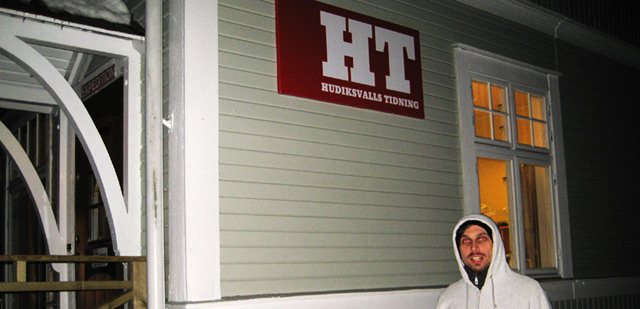
Almost ten years and a score ago, my family made landfall in Sweden and settled down in Hudiksvall. While dad worked at a concrete factory my mom was busy gestating what would become Tomasz. We stayed in Hudiksvall for two years and a week ago I briefly revisited the place.

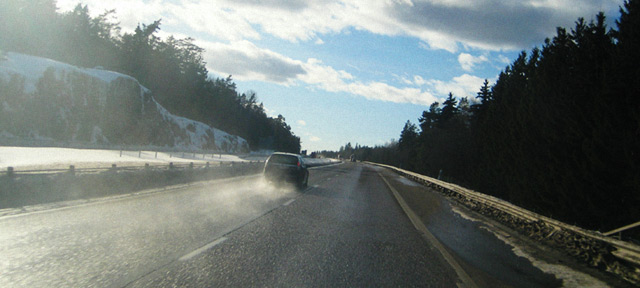
Anna and Jan arranged for Markus Anteskog to show his work Virtual Waters with Skup Palet, and the cheapest way of getting the 1m×1m×1m works to Gothenburg was to rent a lorry and drive 1600 kilometers, returning with both art and artist properly secured.

With a merry “Right ho,” me and Petter set out in a giant Renault early Monday morning. Not five minutes had passed before I was frantically ringing the rental establishment for instructions on how to operate the non-cooperative sound system. They weren’t able to offer any help in the matter, so we turned to the Internet. Using a combination cellphones, wireless broadband and laptops, I soon had a question up on Metafilter and after a couple stops I had wrangled the player into submission. The car rattled too much for my spoken word podcasts to be audible, but Petters supply of rock music tided us over.

After an uneventful journey we met with Markus in Hudiksvall, lifted the God-awfully heavy boxes onto the lorry, and left looking for our hotel. Anna, in a gesture of motherly affection, had found a place north of Hudiksvall which judging from the pictures looked like a manor. Its webpage boasted of a fitness center, sauna and beautiful surroundings. We were to have luxuriant Italian toiletries and designer towels.

Imagine my shock upon discovering that the internets are not always faithful to the truth! The house was big-ish, but a glorified bed-and-breakfast rather than a grand guesthouse; A hard toffee was the only concession to luxury afforded us. The wifi was excellent, but I would gladly have settled for a slower connection in exchange for something more extravagante than Italian soap (no shampoo) and a backed–up shower drain. The towels might have been designed, but as one who has occasionally employed dirty shirts in lieu of traditional devices of absorption, my taste can hardly be called discriminating.

Anna, who had felt that she needed to compensate for the previously mentioned “motherly affection,” had unbeknownst to us called ahead and asked the proprietors to spare no efforts in making our stay as romantic as possible, since I and Petter had been eyeing each other for months and this would be the first time we’d be able to express the gay. Apparently, homosexuality hasn’t been invented in Bergsjö (population 1 243) which would explain the resulting tiptoeing. Also, the mirth expressed at the request of an additional duvet to the king-sized bed was better understood in light of Annas preplanning.

We had dinner at the one pizzeria which was licensed to sell beer, and trudged home. We’d been shown neither sauna nor fitness centre, and soon we fell asleep, with nary a fondle or caress. Breakfast was a toast–and–yoghurt affair, and pretty soon we were off in the truck again. The stereo had regressed to it’s previous state of being a broken piece of crap, and no amount of poking would convince it to work. I tried to entertain with the speaker of my cellphone, but Jay-Z just doesn’t carry the necessary oomph at such meagre volumes. We picked up Markus in Hudiksvall and off we went.

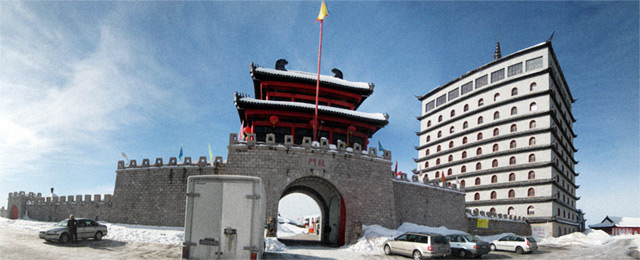
The highlight of the trip was having lunch at Dragon Gate, some twenty kilometres outside of Gävle. It’s an eight story Chinese pagoda with a surrounding wall, where you can eat lunch, get a massage or watch the largest collection of replica terracotta soldiers outside of China. We had spotted the place on our way up, and it was immensely gratifying to stop for a stir-fry, which we enjoyed in a dragon-shaped boat. Petter has already vowed to arrange any future wedding there, and I will most certainly recommend it to anyone going in that direction. The place is other-worldly; A mix of post-apocalyptic Chinese fortification combined with the concept of clave in Diamond Age.

With bellies full of tofu and rice, we continued the uneventful journey home. Long after dusk, with a lingering taste or french fries and coffee we’d picked up, and with lower backs bruised by unforgiving seats, we arrived in Gothenburg. Our precious content was delivered — art and artist in one piece, the latter only slightly worse for the wear — and we went our separate ways, sleeping the sleep of the well deserving. The show opened just the other day, and will be open until 28th March. Check out Skup Palet for more details on hours and so forth.

Proof of value

I’m learning to do silkscreen printing again, and I’m making all the mistakes one would expect; I Overexpose the film, don’t dry the mask properly and forget to harden the emulsion. Too much paint or too little; Too much pressure or too little. And I’m ordering paper samples like there’s no tomorrow.

As much as I look away with poorly hidden mirth when Jan is espousing the merits of one balsamico over another, I’m at the moment hip deep in primers on paper, absorption and paint. So where he has discerning taste buds, I have rough fingertips and Wikipedia. Slave to the geek within.

A month or so ago I became a member of KKV, a workshop for artists doing craft. There are welders, carpenters, printers and potters, and most of them are seriously dedicated to doing stuff by hand. They make me nervous, because I feel like a self-conscious cynic among optimists. This whole thing with materiality, and the high value of craft, sneaks up on me every once in a while. People at KKV talk about stuff as if the stuff was what mattered and not the social interpretation of the stuff.

Because we’re such tactile and fundamentally primitive creatures, it’s easy to understand this drive to interpret ones surroundings directly, and project meaning (and value) onto them so literally. Feel the grain of the paper. Look at the pearl-like coating of the paint. Well. Smell the coffee of fucking post-materiality, you sack of neurons!

Almost immediately when I started printing, I was reminded by a dialogue by Banks in Look Windward, where a human composer and an A.I. discuss the merits of art and the value of labour, when the former is not a result of the latter:

— You have to think like a mountain climber.
— Oh, do I?
— Yes. Some people take days, sweat buckets, endure pain and cold and risk injury and — in some cases – permanent death to achieve the summit of a mountain only to discover there a party of their peers freshly arrived by aircraft and enjoying a light picnic.
— If I was one of those climbers I’d be pretty damned annoyed.
— Well, it is considered rather impolite to land an aircraft on a summit which people are at that moment struggling up to the hard way, but it can and does happen. Good manners indicate that the picnic ought to be shared and that those who arrived by aircraft express awe and respect for the accomplishment of the climbers.
— The point, of course, is that the people who spent days and sweated buckets could also have taken an aircraft to the summit if all they’d wanted was to absorb the view. It is the struggle that they crave. The sense of achievement is produced by the route to and from the peak, not by the peak itself. It is just the fold between the pages.[…]
— How far do I have to take this analogy, Cr Ziller?
— You’ve made your point, but this mountain climber still wonders if he ought to re-educate his soul to the joys of flight and stepping out onto someone else’s summit.

I’ve done three posters so far, all of which in connection with events which Skup Palet has organised. The exhibition Dip To Black with Jesper Norda and Sara Lännerström, a book launch with Signe Vad, and the Textival party this Saturday. We’ve hung original, one-of-a-kind, prints in the rain and sleet as we would any poster; The hand-craft and resources are treated as disposable, instead of being numbered and sold as signed graphic art.

I’m at KKV because I’d like to find a middle ground between worshipping the craft and the idea. What is the value added of me printing posters by hand which just as well have been printed in an inkjet printer? There must be something more to being an artist than just calling them giclée prints, right? Even if you take the errors into account — the diminutive differences between copies caused by human inaccuracy — this bastion of human expression can be substituted with a randomness generator, so what’s the point of doing it by hand?

I’d argue that what I’m adding to the finished object is the time and labour, and more specifically, the marketing of time and labour. You might buy my numbered and signed prints if you knew that there was 40 minutes worth of work behind it, as opposed to the non-effort an inkjet offers. You’re paying for my discomfort so that you can hang my 40 minutes on your wall.

Up to a certain point you can argue that some art is “better” than other, after which it really becomes a question of taste and trends. Beyond a certain limit the inherent value of all that work, the hours learning and thinking and planning, is not something which you see in the resulting object. But if you’re told that it’s the result of six months of suffering and planning and execution? Why, you’d have to be truly monstrous not to appreciate the artistry.

Speaking of objects of desire, two things I want: The Rauschen 4 album and the complete Bembo Book font face family. I just redesigned the Skup Palet business cards, and although the Bembo is nice, I wouldn’t mind the lower x-height; This is what craft has reduced me to, soiling myself over type before the computer at night…

Day of the Triffids: Post-apocalypse made for TV

A while back I read The day of the triffids, a 1951 novel by John Wyndham. It’s a post-apocalyptic tale where one accident leads to another: A cosmic light blinds the majority of the worlds population, and the poisonous, ambulating, and possibly intelligent plants which are being harvested for oil — the eponymous triffids — escape from captivity. So let’s loose a bunch of murderous plants on a blind humanity, leaving the few remaining sighted to help or ignore the suffering. Aaaand, action!

The book starts with Bill Masen waking up in his hospital bed, where he’s been treated for a triffid sting to his eyes. His head is bandaged, so he is unable to see the global borealis which almost everyone else is watching. As luck would have it, this spares his vision, and when the next day neither nurse nor doctor check in on him, he removes his dressing and discovers that everyone is blind but he. In the book, the panic that our protagonist feels is overwhelming, and I found myself mirroring Masens fright at things going bump in the night.

Much like in a zombie story, the humans who have been afflicted walk with outstretched arms, grasping for the non-affected; Wyndham might not have enjoyed killing off civilisation as we know it, but he sure enjoys traumatising his characters:

What was going on was a grim business without chivalry, with no give, and all take, about it. A man bumping into another and feeling that he carried a parcel would snatch it and duck away, on the chance that it contained something to eat, while the loser clutched furiously at the air or hit out indiscriminately. Once I had to step hurriedly aside to avoid being knocked down by an elderly man who darted into the roadway with no care for possible obstacles. His expression was vastly cunning, and he clutched avariciously to his chest two cans of red paint. On a corner my way was blocked by a group almost weeping with frustration over a bewildered child who could see but was just too young to understand what they wanted of it.

As it happens, BBC chose to interpret the book in a two part miniseries, and I had the first episode with breakfast. So far, it’s not all that impressive; The cold war story has become one of nature striking back, and man’s inhumanity to man is business as usual with some people being douche bags. Most of the immense tragedy — millions of Londoners blinded, fighting for food, reassuring their children — is almost glossed over.

No problem in the adaptation seems so big that it can’t be reasoned about; The sense of despair which enthralls the reader is missing, substituted with interpersonal disputes. The actors are more or less convincing, but the script lets them down. Eddie Izzard plays the evil guy, who appears in the book as a fascist character late in the story, but here is an egotistic opportunist, and the main foil for our dislike. We are left not judging the everyday humans who try their best but fail, but Izzards character Terrance who is stopping them from doing their best for his own selfish ends. The triffids become a backdrop in front of which Terrance and Bill fight over the girl, the bereaved radio journalist Jo Playton. The apocalypse happened and the guys are comparing dicks.

The most surprising anti-hero is played by Jason Priestly of 90210 fame, as a brash American who kidnaps the sighted so that they can guide the blind. At the end of the first episode he is redeemed and the audience no longer has to wonder if he’s a good guy or a bad guy. So despite good acting, there’s so little faith in the audience that the story of disaster and new beginnings, becomes one of action and getting the girl.

Of course it’s much more difficult to show someone’s internal struggle on the screen, where you can’t supplement it with your own imagination, but lets draw comparisons with another post-apocalyptic movie: In 28 weeks later there’s a scene where a main character abandons his wife, believing that she’s lost to the zombies. We see him run away from the house where she’s trapped, and he’s sobbing until out of breath — from fright of the zombies, his impotence in the face of the threat, his guilt over the abandon, his grief at losing his wife — leaving us not only conflicted about the moral correctness of his actions, but also with an understanding that there’s a limit to the human reasoning we can marshal under extreme circumstances.

Also, if you’re partial to graphic novels, you might have already heard of Walking Dead, which captures human emotions far better than either 28 days/weeks later or this adaptation of Day of the triffids.

—————-

Update: Part two was crap. The story jumped in time, seemed to skip most of the character developement which might have explained what the hell people are doing — Hey, he’s alive! He’s dead! I don’t trust them! I trust them! —  and hopped from one action sequence to another, lest the audience lose interest. Even if you don’t compare it to the original story, this is just shit storytelling, despite some good acting. Booh!

Fabbing. Now in real time. Or in China. Or at your place.

A couple of weeks ago The Pirate Factory in Malmö demonstrated their RepRap. There’s Flickr pool of the event up here with a shaky video at the end of it. They’re using a spruced up version from Bits from Bytes which looks slightly less dingy than the RepRap usually does (also, it uses a more powerful microcontroller for driving the printer independently of a computer — apparently an SD card is enough) and judging from the pictures there was a bunch of people present. I wonder which of the pictures are going to be used in Swedish school-books in the future, as illustrations of the fabbing revolution and micro-production…

Speaking of which, Wired has an article up on the current state of how manufacturing companies have become accessible to anyone with a credit card, lowering the cost of admission into mass production to more or less zero. Atoms are the new bits is worth your time if you’re the least interested in these matters, or the future in general. It’s full of interesting links, like the one to alibaba.com, an enormous portal of Chinese manufacturers.

I wonder what the environmental costs will be of bespoke production; To some extent you’ll have less hit-and-miss toys occupying landfills, but this gain might well be offset by increased packaging and shipping, or some other corollary. Also, I wonder if these long-tail manufacturing plants will go global or if China and such countries will retain their head start; We in the west will only ever manufacture wars.

If intellectual properties will become impossible to enforce — something which isn’t certain, given the oppressive laws which are passed to counter transparency and openness — this would indeed shift not only the knowledge of how to do something but also the rational for the existence of a specific company. If you can download the plans for a SAAB, you just need someone to manufacture it. In the end, just as globalization has killed the connection between brand and production — after all, the cheap manufacturing plants exist exactly because of the Export Processing Zones in Vietnam and China — it might well kill the last remnant of Company with a capital “c,” the brand with an address.

These realizations are not lost on industry folk, but no-one wants to admit their own obsolescence, thus there’s no hurry to come up with new business models. The exceptions are Threadless of the world, but those start from the bottom up and don’t have to reinvent themselves; Let’s see how well Apple handles the transition — if at all.

Joren De Wachter has written a summation of the coming upheavals — The Return of the Public Domain — and it’s a text targeting those in the manufacturing & design industry. Even though he’s hopeful, or rather, not fearful, of the technological changes which will change intellectual property as we understand it, his text is very thin on the details of how companies will cope, and focus rather on the knowledge workers themselves. (Proffesional Idea Generators, he calls us, which might actually go as an acronym on my next business card)

However, there is also a very clear positive side to the new developments described above for Professional Idea Generators. The new business models that become necessary will clearly provide them with significant competitive advantages for doing business in an environment where the Public Domain is important. Knowledge and expertise, cost effectiveness, continued innovation and networking are key competences of Professional Idea Generators. This puts them in a very strong position in respect of the new developments.

The sentiment seems to be that “someone will still make money, if they just figure out how to add their own knowledge as a value which can be commodified.” As things stand, only those who make stuff will be needed, those who actually have the tools and raw material to manufacture something. Everyone else is part of the Public Domain. And not only figuratively as someone who designs webpages or new pens, but they themselves become part of the commons, and last time I checked there was a tragedy involved in the commons under any scarcity-driven economic model.

You’re going to need a special secret sauce, armed guards keeping it safe for long enough to sell it. And even then you’re either competing for a nieche audience which wants the exclusive, or your elbowing for space with other companies, competing on price.

And here’s a narrative which might seem familiar: Over at The Millions, there’s an interview with a guy who pirates books, and in the comments section some people are upset over a lack of morals. In ten years time, when your kids are printing modified pirated Nikes, maybe the kneejerk debate will be different, but I wouldn’t hold my breath. Home fabbing is killing Nike!

Rocks about to punk ≠ Punks about to rock.

A friend of a friend saw me run around with a camera the other day and asked if I wouldn’t take some pictures of him and his band as they were playing at Henriksberg yesterday. So in skinny jeans and with a leg pouch I climbed all over a small stage, trying to take pictures of The Bang. Usually only my mom asks me to play photographer — “and please don’t make them ‘arty,’ just make them good” — and I’m always nervous whenever I’m supposed to perform. It’s like peeing in public; I’m not a professional enough urinator to be comfortable doing it.

Reviewing the pictured I guess they’re good enough, especially when beaten into submission in post, but it’s so odd looking back at myself and not really remembering what it was I wanted to accomplish with the live shoot. Either you’re documenting live because 1) the light and set and so on are unique enough to warrant taking advantage of the situation, or 2) because you want to document the audience somehow, put the band there and then, bearing witness.

What with every other person in the audience watching the show through viewfinders or cellphone screens, I’d like to see some more effort put into making even concerts like this media friendly. Perhaps a live Bluetooth dump linked to a screen at the bar? Lighting that goes from almost pitch black to living-room, allowing the full range from fanboy to ironic girl to get their desired image. You know, like fenced hunting; The hippo might have nowhere to run, but you’ll still feel rather good about shooting it just so. (As long as you bring ear guards.)

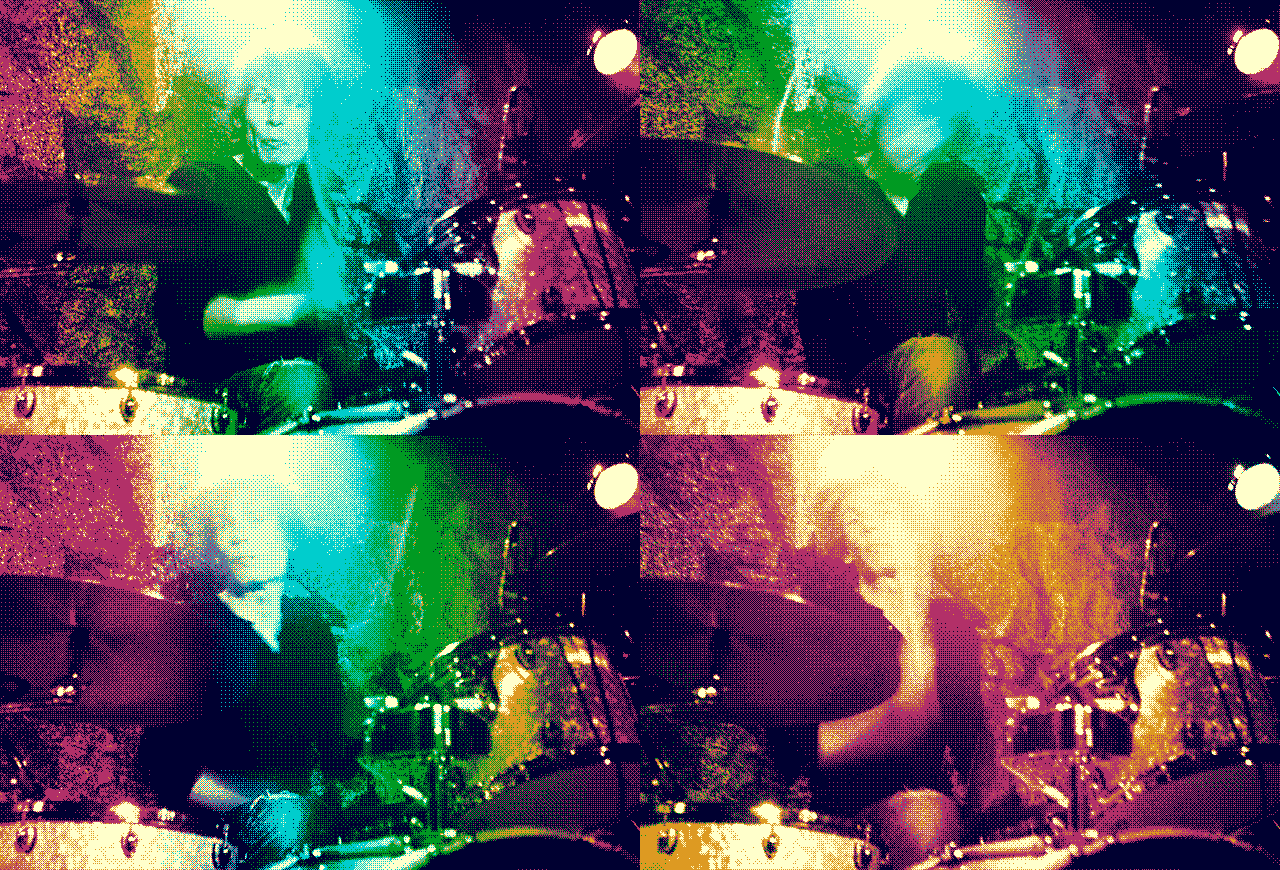
On a side note, I might be coming down with a fever and should go to bed now. Let’s start Monday on a really shiny happy note, shall we? Try not throwing an epileptic fit looking at Jon the drummer above.

In defence of humanity.

Their arms were then hit with a stick. If they gave off a hard, hollow ring, the freezing process was complete. Separately, naked men and women were subjected to freezing temperatures and then defrosted to study the effects of rotting and gangrene on the flesh.

→ Daily Mail, Christopher Hudson: Doctors of Depravity

But Yuasa, who practiced medicine until he was 84, has been active to this day in exposing some of the darkest secrets of the Imperial army. He is propelled by a sense of guilt, as well as the fear that Japan is on a path toward committing the same mistakes again.

→ Japan Times, Jun Hongo: Vivisectionist recalls his day of reckoning

Remember those in prison as if you were their fellow prisoners, and those who are mistreated as if you yourselves were suffering.

→ H-I-M Jail & Prison Ministry: Hebrews 13:3

Robots can take the soldiers’ places, he said. They can continuously keep watch on an area, and if nefarious activity is spotted, “We can take appropriate action. … We can kill those bastards before they plant the IEDs,” he added. That includes mounting a weapon on the robot, he said.

→ National Defense, Stew Magnuson: Failure to field the right robots costs lives

Why are humans so fascinated by robots? Where is the UK’s most innovative robotics research taking place? And how does the biology of the natural world inform robot design and engineering? In this video interview, Noel Sharkey, professor of robotics and AI at the University of Sheffield, discusses developments in robotics – from the proliferation of robots in Japan’s automotive industry to the stair-climbing dexterity of Honda’s Asimo robot and beyond.

→ Silicon, Artificial Intelligence: Noel Sharkey on the inexorable rise of robots (Via Slashdot)

Rather than guiding a missile to its intended target, Arkin’s robotic guidance system is being designed to reduce the need for humans in harm’s way, “… appropriately designed military robots will be better able to avoid civilian casualties than existing human war fighters and might therefore make future wars more ethical.”

→ H+ Magazine, Surfdaddy Orca: Teaching Robots the Rules of War

The US was paying teenagers “thousands of dollars” to drop infrared tags at the homes of al Qaida suspects so that Predator drones could aim their weapons at them, he added. But often the tags were thrown down randomly, marking out completely innocent civilians for attack.

→ The Telegraph: Military killer robots ‘could endanger civilians’

Researchers at the Ecole Polytechnique Fédérale de Lausanne in Switzerland have found that robots equipped with artificial neural networks and programmed to find “food” eventually learned to conceal their visual signals from other robots to keep the food for themselves.

→ Technology Review, Kristina Grifantini: Robots ‘Evolve’ the Ability to Deceive

Fabbing: Been there, done that, made a copy of the copy.

I’m putting together a project description of a workshop I’d like to run. The people I’ve pitched to are enthusiastic, but putting the course into academic-speak is difficult. It’s about 3D printing and other rapid manufacturing technologies, so I’m trying to get my bearings on the state of the art.

I don’t know how I missed the Rhizome article on the subject, Means of Production: Fabbing and Digital Art, as it’s a good primer on how radpid manufacturing is used in modern art. To sum it up: There isn’t much happening and what is happening is mostly concerned with sculptural works.

(Then again, there are trials with printing living cells, so your kids might soon be able to not only pull the legs off spiders, but design and manufacture better legs as replacement…)

Fabbaloo links to a 2001 presentation by Marshall Burns and James Howison which pretty well sums up what I tried to express in the pirate ebay post, when it comes to how our relationship to the object might change:

As in other cases where revenues are in doubt, designers and manufacturers will have to ask themselves what business they are in. In other words, what is it that people will pay them for, what will be their value proposition? Clearly, it will become harder to get paid for the physical arrangement of atoms in a product because that will be too easy for fabbers to make. Even the creative content (“intellectual property”) of a design fades in monetary value because it is too easily duplicated. Link

But now I do have to stop. I simply must. I must put away the Red Bull cans, and stop clicking and typing. I have to stop, so I can print my bed. I have to print my bed, so that I can lie in it.

→ IconEye, Bruce Sterling: The hypersurface of this decade (Via Fabbaloo)

Cornucopia is a concept design for a personal food factory that brings the versatility of the digital world to the realm of cooking. In essence, it is a three dimensional printer for food, which works by storing, precisely mixing, depositing and cooking layers of ingredients.

→ MIT, Fluid Interfaces Group: Cornucopia, Digital gastronomy (Via Shapeways)

On the moon, a research station is being constructed by robots.On top of a gantry, in place of the usual lifting hoist, an automatic arm extends downwards over the station. At the end of this arm, a nozzle squirts a concrete-like material onto the half-built walls like a mechanical hand icing an implausibly large cake. At the same time, computer-controlled trowels shape and smooth the concrete so that it’s flush with the wall below. The whole assembly moves back and forth to build up internal and external walls in layers. Further robotic arms are positioning services inside the building and lifting lintels onto the walls in order to make the roof. In just 24 hours, the house will be complete.

→ Craft, Lee Hasler: A giant leap for a brickie (pdf)

For some reason I start thinking about the space gel ant colony, where the hapless ants are allowed to burrow in 3D space, and out of a solid material create space. When diving last summer the thought struck me that we lack a model of envisioning architecture as a three dimensional space — not strange since we can’t fly, nor swim through the air — except maybe for the astronauts in space, for whom “up” is an arbitrary concept. (Or the IDF soldiers in Gaza, as BLDGBLOG pointed out recently)

Lets assume that 1) we’re extracting space out of matter, not building spaces, but extruding them out of something; destroying material. 2) And into this shapely void which we have made, we introduce objects that we desire – and we don’t build them, or assemble them, but rather extrude them. Need a table? Extrude it. Need somewhere to place the table? Extrude it.

Human will as a metaphor of a factory; Of a digging, burrowing animal, constantly crawling through strata, leaving tunnels behind, filled with the debris of time, want and need, manifested in ABS plastic.