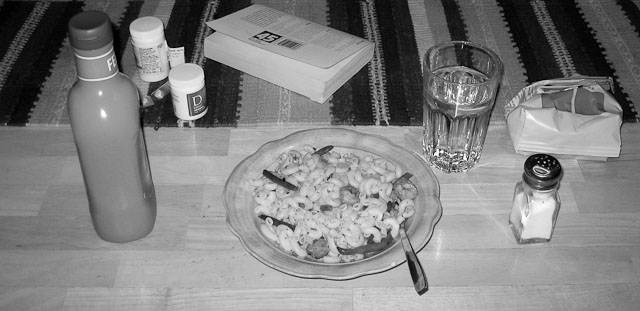
Hi! I’m vegan!

We told the R&D guys they could come up with anything they wanted, as long as it could be thrown together from existing ingredients, cost less than 40 cents to make, and looked enough like dog shit that impressionable lardbutts like you would get a food boner the first time its commercial ran on whatever basic cable reality show keeps you from killing yourself for a week.

→ Kung Fu Grippe, Merlin Mann: A new brown thing you’ll totally eat

Crappy Taxidermy is a visual blog dedicated to exploring the bizarre world of taxidermy. The pictures within are exceptional examples of the strange, the grotesque, and the awful. Though our title may say “crappy” we respect the dedication and talent of the taxidermists who created the works pictured within.

→ About: Crappy Taxidermy

I would kindly like to inform you that I’ve been a vegan for ten years. Unless you count the Snickers bars I ate out of economic necessity when living on in Iceland (where vegetables are paid in installments) in which case I have one more year to go before reaching ten. Ok, let’s rephrase: I decided to switch to a vegan diet ten years ago, and initial Snickers bars notwithstanding, I’m doing well.

To recap: When studying in Karlstad I ran a weekly radio show modeled on Frispel (mentioned previously) where I’d put together a one hour show on a whatever topic I pulled out of my arse. I interviewed a dentist who did hypnosis, a priest about the onthological proof of Gods existence, and this one time I started doing one on milk.

I had spoken to a chef who mentioned that unless the lactal enzyme in our guts have a constant supply of lactose, they disappear and you’re left intolerant. This, he argued, explains why proportionally large number of people in parts of the world are lactose intolerant — milk and other dairy isn’t widely consumed and we producing the enzyme as a result

This is more of less accurate. The enzymes are developed by you own body when you’re young, but with age you stop producing them. Supposedly, this is so that we can be breast-fed as babes, but with the anticipation that we stop drinking milk after we’re weened off it. Historically, milk hasn’t been a staple of human diet so intolerance is common. A majority of all adults in the world are lactose intolerant as a result of the stuff just not being in the food chain.
The first dietician I tried to interview scolded me for not knowing the difference between allergy and intolerance, so I plowed through two books on nutrition and health and return two days later for the interview. I called the Swedish Milk Council (Mjölkfrämjanded, a pro-milk lobby. Originally, named “The Swedish Milk Propaganda” — Wikipedia: Mjölkpropagandan) as well as the National Food Administration and had them comment on a study of osteoporosis prevalence among a group of nurses. Seeing as the report was hosted on MilkSucks.com their reaction was predictably not favourable. (I think they criticized poor methodology)

I barely touched on the whole animal rights issue. As so many others I hadn’t given the question much thought, and found the environmental and health aspects of dairy more interesting. Somewhere in the process of doing the show I came to the conclusion that the only environmentally conscientious thing to do was to switch to a vegetable based diet, which also seemed to be a healthy way of eating.

Of course, now I know that “vegetable” doesn’t always equate “environmentally sound” nor necessarily “healthy” if you take processed foodstuffs into account — even skirting the necessity of B12 supplements. If you are an omnivore who eats with moderation you might not experience the adverse effects of cholesterol and whatnot, and locally raised beef might have a smaller environmental impact than a soybean transported halfway across the globe.
The question of food and where it comes from is very complex, and if you are so inclined I encourage you to read the The State of Food and Agriculture 2009, the yearly report from FAO (the Food and Agriculture Organisation of the United Nations) or why not just skim Wikipedia: Environmental effects of meat production. Of course, once these folks get in vitro meat going we might satisfy the tastes of everyone except those bent on organic food.

Having written that, today it’s the animal rights issue which is the deciding factor for me. There’s overwhelming proof that we’re causing suffering and pain to animals directly by using them for food or other products, and there’s secondary misery caused by the environmental impact of rearing animals. You could do worse than to read All animals are equal, by Peter Singer as a more well-put introduction to “animal rights” than I could give.

It took me 21 years before reaching the conclusion that veganism is a step in the right direction, and I don’t remember anyone else influencing me one way or another, so I try not to preach, but every once in a while I get into a debate on animal rights. It can be fun, but is more often a losing proposition, as illustrated by a thread over in Metafilter, where the subject usually turns into an anti-vegan dogpile for some reason: Operation Pancake.

Also, I have a standing bet with a chef friend that if he can make me a human steak out of someone who hasn’t suffered and the eating of which wouldn’t cause anyone grief, I’d eat it. Rather disgusting, but that’s what you get when debating veganism drunk.

Come together. Right now. Over here.

Over at We Make Money Not Art, there’s a brief description of the work Hello Process which is being exhibited at the Process Becomes Paradigm show. In a related vein, Rhizome just published an editorial by Jacob Gaboury on the art collective JOGGING which are all about process instead of product. JOGGING are indeed mostly interesting in terms of process, as most of the documentation / made for net / performance, is undistinguishable from a Onion parody of art, or perhaps a Mcsweeneys piece.

While each piece may seem unimportant on its own, when viewed as part of a growing collection of work unconcerned with the materiality, permanence, or the importance of the individual piece, any insistence on the auratic quality of the object itself falls away. Indeed the content of each piece is doubly immaterial. Not only do they exist in passing, as documentation, or not at all, they are also unconcerned with the question of quality or importance, and are relevant as process rather than as product.

→ Rhizome, Jacob Gaboury: Immaterial Incoherence: Art Collective JOGGING

It’s through editing we make something beautiful appear. This Youtube choir, bringing together 185 individuals in a performance is inspiring — despite the slightly cheesy look of the stage and conductor Eric Whitacre — not because it resulted in this particular musical arrangement, but because there is a sense of universality to the participant’s ambitions. There’s a common denominator which becomes visible exactly because it’s mediated through a webcam, each video independently recorded. It’s the audience performing for itself.

The arrangement of the singers and panning over their individual videos in faux 3D also changes the interpretation of the piece; Compare the feeling of this version to the previous experiment he did, Sleep, in which all videos are arranged on a flat grid. The edit of Sleep creates a monumental feeling of the choir, whereas Lux Aurumque seems made up of individuals acting in concert. [Via The Technium]

As an aside, my name appears in an Excel file at one of the largest dairy producers in Sweden, Arla, since I sent in a bogus recipe containing cottage cheese to a competition. I don’t know if I’ve won anything, but judging from the other entries (all visible in the same document) I’m not the only one who’ve fibbed a love to that product. Twohundredandeightysix other people filled sent in their recipes to win whatever it was one could win. Imagine if you could get 287 people to spend those five minutes working doing some work for you, paying all of them fractionally more for their time than they stand to gain on average from a competition and thereby creating a win-win! What would you do with those 24 hours of labour? Or is an XLS-file with slogans enough?

Editing the point of view.

A couple of months ago there was a outrage and general brouhaha over an how ACORN — an organisation which helps underclass folk in US with getting bank loans and such — supposedly was advising a pimp & hooker couple on how to start a child prostitution business. It turned into a giant shitstorm, and it’s only now that the dust has settled and the source material has been examined that a more true version of the story is emerging.

→ MSNBC: Rachel Maddow explains how Fox News bought and sold the ACORN story. [Via Media Matters]

“This place,” says Bahram, shouting somewhat, it’s amazing. You can’t imagine! The schools, the hospitals, the way they live! And nothing is done by hand, even the baking, even cleaning the street. They have these little carts, just press a button. The police, they smile at you and say “hej.”

→ From our own correspondents, Monica Whitlock: Adjusting to Swedish life after the Andjian massacre

[audio:https://monocultured.com/blog/wp-content/uploads/2010/04/Monica_Whitlock.mp3|titles=Adjusting to Swedish life after the Andjian massacre|artists=BBC, Monica Whitlock]

I do not want to prescribe a means of viewing images of Fabienne’s death. I am interested in informing the public about the photographers who witnessed and recorded the event.

Prison Photography, Pete Brook: Fabienne Cherisma [via A Photo Editor]

But what makes it all such good fun is the element of surprise. No matter how much you practise or prepare, many of your best mammal behaviour shots will be of moments you hardly remember – because they happened so fast. These are the ones that make all that effort worthwhile.

→ BBC Wildlife Magazine, Mark Carwardine: Mammal Behaviour [scroll down for individual PDF]

Compelling narratives.

Thomas Bey William Bailey over at Vague Terrain has an analysis of Modern Warfare 2. It’s a bit too uptight for my taste, but it balances the lavish superlatives I’ve heaped on the game quite nicely. His objection is that because of the extremely compelling narrative of games like these, we’re fed a bunch of propaganda and taught a manufactured history of the world. This is completely true. Thomas critiques isn’t limited to this game but rather highlights the possibilities for nefarious uses which the medium can be put to. The FPS Americas Army is in its third iteration, and they have spun it off into a graphic novel as well — the first story unironically entitled Knowledge is Power — but they get a free pass since it’s an obvious recruitment tool for the US army.

As Walter Benjamin mentions (in an essay you might have noticed lately) film, like architecture, is an art form which you learn to appreciate by habit and osmosis, rather than contemplation. Computer games have the grandiose scenarious of movies, as well as the tactility of architecture (since you’re able to navigate the world and develop an appreciation of the physics of the place.) so they really act as a multiplier of knowledge and narrative. (Regardless of their relationship to fact, mind you)

The exciting thing with photo-realistic games isn’t that we might end up with a Matrix-like scenario where we won’t be able to distinguish between ‘reality’ and ‘not-reality’ but that our memories of events will be messed up. Are you remembering something which you experienced in the ‘real world’ or the surreal world? We don’t have to mess up our physical perception of things for this technology to be scary, only our remembrance of things. Look at how much importance we place on photography as an external memory, and multiply that.

I know that I have created historical narratives based on nothing else than the tech tree in Civilization, so obviously I give more credence to a story than to static statements of fact; And since we experience the stories of computer games first hand, we might absorb the sentiments expressed even more readily. MW2 is a kick-ass game exactly because it fits within the narrative which the West has spun, and which countless action movies has reinforced — it’s “as close to reality as you get” exactly because it’s a narrative which is fictionalized from start to finish.

To paraphrase: Guns don’t kill people. People who live in a world where guns are seen as necessary responses to certain crises, kill people. Political action is necessary if we’d like to change the story, and it would be awesome if computer games could be a change for good, instead of only mirroring an already dominant narrative of how the world works and who we are as humans.

[flv:https://monocultured.com/blog/wp-content/uploads/2010/02/PBS_The_War_by_Ken_Burns.flv https://monocultured.com/blog/wp-content/uploads/2010/02/PBS_The_War_by_Ken_Burns.jpg 640 360]

A more upbeat rider to this story comes from the podcasting world, where fictional parallel universes are less flat and predictable than in MW2:

Myke Bartlet has continued writing and podcasting stories in the Salmon & Dusk universe. The latest short story, Yesterday came too soon, is a nice introduction to his stuff if you don’t feel like starting on a longer series. As previously mentioned, Mykes reading is half the enjoyment of his podcast, not cause the stories are so-so, but cause his tempo and timbre is excellent. Go listen.

Fabbulousness and the taste of masses.

Bruce Sterling allowed Starship Sofa to podcast his novella The Kiosk the other day, and it’s two hours well spent if you’re in the least interested in the (possible) disruptive tendencies of fabbing and rapid manufacturing. Go listen to it before it disappears, then come back here. (You can skip the first ten minutes to get to the story)

Skip the first ten or so minutes, which are of more interest to sci-fi people rather than you, and take notes on which predictions you agree with. Having listened to the story, I had to remind myself that rapid prototyping is still in its infancy and not a foregone conclusion, lest I give up on it in favour of something more bleeding edge.

Fabbing. Now in real time. Or in China. Or at your place.

A couple of weeks ago The Pirate Factory in Malmö demonstrated their RepRap. There’s Flickr pool of the event up here with a shaky video at the end of it. They’re using a spruced up version from Bits from Bytes which looks slightly less dingy than the RepRap usually does (also, it uses a more powerful microcontroller for driving the printer independently of a computer — apparently an SD card is enough) and judging from the pictures there was a bunch of people present. I wonder which of the pictures are going to be used in Swedish school-books in the future, as illustrations of the fabbing revolution and micro-production…

Speaking of which, Wired has an article up on the current state of how manufacturing companies have become accessible to anyone with a credit card, lowering the cost of admission into mass production to more or less zero. Atoms are the new bits is worth your time if you’re the least interested in these matters, or the future in general. It’s full of interesting links, like the one to alibaba.com, an enormous portal of Chinese manufacturers.

I wonder what the environmental costs will be of bespoke production; To some extent you’ll have less hit-and-miss toys occupying landfills, but this gain might well be offset by increased packaging and shipping, or some other corollary. Also, I wonder if these long-tail manufacturing plants will go global or if China and such countries will retain their head start; We in the west will only ever manufacture wars.

If intellectual properties will become impossible to enforce — something which isn’t certain, given the oppressive laws which are passed to counter transparency and openness — this would indeed shift not only the knowledge of how to do something but also the rational for the existence of a specific company. If you can download the plans for a SAAB, you just need someone to manufacture it. In the end, just as globalization has killed the connection between brand and production — after all, the cheap manufacturing plants exist exactly because of the Export Processing Zones in Vietnam and China — it might well kill the last remnant of Company with a capital “c,” the brand with an address.

These realizations are not lost on industry folk, but no-one wants to admit their own obsolescence, thus there’s no hurry to come up with new business models. The exceptions are Threadless of the world, but those start from the bottom up and don’t have to reinvent themselves; Let’s see how well Apple handles the transition — if at all.

Joren De Wachter has written a summation of the coming upheavals — The Return of the Public Domain — and it’s a text targeting those in the manufacturing & design industry. Even though he’s hopeful, or rather, not fearful, of the technological changes which will change intellectual property as we understand it, his text is very thin on the details of how companies will cope, and focus rather on the knowledge workers themselves. (Proffesional Idea Generators, he calls us, which might actually go as an acronym on my next business card)

However, there is also a very clear positive side to the new developments described above for Professional Idea Generators. The new business models that become necessary will clearly provide them with significant competitive advantages for doing business in an environment where the Public Domain is important. Knowledge and expertise, cost effectiveness, continued innovation and networking are key competences of Professional Idea Generators. This puts them in a very strong position in respect of the new developments.

The sentiment seems to be that “someone will still make money, if they just figure out how to add their own knowledge as a value which can be commodified.” As things stand, only those who make stuff will be needed, those who actually have the tools and raw material to manufacture something. Everyone else is part of the Public Domain. And not only figuratively as someone who designs webpages or new pens, but they themselves become part of the commons, and last time I checked there was a tragedy involved in the commons under any scarcity-driven economic model.

You’re going to need a special secret sauce, armed guards keeping it safe for long enough to sell it. And even then you’re either competing for a nieche audience which wants the exclusive, or your elbowing for space with other companies, competing on price.

And here’s a narrative which might seem familiar: Over at The Millions, there’s an interview with a guy who pirates books, and in the comments section some people are upset over a lack of morals. In ten years time, when your kids are printing modified pirated Nikes, maybe the kneejerk debate will be different, but I wouldn’t hold my breath. Home fabbing is killing Nike!

In defence of humanity.

Their arms were then hit with a stick. If they gave off a hard, hollow ring, the freezing process was complete. Separately, naked men and women were subjected to freezing temperatures and then defrosted to study the effects of rotting and gangrene on the flesh.

→ Daily Mail, Christopher Hudson: Doctors of Depravity

But Yuasa, who practiced medicine until he was 84, has been active to this day in exposing some of the darkest secrets of the Imperial army. He is propelled by a sense of guilt, as well as the fear that Japan is on a path toward committing the same mistakes again.

→ Japan Times, Jun Hongo: Vivisectionist recalls his day of reckoning

Remember those in prison as if you were their fellow prisoners, and those who are mistreated as if you yourselves were suffering.

→ H-I-M Jail & Prison Ministry: Hebrews 13:3

Robots can take the soldiers’ places, he said. They can continuously keep watch on an area, and if nefarious activity is spotted, “We can take appropriate action. … We can kill those bastards before they plant the IEDs,” he added. That includes mounting a weapon on the robot, he said.

→ National Defense, Stew Magnuson: Failure to field the right robots costs lives

Why are humans so fascinated by robots? Where is the UK’s most innovative robotics research taking place? And how does the biology of the natural world inform robot design and engineering? In this video interview, Noel Sharkey, professor of robotics and AI at the University of Sheffield, discusses developments in robotics – from the proliferation of robots in Japan’s automotive industry to the stair-climbing dexterity of Honda’s Asimo robot and beyond.

→ Silicon, Artificial Intelligence: Noel Sharkey on the inexorable rise of robots (Via Slashdot)

Rather than guiding a missile to its intended target, Arkin’s robotic guidance system is being designed to reduce the need for humans in harm’s way, “… appropriately designed military robots will be better able to avoid civilian casualties than existing human war fighters and might therefore make future wars more ethical.”

→ H+ Magazine, Surfdaddy Orca: Teaching Robots the Rules of War

The US was paying teenagers “thousands of dollars” to drop infrared tags at the homes of al Qaida suspects so that Predator drones could aim their weapons at them, he added. But often the tags were thrown down randomly, marking out completely innocent civilians for attack.

→ The Telegraph: Military killer robots ‘could endanger civilians’

Researchers at the Ecole Polytechnique Fédérale de Lausanne in Switzerland have found that robots equipped with artificial neural networks and programmed to find “food” eventually learned to conceal their visual signals from other robots to keep the food for themselves.

→ Technology Review, Kristina Grifantini: Robots ‘Evolve’ the Ability to Deceive

Fabbing: Been there, done that, made a copy of the copy.

I’m putting together a project description of a workshop I’d like to run. The people I’ve pitched to are enthusiastic, but putting the course into academic-speak is difficult. It’s about 3D printing and other rapid manufacturing technologies, so I’m trying to get my bearings on the state of the art.

I don’t know how I missed the Rhizome article on the subject, Means of Production: Fabbing and Digital Art, as it’s a good primer on how radpid manufacturing is used in modern art. To sum it up: There isn’t much happening and what is happening is mostly concerned with sculptural works.

(Then again, there are trials with printing living cells, so your kids might soon be able to not only pull the legs off spiders, but design and manufacture better legs as replacement…)

Fabbaloo links to a 2001 presentation by Marshall Burns and James Howison which pretty well sums up what I tried to express in the pirate ebay post, when it comes to how our relationship to the object might change:

As in other cases where revenues are in doubt, designers and manufacturers will have to ask themselves what business they are in. In other words, what is it that people will pay them for, what will be their value proposition? Clearly, it will become harder to get paid for the physical arrangement of atoms in a product because that will be too easy for fabbers to make. Even the creative content (“intellectual property”) of a design fades in monetary value because it is too easily duplicated. Link

But now I do have to stop. I simply must. I must put away the Red Bull cans, and stop clicking and typing. I have to stop, so I can print my bed. I have to print my bed, so that I can lie in it.

→ IconEye, Bruce Sterling: The hypersurface of this decade (Via Fabbaloo)

Cornucopia is a concept design for a personal food factory that brings the versatility of the digital world to the realm of cooking. In essence, it is a three dimensional printer for food, which works by storing, precisely mixing, depositing and cooking layers of ingredients.

→ MIT, Fluid Interfaces Group: Cornucopia, Digital gastronomy (Via Shapeways)

On the moon, a research station is being constructed by robots.On top of a gantry, in place of the usual lifting hoist, an automatic arm extends downwards over the station. At the end of this arm, a nozzle squirts a concrete-like material onto the half-built walls like a mechanical hand icing an implausibly large cake. At the same time, computer-controlled trowels shape and smooth the concrete so that it’s flush with the wall below. The whole assembly moves back and forth to build up internal and external walls in layers. Further robotic arms are positioning services inside the building and lifting lintels onto the walls in order to make the roof. In just 24 hours, the house will be complete.

→ Craft, Lee Hasler: A giant leap for a brickie (pdf)

For some reason I start thinking about the space gel ant colony, where the hapless ants are allowed to burrow in 3D space, and out of a solid material create space. When diving last summer the thought struck me that we lack a model of envisioning architecture as a three dimensional space — not strange since we can’t fly, nor swim through the air — except maybe for the astronauts in space, for whom “up” is an arbitrary concept. (Or the IDF soldiers in Gaza, as BLDGBLOG pointed out recently)

Lets assume that 1) we’re extracting space out of matter, not building spaces, but extruding them out of something; destroying material. 2) And into this shapely void which we have made, we introduce objects that we desire – and we don’t build them, or assemble them, but rather extrude them. Need a table? Extrude it. Need somewhere to place the table? Extrude it.

Human will as a metaphor of a factory; Of a digging, burrowing animal, constantly crawling through strata, leaving tunnels behind, filled with the debris of time, want and need, manifested in ABS plastic.

And he spake onto them: Readeth this!

In Grand Theft Auto, no misbehavior is so grievous that it can’t be washed away after a quick trip to the police station or the hospital. That conceit works well for gameplay, but it hinders the narrative by suggesting a world in which even the gravest actions have no meaning. How could we buy Lady Macbeth’s “Out, damn’d spot! Out, I say!” if she could have just headed to the nearest Pay’n’Spray?

→ Escapist magazine, Brendan Main: Fall of the house Bellic

We’re pleased to announce a new addition to our shop, in the shape of If Drawings Were photographs – the first ever zine published by It’s Nice That. The brainchild of designer Rob Matthews and Illustrator Tom Edwards, put simply – “Tom gave drawings to Rob and Rob tried to make them into photographs.”

→ It’s Nice That, Alex: If drawings were photographs Via Wakaba

Avatar Machine is a wearable system which replicates the aesthetics and visuals of third person gaming, allowing the user to view themselves as a virtual character in real space via a head mounted interface. The system potentially allows for a diminished sense of social responsibility, and could lead the user to demonstrate behaviors normally reserved for the gaming environment. Via Jonas

This product was originally designed to be: Impossible for child to suck the thumb while wearing, Unrestrictive and fun to wear, Extremely difficult for child to remove. The function of the Thumb Guard is to prevent the seal made around the thumb with the child’s lips. Without this seal, there can be no suction, which is the main source of pleasure in sucking the thumb.

→ Amazon.com: Stop Thumb Sucking with Thumb Guard Kit for One Hand

Fabbing, contd.

Desktop Factory might be the LaserWriter of additive manufacturing. Priced at under $5000 it’s cheaper than the LaserWriter was, and would allow individuals to buy it for themselves or collectives to scrounge funds together. I would love to play around with it; Barring too high running costs (think of the ink in printers) you could do limited edition runs of stuff.

Maybe the RapMan would be good starting kit for a workshop on building and using 3D printers? I’m actually more interested in building the kits than I am using them, but I guess that the practical applications will reveal themselves once I know what can be done. Or whenever I need a new filterholder for a on-camera-flash or something such.

In the end, I’d probably do what everyone does when confronted with a creative outlet with endless possibilities and print genitalia. But it would be a rapidly prototyped genitalia how cool wouldn’t that be!

The link to Desktop Factory came via Fabbaloo, an excellent fabbing blog with a silly name. Then again, once the 3D printing revolution happens and your ten year old kids will print the latest manga characters, they might very well shout “Faa-baa-loooo!” so perhaps it’s just good brand positioning on their part.

Barn_pa_garden_med_svard

copenhagen_art_fair_hund

Over at blog.ponoko.com there’s a debate in the comments section about how object models will be pirated, and what effects this will have on the designers and manufacturers of stuff. It’s odd how similar the discussion is to the one about music and movie piracy.

Morals don’t always dictate if we pirate or don’t, but rather convenience. What is considered ethical will be adjusted to the technological lowest common denominator, just as will the job market. It’s not a fair way of going about it, but I don’t know how designers of stuff will make a living in a post-fab world, nor how they can hope to stem the tide of obsolescence. Sitting back with some popcorn and watch the slowly dawning realisation on the faces of panicked designers might become the new spectator sport.

Fabb it all and let the added value sort the back end, maybe? This approach hasn’t prevailed among the more litigious media companies, nor curbed their enthusiasm of that business model. I don’t see the future of fabbing to be any different.

In Neal Stephensons book The Diamond Age nano-manufacturing is a reality. People use matter compilers (MC) to make food or clothes or anything else that they might need or want. (Similar to the cornucopia machines of Charles Stross Singularity Sky, the acronym of which is CM, curiously enough) As long as they have the blueprints for something, they can build it. As long as you have access to a feed line you can use it to make stuff. (This is part of what fabbing might offer, even though we’re far off from nano-assembly)
In the book there’s talk of the seed, a concept where you’ll have self-contained seeds that can grow into whatever you’d like. The difference being that their energy stores are self-contained and wouldn’t have to rely on a centrally controlled feed, much like a seed draws upon the earth and surrounding nutrients when growing. One variation on this theme is presented on by Sascha Pohflepp in the work Growth Assembly, a series of drawings reminiscent of the Codex Seraphinianus but with real-world application instead of high fantasy.

eskil_pallazzo_dj

As for fabbing in art, I still haven’t found much worth mentioning. I might be looking in all the wrong places though.

Peter Jansen did a sculpture series, Strange Attractors, using 3D printing to create molds which are then cast in bronze. the shapes themselves are created using the Chaoscope software, which itself is used to generate representations of strange attractors (something I’m wholly unqualified to tell you anything about except that it’s related to chaos theory) examples of which you can see in their gallery. They make for pretty pictures, and to someone who understands the math involved I’m sure there’s an theoretically beautiful part that is unknowable to the rest of us, but it’s just not very interesting. Casting them in bronze doesn’t add much conceptual value to them, neat though it might be.

A better beginning would perhaps be Peters Human Motion series, but I’m not certain if they’re fabbed or traditionally sculpted and cast. As a comment of a technology on its relationship to space and previous art — Nude Descending and Muybridges studies of motion — it might be an interesting statement of intent. But halting there, making the object itself the work of art, would be dull. As it stands I don’t even know if the motion series was fabbed, but one would hope that there will be more to the tech than mere convenience for sculptors. Not that I begrudge them that, mind.

The link to Peter Jansen came via Metafilter: Human Motions