Take me to those stars.

I’ve lived in Gothenburg for almost as many years as I’ve wanted to visit the star observatory in the park, and not until yesterday did I actually go. Bus 60 took me and Sara to the top of the hill, and after a while Olle and Helga joined us at the small building which houses four telescopes and dioramas left over from other, probably upgraded, museums.

At the observatory, a gawky guide shuffled us around telescopes swaying in the wind, requiring constant adjustment to remain fixed on the Pleiades or twinkly Sirius. The stars look nothing like in the movies, and even less like the colour-composite images NASA releases. Turns out that when you’re looking closely at bright dots, what you see is slightly larger bright dots, and even more dots around those. It’s dots all the way, so to say, which was the sentiment of one vocal woman, who exclaimed “you have got to be bloody shitting me, I can see as much in my binoculars at home!” It was a tense moment, and with the exception for a brat who just wouldn’t shut the hell up — his parents resigned to his annoying existence — twenty or so people held their breath, expecting the woman to lay into the poor, bumbling, guide. She was somewhat placated by seeing the Andromeda galaxy.

At the end of it all, we got to see some constellations and their constituent stars, and even got to see a blurry Saturn with a blurry ring. According to the other guide — the jovial one with the nose ring — this popping of ones Saturn cherry is a big moment in any stargazers career, and we did our best to feel properly awed. It was very nice to see it for real, and next time I’ll be in a city with a bigger telescope I’ll do my best to sneak a peek at the other planets. Not buying my own telescope yet though.

Wednesday: a day, well, spend

In any other city I wouldn’t hesitate to move about, but here in Warsaw I have old habits and they are difficult to break. My expensive Apple phone finally became useful with some creative use of offline maps and the GPS, and me and Tomasz managed to bus about with a minimum of confusion and lost time. Tomorrow we’re heading to a barn and then to a commentator for an interview; we’re actually watching the guy on TV right now, and I’m trying to come up with a lighting strategy. Somehow, it’s far simpler to tell other people how to take pictures than to improvise yourself, but I’m sure I’ll figure something out.

The Internets did lie to me as for the weather – I was told, in no uncertain terms, that there’d be 8 degrees and sunny today, but I really should have packed something besides my optimistic jacket. Also, I ought to be a better brother to my brother and get him a present, seeing as it’s his birthday today. (Which reminds me that I missed Matildas birthday three days ago. Oh well, I guess we’re even now)

[x_video_embed no_container=”true”][/x_video_embed]

We go to country. No, other country

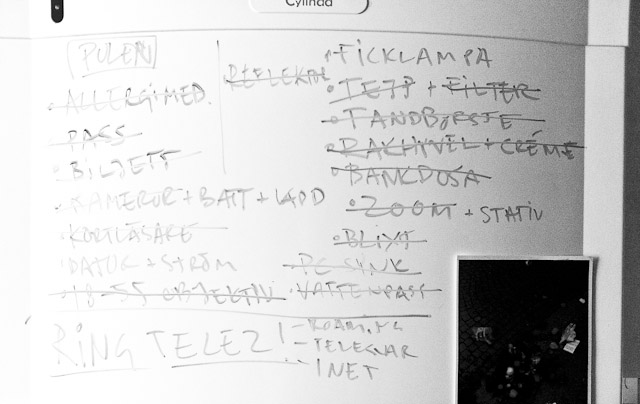
Fridges are ultimate todo-lists, I’ve discovered. I’m going to Poland for a couple of days with my brother. I haven’t been for a while except for funerals, so it’s a good change of pace tagging along to something which is less depressing. I don’t know how I’ll fit all the orders for Zubrowka, but I’ll manage somehow. I might be difficult to get hold of, but SMS ought to work as usual. If there are requests, I might upload video and stuff! How about that!

Adjustable table: adult rollercoaster

[x_video_embed no_container=”true”][/x_video_embed]

Last fall I got a grant in order to take some time off, buy some equipment, read a book and hopefully produce some new art. Perhaps not surprisingly, I’ve done fuck-all since I got that grant except working on non-art related things. What the grant money did get me — in addition to a very nice knife, new running shoes and tights, an unending supply of freshly squeezed juice and some new in-ear-headphones — is some peace of mind and a bourgeois disposition. Just cause I’m not flat out broke, I suddenly felt that getting a stockbroker account was a “sound idea” and it feels as though I’m spiraling into a bad habit which will end up with me crashing at the end anyway, when I’m back to hand-to-mouth.

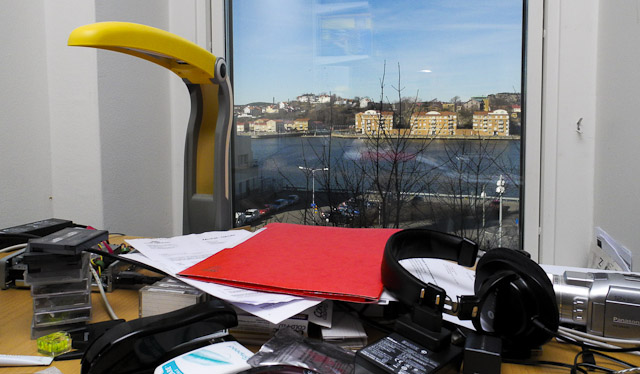
The new apartment is nice enough but I keep putting off inviting people. I don’t know if it’s cause I’ve still not gotten around to getting a proper lamp in the hall, where the rechargeable flashlight is getting electronically incontinent, or if I’m in a reclusive state of mind of late. I have an adjustable table which goes up and down at the touch of a button, and standing at it I can watch the ferries pass my window, which is nice and occasionally disconcerting, creating an illusion of the whole building moving. I would have liked to have learned the names of the ships by now but they don’t seem to stick. Perhaps I need a diagram.

Earlier today, my barber Hasse told me of a friend of his who, having spent his life and career on land, decided to fulfill his dream and signed on to a ship at the age of 57. He had dreamed of going to sea for all his life, and when he finally badgered the shipping line to give him a chance he concluded after the three month stint that it sucked balls. The moral being that you set some goals for yourself in life, and even if those don’t become fulfilled at least you did some fun stuff along the way, made some good friends and didn’t start a genocide or something similarly awful. As morals go, it’s not that bad.

Well, fuck. Sorta.

When my paternal grandmother died last spring, we stopped by in Sanok to check in with my fathers father. Although not totally estranged, the relationship wasn’t very cordial and he hadn’t yet met dads second wife of fifteen years, nor their kids. The meeting was short and somewhat strained, but since grandfathers refusal of taking chemotherapy had left him with only a handful of months to live, dad thought he’d make an effort.

The previous occasion that I’d spoken to him had been almost ten years ago. Dad called me up on Iceland while visiting grandfather who had taken ill, and asked that I talk with him. I told shortly of what I was doing and where I was, and he sounded very weak and grateful that I’d taken the time to speak with him. The stories I’ve heard about him has him pegged as a dick, and perhaps illness had brought awareness of this to the foreground.

Regardless of his feelings, he died two weeks ago from metastasized cancers. When we met him in spring he had a brisk step and keen, albeit weary eyes. He’d cut back on the amount of work and now went to his tailors studio only to keep himself occupied during the days. He was living with a woman who cared for him, and if he was wanting for anything it was certainty that he’d die with dignity, which he’d found lacking as of late.

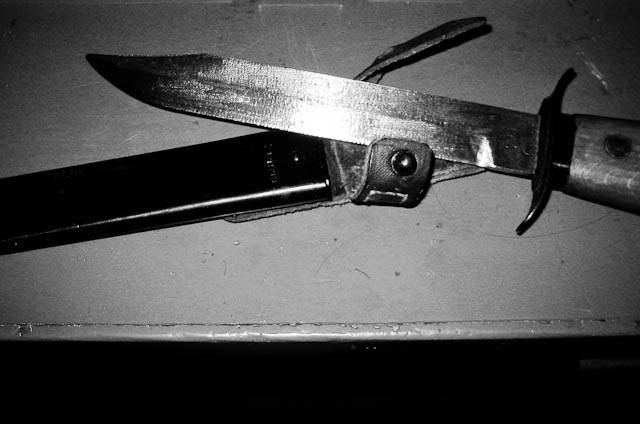
When I last saw him, I was ten or twelve. He gave my brother a straight razor and me a paratrooper knife. “When the Russians attack at least you can take one with you” he said. Mom confiscated the razor. I used the knife when I parachuted ten years ago, but have not killed any Russians. My brother went to the funeral a week ago, while I stayed at home, tied to work, sending my regards to those left behind, and from afar.

Now both my parents are without parents.

Graphic artists deserve financial advisors.

I was invited to a group exhibition in Marstrand earlier this year, and last weekend I travelled there for the opening. Marstrand is an island a bit up the coast from Gothenburg, part of the northern archipelago, and in the summer its population of ≈1500 swells to include thousands of rich people who like to park their boats and buy expensive art. Or rather, they like to dock their yachts and buy expensive windbreakers.

We were ten artist from the KKV graphic workshop who’d put together a show, and the day after the opening I was guarding the exhibition. Having put on my most charming T-shirt and demeanor, I welcomed fifty or so visitors during the day, answering questions about techniques to the best of my ability (having to admit that I know nothing about photopolymers) and generally being pleasant and accommodating to all prospective patrons.

I was out of my element. Most of the others exhibiting had done this before, but besides their experience I found the lack of irony the oddest. Most people I know would balk at titling their works “Revenge” or “Woman” and would certainly not expect me to keep a straight face if they did. Having said that, the works represent a tremendous amount of labour, because heaven knows lithography isn’t a time-efficient way of creating images.

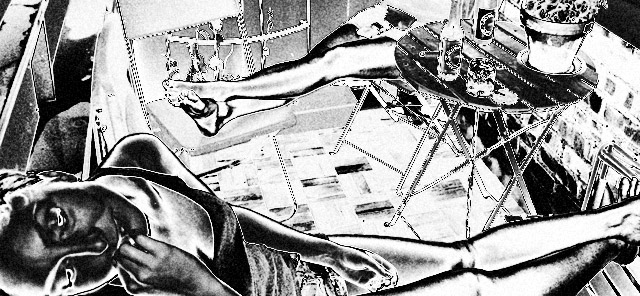
I’m mostly doing screen printing — when you do it as an artist you call it “serigraphy” — and it’s a messy process prone to failure and general fucking-upingness. Last time, the paint I was working with was giving me lip, and with the addition of a poorly cured screen I only got ten good copies out of 10 hours worth of printing, and close to fifty large sheets of shieet.

On the day I was guarding the exhibition, I had to compile a new list of works and their asking price since some changes had been made, and I started thinking about how the prices related to the works. People who are not used to buying art might dismiss pricing as a result of wishful thinking and whims of artists, but there is a pattern to the pricing which I’ve been trying to suss out. On recommendation of Jazzin over at Faas I started in on Why are artists poor?, a book by economist and artist Hans Abbing. I’m only through the first few chapters, but his discussion on the value and pricing of art mirrors what I’ve been thinking whenever I take a step back from the screenprinting vacuum table, surveying the value that I’ve somehow added.

Except what someone would expect to pay for the materials — paper, screen, chemicals, paint, studio rent — I’m adding my own time and labour, as well as whatever skills and knowledge I can verify or we can agree upon. This is measurable and would be quite easy to put a price on using the same model as you’d use for evaluating how much to pay your carpenter, for two differences. It’s difficult to estimate how much demand there is for art, and there’s also very little to judge a “proper” artist by, allowing for an unlimited supply of people who would consider themselves artist. “I could do that, and so could my dog and therefore it’s not proper art!” so to speak.
So that which sets the work of an artist in general apart from a carpenter — the aura using Benjamin — is not appraised by traditional supply & demand if we’re talking fine art, but rather a gray area of value embodied. What is the value added that isn’t measurable straight on? (This doesn’t necessarily apply when it’s a particular artist who is in demand, since per definition those who hold that specific artist in demand view an art object by that artist as having a value intrinsic to that relationship, and there’s only so many works one person can produce.)

Regardless of what in a work that we like, we might divide our way of arriving at the value in a few different ways, which will put us in different segments of art buyers.

1. The work is beautiful in itself, with as little reference to the notion of “art” as possible. (–Seurat-Le Bec du Hoc à Grandcamp renders the cliff and waters beautifully.)

2. The work is good because is comments on itself and gives an interesting understanding of what “art” is or could be. (–Georges Seurat demonstrates how by viewing we create a coherent image)

3. The artist’s story or oeuvre is interesting enough to confer value to the individual work.
(–Let’s hang this sucker next to Renoir just to piss Seurat off!)

As an example, lets say that I take fifteen of the twenty copies that exist of a certain print, and staple them up downtown as “regular posters.” What the weather doesn’t destroy, some kids take home, and I’m now left with five posters out of a set of 20. For all intents and purposes I might as well just have produced five copies to begin with, which would have merited a higher price per copy.

But since the 15 copies that weather and kids took were not bought at my set price — in fact, the audience for “taking a poster off a wall home” and “buying fine art” doesn’t overlap much — this would very likely be considered by prospective buyers as an indication that I myself don’t accept the face value of my own art and I’ve now sown distrust among graphic buyers regarding my artistic credibility and/or the merits of my work.

There’s of course a possible positive corollary to this destruction: My stapling of the 15 posters could be considered as an “artistic action in itself” and indirectly increase the value of my remaining five posters.

Actions such as the one above will affect your status among artists and buyers. But price seems to have a particular place in how some kinds of buyers value works, and it seems possible that if your prices are too high you are pricing yourself out of the market, but if your prices are too low, you are pricing yourself out of a market. In other words: If you’re too expensive, your patrons will wait until you lower your price — the demand is still there but it doesn’t agree or can’t meet your price. But if you price yourself below a certain level, you can’t easily hike your prices up again since you no longer have the same market available to you. Your “price slumming” has left you tainted, as it were.

[x_video_embed no_container=”true”][/x_video_embed]

Back again to the “creating value” part. If “art value” only is “social value” then we still should be able to agree on what exactly it is that we’re valuing. And here I guess that people have different understanding of what art is. Many people have an understanding of art as something that has to do with pure æsthetics. Ignore the notion that æsthetics are socially constructed, and you have people talking about beauty and form and colour and so on. Listening in on the conversations at the show, many people expressed their approval of certain works as being very “energetic” or “pleasing”, and having read over the descriptions of the work (someone wanted to express their interest in dancing, for example) they could judge a work on how closely the work aligned with their own ideas of how dancing might be represented.

I think my works failed on the expectation that proper graphic art shouldn’t be too funny. “Funny” means that there’s a joke that you have to get, and if you don’t get it you’d have to pretend-laugh and you don’t want to be found laughing at a fart joke, and so you don’t laugh and then the work’s not good. (I could be over-thinking a bowl of sour grapes here.)

No-one asked for prices on the three graphic works I participated with. No-one bought anything at all while I was there in fact, but did check out a few of the other works and asked for prices. No-one was thrown by the prices, and this could have three possibilities.

1. They agree to the worth of the work in itself. (This is worth 3000SEK to me)
2. They know the graphics market and know that the prices are within range of what could be expected. (This would usually cost around 3000SEK)
3. They don’t want to admit otherwise, for personal or social reasons. (I don’t want to seem uncultured, but Jeezus Christ on a crutch I wouldn’t take it if it was free)

I’m thinking of tiering some works as an experiment, and see that might work out. When you’re working with print you can do drastic changes in material without changing your matrix, so I’m thinking of doing a set of more expensive prints alongside cheaper ones, without losing any artistic aura in the process, but stratifying them socially.

The show was a learning experience, and I’m even more motivated than previously to make good work and let it find its market organically rather than shoehorning it into a pre-existing mold. And of course, if you’re interested in acquiring a poster, get in touch.
Ode to Nook: Reading ebooks in an eink eworld.

My awesome mother gave me an ebook reader as birthday present, which sorta proves that if you bitch, whine and drop hints like a rabbit shits, someone will give in. I have tons of stuff which I’m slowly transferring to the Nook, and reading is encroaching on my podcast listening which is a good thing. There’s no app for organizing your documents on the computer, so I’m using the competent but ass-ugly Calibre for this. I might not be paying enough attention, or I might just have low tolerance for stupid interfaces, but using Calibre isn’t very efficient. Unfortunately there are no alternatives. I’ve found an app for syncing Instapaper articles which works like a charm though. (Ephemera)

All in all, I enjoy using the Nook. It’s easy enough to use and once you get used to reading on a computer device in broad daylight you’ll be annoyed with all the gadgets which aren’t legible in direct light. E ink is awesome and very pleasant to read — not quite like paper but miles beyond LCD screens. (Although if you spend your days in murky settings you might go for the backlit iPad.) It’ll be interesting to see how the usability will change once winter and darkness comes.

I jailbroke the Nook but had little use for it. Using Internet over 3G would be useful if there was a good RSS app and/or syncing with a desktop app like Evernote, so jailbreaking might become more interesting once the proper Android apps are adapted for the Nook LCD.

The battery only lasts some 400 page turns over three days, but Barnes & Noble seem to consider it within acceptable levels. I concede that it’s not an undue burden to charge the thing every other night, but it galls me that they’re advertising it as lasting for 10 days with “normal use” without mentioning that “normal use” is “up to one hour per day.” Their support personell is quick to respond but are writing straight from a flowchart — I don’t know if it’s corporate culture or unmotivated kids, but if they replaced them with scripts they’d still improve on service and “the human touch.”

Because I’m a positive and creative person I express my disappointment through poetry in odd meter. If you can get someone to read this with a deep voice and British accent I will send you a present. Until then, imagine Ian McKellen doing a dramatic reading:


Quite a device, my Nook
it’s swell in the sun!
People stop and stare,
it fails to impress no-one.
As long as it works,
it works rather fine.
So I’ve grown quite fond
of this Nook of mine.

But compared with your ads,
“foul!” ring my cries,
the sparkle and shine,
mostly mirrors and lies
“go to page” is a “feature”
we got with point four.
as if skipping pages
was unheard of before.

Browsing books is a pain,
all’s one big directory,
Sorting Gutenberg documents
like colon endoscopy.

No apps for the desktop
is vexing indeed
While non-standard USB
make hairlines recede.

I don’t mind that it scratches,
dulls or is slow,
But wish your support wasn’t also.
They read from a sheet,
and not my complaint,
perhaps y’all lay off the lead paint?

Quite a device, my Nook
it’s nimble and fun!
People stop and ask,
and I recommend it to some.
As long as it works,
it works rather fine.
So despite Barnes and Noble
I’m fond of this Nook of mine.

Exfoliating hate using super-reality.

I have no pictures of the weekend before midsummer because my skills failed me. Or in more practical terms: I relaxed the crap out of myself and couldn’t be arsed to take pictures. Sara, I and Petter left for the countryside for a couple of days, staying at his cottage an hour north of Gothenburg. I slept until late noon, had a breakfast consisting of more than oats, and then sat with a coffee on the porch, forcing my way through the shittier parts of the Nights Dawn trilogy.

The whole experience was such a sensory overload of idyllic post-card super-reality it had me giggling. It’s difficult to take such an experience seriously. It’s not only that I’m slightly high-strung and can’t really relax properly, but also because reading a book for five hours straight is something so unproblematic by body doesn’t know what to do with itself. This hasn’t happened since I was a teenager, and since then relaxing into a book has been rather more difficult.

Had Bambi showed up and fallen asleed in my lap it wouldn’t have made the place and experience any less extreme. This kind of existence is what is allured to when advertising a product which is supposed to appeal to a sense of Sweden. Only the hangover on Sunday reminded me of home, but even that was soothed by wind, water and dozing off on the porch.

Apparently, my cracking knuckles found their way into Saras snoozing. I would make for a really poor ninja, but we knew that already. Polish people aren’t ninjas, we dress in fur hats and kill people from horseback. Failing that, we charm our friends into helping us in the garden.

[x_video_embed no_container=”true”][/x_video_embed]

Where green things are.

Remember that allotment garden me and Olle were queuing for last summer? Well, three weeks ago I got a call with an offer to sign up for a 46 m² lot. It’s been left fallow for a year, so except a few raspberry bushes there’s not much there except w a whole bunch of weeds. I took some pictures and posted them to ask.metafilter which yielded some answers, and I’m constantly asking other people for advice, with the hope of actually learning something here.

As things stand, and with Olle away on vacation and leaving me with dictatorial power, there will be heritage potatoes, unions and possibly tulips here. Failing that, whatever will take.

Work as progress.

— Mateusz, you handsome devil, what is it that you do for a living?

I get this question more often than you’d think, even though the phrasing might be slightly different. My mother, for example, might sigh “Have you got a proper job yet?”

Every once in a while I go through an identity reassessment, especially when sketching a new version of the blog or a business card, or when I stumble upon a piece of insight like Merlin Manns “Watching the Corners: On Future-Proofing Your Passion” — the premise of which is that we hang our identity on old merits long after those merits have ceased to be relevant.

What got me thinking was my first ever end-of-semester gift I received from the students at Chalmers.

I teach courses in photography at community collages in Gothenburg (Folkuniversitetet & Medborgarskolan), and I work as a guest tutor at the international Master of architecture and urban planning studios with Ana Betancour at Chalmers and KTH, teaching people how not to fuck up public presentations, discussing the value of film as an analytical tool in architectural practice and generally asking future architects stuff which I wouldn’t ask if I’ve had architectural schooling.

Many of them don’t seem to know why they want to be architects, nor is there any consensus regarding what an architect does, so the area is ripe for someone like me to come in and ask what they think they are doing — it’s great fun.

The photography courses present a rather mixed crowd, from people who’ve taken pictures their whole life and who just want to learn the digital end of it, to people who’ve become parents and want to document their toddlers with the shiny dSLR the friendly salesperson sold them. I draw diagrams of focal length and JPEG compression algorithms.

That’s the tofu and potatoes of my life, and it’s pretty awesome. Teaching keeps you on your toes and I’ve learned to draw on the eclectic knowledge I’ve amassed, working with people to reach interesting conclusion and alternative angles to problems. The work description could be “talking with people” but in my more interesting moments, and with enough caffeine pills, I become an apophenic Eliza, channeling the on/off-lined world.

I haven’t done freelance media work for a while, but should anyone want to give me money for recording their seminar, proofread their dissertation or photograph something I could give references and manage it. So the question of how I make money is easy enough to answer, but the problem arises when it bleeds into my understanding of who I am, especially when there’s a discrepancy.

For example: I’m not paid to do art. I occasionally apply for grants, which in a sense amounts to spec work, and I do art works and publish them on/off-line, but I’m not getting paid for it. I do it, and my formal art-education opens up related fields (e.g. the urban architecture courses) but it’s not my livelihood per se. I know that this shouldn’t bias me against seeing myself as an artist, but I have always had the notion that one is in part one’s job description, and ones job is the thing one does for money. So if you describe yourself as someone who does something for which you’re not getting paid, the jump to describing yourself as monetarily worthless isn’t big. It’s a way of thinking which is hard to shake.

All this doesn’t interfere with what I actually do, as I’m doing more art now than before, but it’s a shift in perspective which I’m adjusting to.