Funeral. Photography as coping mechanism.

After four days of travel to and from the funeral, I’m back in Gothenburg. Playing chess in granmas room felt odd with her not present, and suddenly every medicin and picture on her dresser took on new meanings. The blanket I’d used as a backdrop for her portrait was on her bed, and our youngest half-brother was sitting on it, dispensing dubious chess advice.

Once in Sanok, seeing relatives I hadn’t seen for years was truly a memento mori moment — gray hairs, walking canes, half-serious comments of “it’s us next” over dinner and photo albums. The jovial uncle who used to tell dirty jokes now tells of the dirty jokes he told the nurses when recovering from surgery.

Below are all the pictures I took in chronological order. I don’t know what grandma would have thought of the video, but she might’ve asked if doing it hadn’t made me hungry, and perhaps I ought to have some dumplings.

Well fuck. Again.

When I visited Poland with Anna and Andreas a couple of years ago, my paternal grandmother delighted in having new guests for dinner, especially since my veganism interfered with her understanding of proper food. At one point she cried when I asked her to not feed my friends because they were in a hurry to another dinner.

When my maternal grandmother died last fall I stopped by my dads place, and she was bedridden and ill. She’d been on the go for most of her life, but despite the radiation therapy, the cancers were making her worse. Her prediction that it would be the last time we’d meet proved right, and she died Friday morning.

Tomasz is better at keeping in touch with the family, and after a recent visit he mentioned that she only had few months to live. I called her on her birthday afterwards; She was tired and sad. I was planning on visiting in May, when work will ease up a bit; Now that I’m leaving for her funeral, shuffling a few appointments around doesn’t seem like such a big deal that I couldn’t have done it earlier. Odd how ones priorities change.

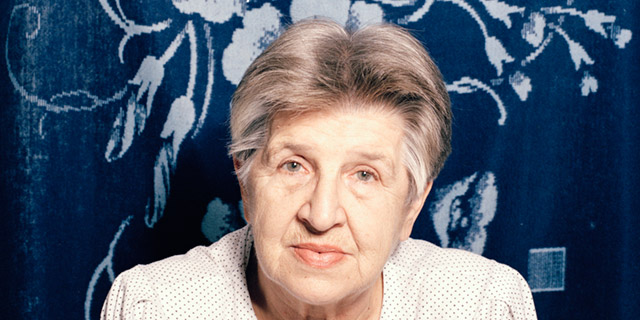
As far back as I remember her, I remember granma as worrying and caring. Caring often came down to a question of food, as it often seems to do with people who have seen war and scarcity. She would rise early to make dumplings or tenderize pork, and eat either standing up or sitting near the kitchen so that whoever seemed to run out of something would get a refill. Dinner was always a three course affiar.

She worried about her extended family and did her best to accomodate everyone. She’d offer you the clothes off her back, and did so literally — I once complimented her scarf, and later found it packed in my suitcase, next to a container of jam pastries and sandwiches.

She worked as a waitress at a diner in Dalarna when my dad had some business up north, and between running a bed & breadfast in Polanczyk and caring for her son’s families, her work ethic was beyond reproach. She used to sell Amway to do something with her spare time. She would enjoy coffee and cigarettes, promising to quit but laugh when taking up smoking again an hour later.

The last three years she’d become progressively worse, and the last six months, as so often is the case, sucked. For someone who always worked and never wanted to be a bother, her illness added insult to injury. We don’t get to choose, but it would be nice if we could die doing what we love, or that which gives us purpose. It seems unfair that she saw herself become unable to work, then move, and finally even to breath.

End-stage pain is the price the sufferer pays for the survivors to be able to see death as something other than only tragedy, and that helps people to move on, but regardless of how it ends we’re one person short.

Editing the point of view.

A couple of months ago there was a outrage and general brouhaha over an how ACORN — an organisation which helps underclass folk in US with getting bank loans and such — supposedly was advising a pimp & hooker couple on how to start a child prostitution business. It turned into a giant shitstorm, and it’s only now that the dust has settled and the source material has been examined that a more true version of the story is emerging.

→ MSNBC: Rachel Maddow explains how Fox News bought and sold the ACORN story. [Via Media Matters]

“This place,” says Bahram, shouting somewhat, it’s amazing. You can’t imagine! The schools, the hospitals, the way they live! And nothing is done by hand, even the baking, even cleaning the street. They have these little carts, just press a button. The police, they smile at you and say “hej.”

→ From our own correspondents, Monica Whitlock: Adjusting to Swedish life after the Andjian massacre

[audio:https://monocultured.com/blog/wp-content/uploads/2010/04/Monica_Whitlock.mp3|titles=Adjusting to Swedish life after the Andjian massacre|artists=BBC, Monica Whitlock]

I do not want to prescribe a means of viewing images of Fabienne’s death. I am interested in informing the public about the photographers who witnessed and recorded the event.

Prison Photography, Pete Brook: Fabienne Cherisma [via A Photo Editor]

But what makes it all such good fun is the element of surprise. No matter how much you practise or prepare, many of your best mammal behaviour shots will be of moments you hardly remember – because they happened so fast. These are the ones that make all that effort worthwhile.

→ BBC Wildlife Magazine, Mark Carwardine: Mammal Behaviour [scroll down for individual PDF]

Thanks for the memories and storage.

It’s odd what will make you sad.

Between 1998 and 2004 I ran Hotline and KDX servers, dedicated to political material and whatever else I fancied. In a time when online storage was expensive and legally risky, running a small server with files on your home computer felt safe, and if you managed it well you got to know people who would log on to your computer regularly and chat for a bit. I still have chat-logs of conversations ranging from trite bullshit to discussions on abortion and propaganda…

What sets places like a KDX server apart from cloud-hosted communities (Facebook, MySpace, Betapet) is that you actually feel like you’re at someone’s place when you log in. When I was running the Tiny Socialist Server I had a rule that you had to greet everyone who was logged on before downloading anything; It’s common courtesy to at least say “hi” when entering a house, even if all you want to do is to sit on the couch, so I started to kick people out if they logged on and downloaded stuff without greeting the other users. Anarchism requires you to have some fucking manners.

The other day I needed to transfer 7 GB of video so I brought the KDX server back from retirement.

While I was at it, I decided to find an old KDX hangout on which I knew some people, the Documentary Archives. This server was a giant in its time, with scores of users, many of whom I considered some sort of friend. My old bookmarks didn’t work, so I logged into another server — one of the few remaining — to ask if anyone knew where I could find DA or what had happened to it. The response I got was:

[netfreak] I’ve heard of that place but never was on it

I felt both excited and depressed at the same time. Excited because something which I had been a part of now was considered “history” by the newcomers, and depressed because I missed the place; I’ll never find the fragmented, reformatted, erased or mothballed harddrive sectors I remember hanging out at.

Is this how people felt when FidoNet servers started to drop out in favour of WWW, or when their favourite MUD/MUSH shut down? Considering the hundreds, if not thousands, of hours I put in to make my server run smoothly, chatting with people from all over the world, and nesting in general, I feel a personal sense of betrayal that there isn’t even a Wikipedia page dedicated to KDX, to say nothing of the Documentary Archives, only a mention in the Hotline article.

For a time I nourished the idea that I should be logged in somewhere at all times. By running my own server, I could be online and present at a place where others could see me, and often I would log in to servers or join an IRC channel just to be somewhere while I slept. Even though you are not conscious of your surroundings when you sleep, you still exist; And it felt important to think of myself as existing online, not only to me, but as a proof of the possibilities that the net embodied.

This wasn’t about being connected 24/7, but rather an acknowledgement of that you belong at one place at a time — that even if you’re jumping across continents from server to server, your attention is still mediated through a sense of place; Running servers and visiting others’ servers helped me establish who I was — and still am — online.

The feeling of sadness and loss is pure nostalgia though; Today, my presence online isn’t defined by a logged in piece of software, but rather though the ubiquitous connectivity afforded me by my cellphone — alas, the nerd I has merged with the physical me, and we’re once again meat and fat wrapped in a sack of skin, only with a smartphone stuck to the side of the head.

Gay driving.

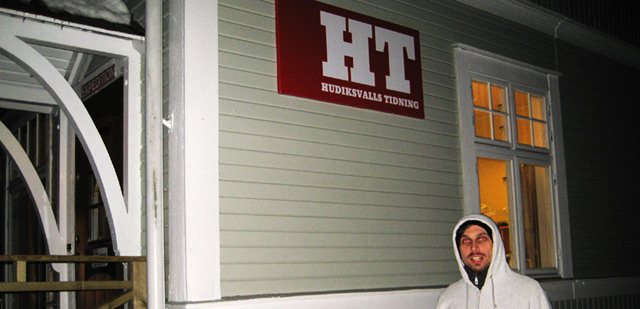
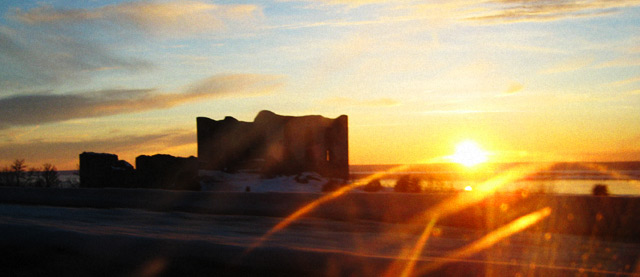
Almost ten years and a score ago, my family made landfall in Sweden and settled down in Hudiksvall. While dad worked at a concrete factory my mom was busy gestating what would become Tomasz. We stayed in Hudiksvall for two years and a week ago I briefly revisited the place.

Anna and Jan arranged for Markus Anteskog to show his work Virtual Waters with Skup Palet, and the cheapest way of getting the 1m×1m×1m works to Gothenburg was to rent a lorry and drive 1600 kilometers, returning with both art and artist properly secured.

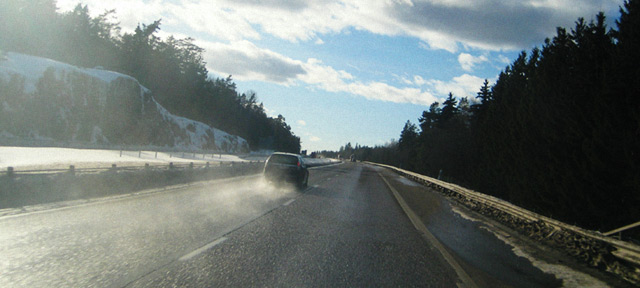
With a merry “Right ho,” me and Petter set out in a giant Renault early Monday morning. Not five minutes had passed before I was frantically ringing the rental establishment for instructions on how to operate the non-cooperative sound system. They weren’t able to offer any help in the matter, so we turned to the Internet. Using a combination cellphones, wireless broadband and laptops, I soon had a question up on Metafilter and after a couple stops I had wrangled the player into submission. The car rattled too much for my spoken word podcasts to be audible, but Petters supply of rock music tided us over.

After an uneventful journey we met with Markus in Hudiksvall, lifted the God-awfully heavy boxes onto the lorry, and left looking for our hotel. Anna, in a gesture of motherly affection, had found a place north of Hudiksvall which judging from the pictures looked like a manor. Its webpage boasted of a fitness center, sauna and beautiful surroundings. We were to have luxuriant Italian toiletries and designer towels.

Imagine my shock upon discovering that the internets are not always faithful to the truth! The house was big-ish, but a glorified bed-and-breakfast rather than a grand guesthouse; A hard toffee was the only concession to luxury afforded us. The wifi was excellent, but I would gladly have settled for a slower connection in exchange for something more extravagante than Italian soap (no shampoo) and a backed–up shower drain. The towels might have been designed, but as one who has occasionally employed dirty shirts in lieu of traditional devices of absorption, my taste can hardly be called discriminating.

Anna, who had felt that she needed to compensate for the previously mentioned “motherly affection,” had unbeknownst to us called ahead and asked the proprietors to spare no efforts in making our stay as romantic as possible, since I and Petter had been eyeing each other for months and this would be the first time we’d be able to express the gay. Apparently, homosexuality hasn’t been invented in Bergsjö (population 1 243) which would explain the resulting tiptoeing. Also, the mirth expressed at the request of an additional duvet to the king-sized bed was better understood in light of Annas preplanning.

We had dinner at the one pizzeria which was licensed to sell beer, and trudged home. We’d been shown neither sauna nor fitness centre, and soon we fell asleep, with nary a fondle or caress. Breakfast was a toast–and–yoghurt affair, and pretty soon we were off in the truck again. The stereo had regressed to it’s previous state of being a broken piece of crap, and no amount of poking would convince it to work. I tried to entertain with the speaker of my cellphone, but Jay-Z just doesn’t carry the necessary oomph at such meagre volumes. We picked up Markus in Hudiksvall and off we went.

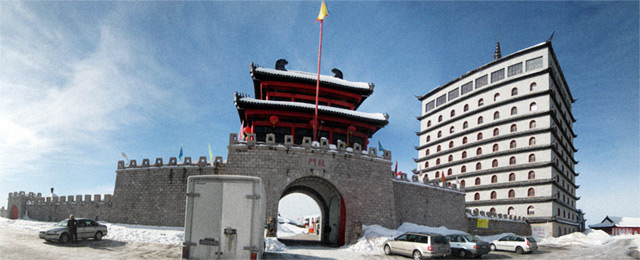
The highlight of the trip was having lunch at Dragon Gate, some twenty kilometres outside of Gävle. It’s an eight story Chinese pagoda with a surrounding wall, where you can eat lunch, get a massage or watch the largest collection of replica terracotta soldiers outside of China. We had spotted the place on our way up, and it was immensely gratifying to stop for a stir-fry, which we enjoyed in a dragon-shaped boat. Petter has already vowed to arrange any future wedding there, and I will most certainly recommend it to anyone going in that direction. The place is other-worldly; A mix of post-apocalyptic Chinese fortification combined with the concept of clave in Diamond Age.

With bellies full of tofu and rice, we continued the uneventful journey home. Long after dusk, with a lingering taste or french fries and coffee we’d picked up, and with lower backs bruised by unforgiving seats, we arrived in Gothenburg. Our precious content was delivered — art and artist in one piece, the latter only slightly worse for the wear — and we went our separate ways, sleeping the sleep of the well deserving. The show opened just the other day, and will be open until 28th March. Check out Skup Palet for more details on hours and so forth.

The work of art in the age of mechanical reproduction. Part 18: Epilogue

Part 18 covers the epilogue of Walter Benjamins 1935 essay “The work of art in the age of mechanical reproduction.” It’s the longest part of the text, so I encourage you to warm your wrist up, and maybe consider a short break in the middle. As usual, we’re using the Andy Blunden version of the essay which you can find through Wikipedia (Although you know this already, since you’ve done the previous tutorials, right?)

With this, this course on how to write art theory comes to an end. I’d like to thank you for your patience and perseverance, and I hope that you feel it has been time well spent. Hopefully you’re more confident in your ability to write art theory, and I wish you good look in your future endeavors, be they professional or private!

Don’t hesitate to get in touch if you have questions or comments regarding this or any other episode, or would like some advice on how to further hone your writing skills.

Proof of value

I’m learning to do silkscreen printing again, and I’m making all the mistakes one would expect; I Overexpose the film, don’t dry the mask properly and forget to harden the emulsion. Too much paint or too little; Too much pressure or too little. And I’m ordering paper samples like there’s no tomorrow.

As much as I look away with poorly hidden mirth when Jan is espousing the merits of one balsamico over another, I’m at the moment hip deep in primers on paper, absorption and paint. So where he has discerning taste buds, I have rough fingertips and Wikipedia. Slave to the geek within.

A month or so ago I became a member of KKV, a workshop for artists doing craft. There are welders, carpenters, printers and potters, and most of them are seriously dedicated to doing stuff by hand. They make me nervous, because I feel like a self-conscious cynic among optimists. This whole thing with materiality, and the high value of craft, sneaks up on me every once in a while. People at KKV talk about stuff as if the stuff was what mattered and not the social interpretation of the stuff.

Because we’re such tactile and fundamentally primitive creatures, it’s easy to understand this drive to interpret ones surroundings directly, and project meaning (and value) onto them so literally. Feel the grain of the paper. Look at the pearl-like coating of the paint. Well. Smell the coffee of fucking post-materiality, you sack of neurons!

Almost immediately when I started printing, I was reminded by a dialogue by Banks in Look Windward, where a human composer and an A.I. discuss the merits of art and the value of labour, when the former is not a result of the latter:

— You have to think like a mountain climber.
— Oh, do I?
— Yes. Some people take days, sweat buckets, endure pain and cold and risk injury and — in some cases – permanent death to achieve the summit of a mountain only to discover there a party of their peers freshly arrived by aircraft and enjoying a light picnic.
— If I was one of those climbers I’d be pretty damned annoyed.
— Well, it is considered rather impolite to land an aircraft on a summit which people are at that moment struggling up to the hard way, but it can and does happen. Good manners indicate that the picnic ought to be shared and that those who arrived by aircraft express awe and respect for the accomplishment of the climbers.
— The point, of course, is that the people who spent days and sweated buckets could also have taken an aircraft to the summit if all they’d wanted was to absorb the view. It is the struggle that they crave. The sense of achievement is produced by the route to and from the peak, not by the peak itself. It is just the fold between the pages.[…]
— How far do I have to take this analogy, Cr Ziller?
— You’ve made your point, but this mountain climber still wonders if he ought to re-educate his soul to the joys of flight and stepping out onto someone else’s summit.

I’ve done three posters so far, all of which in connection with events which Skup Palet has organised. The exhibition Dip To Black with Jesper Norda and Sara Lännerström, a book launch with Signe Vad, and the Textival party this Saturday. We’ve hung original, one-of-a-kind, prints in the rain and sleet as we would any poster; The hand-craft and resources are treated as disposable, instead of being numbered and sold as signed graphic art.

I’m at KKV because I’d like to find a middle ground between worshipping the craft and the idea. What is the value added of me printing posters by hand which just as well have been printed in an inkjet printer? There must be something more to being an artist than just calling them giclée prints, right? Even if you take the errors into account — the diminutive differences between copies caused by human inaccuracy — this bastion of human expression can be substituted with a randomness generator, so what’s the point of doing it by hand?

I’d argue that what I’m adding to the finished object is the time and labour, and more specifically, the marketing of time and labour. You might buy my numbered and signed prints if you knew that there was 40 minutes worth of work behind it, as opposed to the non-effort an inkjet offers. You’re paying for my discomfort so that you can hang my 40 minutes on your wall.

Up to a certain point you can argue that some art is “better” than other, after which it really becomes a question of taste and trends. Beyond a certain limit the inherent value of all that work, the hours learning and thinking and planning, is not something which you see in the resulting object. But if you’re told that it’s the result of six months of suffering and planning and execution? Why, you’d have to be truly monstrous not to appreciate the artistry.

Speaking of objects of desire, two things I want: The Rauschen 4 album and the complete Bembo Book font face family. I just redesigned the Skup Palet business cards, and although the Bembo is nice, I wouldn’t mind the lower x-height; This is what craft has reduced me to, soiling myself over type before the computer at night…

The work of art in the age of mechanical reproduction. Part 17

In this episode we’re writing the last chapter of Walter Benjamins 1935 essay “The work of art in the age of mechanical reproduction,” as translated by Andy Blunden. Once we’re done with this chapter, only the epilogue remains. This episode is rather long and clocks in at around one hour, so you might want to prepare for taking a break halfway.

By now you know the drill, and hopefully you’re feeling more confident of your ability to write art theory. Good on you! If you have any questions or comments, please get in touch.

Compelling narratives.

Thomas Bey William Bailey over at Vague Terrain has an analysis of Modern Warfare 2. It’s a bit too uptight for my taste, but it balances the lavish superlatives I’ve heaped on the game quite nicely. His objection is that because of the extremely compelling narrative of games like these, we’re fed a bunch of propaganda and taught a manufactured history of the world. This is completely true. Thomas critiques isn’t limited to this game but rather highlights the possibilities for nefarious uses which the medium can be put to. The FPS Americas Army is in its third iteration, and they have spun it off into a graphic novel as well — the first story unironically entitled Knowledge is Power — but they get a free pass since it’s an obvious recruitment tool for the US army.

As Walter Benjamin mentions (in an essay you might have noticed lately) film, like architecture, is an art form which you learn to appreciate by habit and osmosis, rather than contemplation. Computer games have the grandiose scenarious of movies, as well as the tactility of architecture (since you’re able to navigate the world and develop an appreciation of the physics of the place.) so they really act as a multiplier of knowledge and narrative. (Regardless of their relationship to fact, mind you)

The exciting thing with photo-realistic games isn’t that we might end up with a Matrix-like scenario where we won’t be able to distinguish between ‘reality’ and ‘not-reality’ but that our memories of events will be messed up. Are you remembering something which you experienced in the ‘real world’ or the surreal world? We don’t have to mess up our physical perception of things for this technology to be scary, only our remembrance of things. Look at how much importance we place on photography as an external memory, and multiply that.

I know that I have created historical narratives based on nothing else than the tech tree in Civilization, so obviously I give more credence to a story than to static statements of fact; And since we experience the stories of computer games first hand, we might absorb the sentiments expressed even more readily. MW2 is a kick-ass game exactly because it fits within the narrative which the West has spun, and which countless action movies has reinforced — it’s “as close to reality as you get” exactly because it’s a narrative which is fictionalized from start to finish.

To paraphrase: Guns don’t kill people. People who live in a world where guns are seen as necessary responses to certain crises, kill people. Political action is necessary if we’d like to change the story, and it would be awesome if computer games could be a change for good, instead of only mirroring an already dominant narrative of how the world works and who we are as humans.

[flv:https://monocultured.com/blog/wp-content/uploads/2010/02/PBS_The_War_by_Ken_Burns.flv https://monocultured.com/blog/wp-content/uploads/2010/02/PBS_The_War_by_Ken_Burns.jpg 640 360]

A more upbeat rider to this story comes from the podcasting world, where fictional parallel universes are less flat and predictable than in MW2:

Myke Bartlet has continued writing and podcasting stories in the Salmon & Dusk universe. The latest short story, Yesterday came too soon, is a nice introduction to his stuff if you don’t feel like starting on a longer series. As previously mentioned, Mykes reading is half the enjoyment of his podcast, not cause the stories are so-so, but cause his tempo and timbre is excellent. Go listen.

The work of art in the age of mechanical reproduction. Part 16

In this episode we write chapter 14 of Walter Benjamins essay “The work of art in the age of mechanical reproduction” as it’s translated by Andy Blunden. Your writing speed and confidence ought to have increased by now, and if you set out to learn how to write art theory I hope that you feel that our time together has been well spent so far. If you’re just joining us, I recommend that you stop this video and go to the first episode; Learning how to write art theory is hard work, and jumping in at the end will only frustrate you.