Mu Hwit said she had discarded her neck rings not only because they would hinder her chances of studying abroad but also because she was “unhappy” at being a low-paid tourist attraction.
It plopped into the toilet and sat there till I scooped it out into an empty hummus container. I poked at it with the end of a plastic spoon. Turned it over. It was so small, this thing that loomed so large. I was too tired to be upset. I was just happy the pain had stopped.
A while back Daniel Josefsson of The Immaterial asked me to do a writeup of a project or an idea, and he suggested that I’d expound on the video project How to write like Walter Benjamin i did back in 2009-2010. I finally got around to writing the short essay, and it’s now up his blog.
Edit 2021.07: As The Immaterial seems defunct, I’m posting my essay here instead. I’m clearing up the text a bit, adding quotes and such where needed.
Let me explain how to write like Walter Benjamin
A while back I transcribed Walter Benjamin’s seminal 1936 essay The work of art in the age of mechanical reproduction by hand. I recorded it in real-time and published it on my blog and elsewhere to be used as an introduction to writing art theory. It was titled How to write like Walter Benjamin. The whole series spans 18 episodes, and makes for about 13 hours of video. I don’t know that anyone has seen the whole thing.
Hindsight is a mixed bag when it comes to explaining ones earlier motivations, so I won’t try to explain how I came up with the idea or why I thought it was worth to carry through. But the two years that have passed since, make a dispassionate analysis easier and I think I can see three ways to read the work — not mutually exclusive — which present it as a stop along a path rather than the final destination.
Perhaps it’s telling that the version of the essay that I used for the project was chosen based on accessibility — It’s certainly something which Benjamin might have found interesting — and you don’t get much more convenient than Wikipedia, where I found the original link to the essay transcribed by Andy Blunden.
As a preamble to the explanations below, let’s agree that doing no research at all on a text before embarking on a two month long art project — one of the core tenets of which is the bearing of authenticity on an artwork — is lazy in a stupid way. Benjamin is throughout the text concerned with how the “aura” of an actor is lost in the translation from stage to film, while my approach is to not even bother to check if the actors are switched out in the middle of the movie and their voices dubbed over.
With that in mind, let me offer three readings of How to write like Walter Benjamin:
First as humour
When it comes to artists doing theory or framing themselves within an academic discourse, it’s easy to point to the Post-modern essay generator and have a laugh at the convoluted language, never-ending name-dropping, and the discourse by way of apophenia that is too often accepted for publication. But there are texts which actually say something about the state of the world or how we perceive it, and Benjamin’s is one of them. Therefore, everyone aspiring to write coherent, well-understood and reasoned art theory would do well to mimic his style and reasoning. And what better way than to transcribe it whole cloth?
Above all other considerations, the first thing, which strikes me about the project, is the deadpan seriousness of both the pretence and the execution. On the face of it, it’s an instructional video much like any other you might find on Youtube or Vimeo, made by someone who takes their work seriously and has already accepted the framework of what they are offering as legitimate. There is no question in our presenters mind that what he is offering is a reasonable approach to learning how to write art theory.
The instructor conflates the two meanings of “writer” (as in “author” and someone who sets letters to paper) and sees himself as setting an example by showing you that he’s actually “writing” the text, and to emphasise that it’s “writing” and not “copying,” he’s doing it by hand no less!
It’s not meant to be a parody of actual theory instructions or criticisms; it’s much more fun to view it as a documentation of an absurdist performance than a pisstake on the teaching of art theory to artists. Repeat a sentence enough times and the repetition takes on a meaning of itself, be it for humorous effect, as a means to extinguish meaning as in Alvin Luciers “I’m sitting in a room” or to make technology visible, as in Patrick Lidells take on Luciers original.
Perhaps the monotonous instructions can persuade you for at least a moment and actually say — yeah, this might totally be a thing I could do. That would be fun.
Secondly, we can perhaps use this work to try the premise of Benjamin’s work — to see what happens with the aura of the text, or of him as writer, when someone else writes it verbatim.
One would have to assume that a text itself has aura, which is not something Benjamin mentions in the essay. The absence of references to classical literature in his analysis allows us to speculate freely — surely there is an aura of authenticity in a book, or does it merely exist in the act of writing? If it only exists in the act, how then understand the following quote, on the role of the author:
“Thus, the distinction between author and public is about to lose its basic character. The difference becomes merely functional; it may vary from case to case. At any moment the reader is ready to turn into a writer.”
This observation, combined with the assumption of the act of writing as being the moment where “aura” can be understood, would leave us with an understanding that any writing could be understood as containing more aura, more authenticity, than any printed — mass reproduced — book might convey.
Perhaps it’s here that our instructor can be found — someone writing for the sake of the aura which writing bestows on him.
Should we assume the obverse, that the text itself is a “medium-free” object, having a self-contained aura or authenticity quite apart from it’s means of dissemination, we would need to give reason to the special status of text which sets it’s “aural worth” apart from other works of art.
By his own words, text might almost take the place of a natural phenomena — perhaps one might assume “thinking on paper” — when he categorically says of aura that:
“In the case of the art object, a most sensitive nucleus —namely, its authenticity —is interfered with whereas no natural object is vulnerable on that score.”
In Borges short story Pierre Menard, Author of the Quixote, he describes how the eponymous writer word by word rewrites parts of Don Quixote, but “[…]doesn’t contemplate a mechanical transcription of the original: he did not propose to copy it. His admirable intention was to produce a few pages which would coincide — word for word and line for line — with those of Miquel de Cervantes.” Menard goes on to write parts of the original text, but even though the resulting text is exactly the same, Borges comments that it has different qualities, which sets it apart from the “original.”
In Borges, a writer on the edge, Beatriz Sarlo focuses on what Borges is actually suggesting in the somewhat absurdist description of Menards works, and writes that:
The process of enunciation modifies any statement. As a study of linguistics in the twentieth century has emphasised, this principle destroys and at the same time guarantees originality as a paradoxical value which is related to the ‘enunciation’: it comes from the activity of writing and reading, not tied to words but to words in a context.”
And this understanding of context is much the same as what Benjamin writes about an object of art having a certain position within society based on the societal norms.
“It is significant that the existence of the work of art with reference to its aura is never entirely separated from its ritual function. […] This ritualistic basis, however remote, is still recognizable as secularized ritual even in the most profane forms of the cult of beauty.”
If aura is created in the ritual of thinking on paper — writing — we confer aura when writing; but if reading is a creative endeavour, one where our approach and understanding of the text and the conditions under which it was created shape its meaning, the ritual we celebrate is the creative one, and each moment we reflect is a moment of creation. In this latter interpretation, an art object is imbued with aura at the time of “consumption” (viewing, listening, reading, etc.) rather than at the time of creation. I.e. we can’t help but to be creators of aura most all of the time.
Or as Benjamin somewhat dramatically puts it:
“This image makes it easy to comprehend the social bases of the contemporary decay of the aura. It rests on two circumstances, both of which are related to the increasing significance of the masses in contemporary life. Namely, the desire of contemporary masses to bring things “closer” spatially and humanly, which is just as ardent as their bent toward overcoming the uniqueness of every reality by accepting its reproduction. […] To pry an object from its shell, to destroy its aura, is the mark of a perception whose “sense of the universal equality of things” has increased to such a degree that it extracts it even from a unique object by means of reproduction.”
Thirdly, it’s a presentation of art production as drudgery.
One way of reading the work is as a metaphor for what artistic work is, or could be, or ought to be understood as. The western celebration of the individual as a “free agent” in combination with the lingering societal understanding of an artist as a “free spirit,” has built a cherished altar for the gods of creativity. Coupled with a competitive scene comprising millions and millions of creators of all strand, each vying for attention, novelty takes the lead.
If Benjamin complained about print transforming us all to writers, I would lament that global communications and the eyeball business-models are promoting the “barely-unconventional,” and this has found willing adherents among artists who in this approach actually find a metric by which they can justify themselves as “useful.”
The more mundane and boring we can make art, the more we will provoke a discussion on why we do it, and under what conditions it’s most valuable to us. Ten years ago I had a notion that it would be interesting to cover a full grown pine tree with potato peelings — branch by branch, carefully minding the needles and peeling it all by hand — for no other reason than as a gesture of futility and human defiance in the face of death meaning. As art works go it wasn’t much of an idea, but the sense of doing art work has stuck, and there’s a sense that if I only put in my dues, I’ll actually be an artist, and will in the process be judged on the merits of what role I have in society rather than the novelty of my work.
That is, if I do more boring art, perhaps people might leave me alone.
When life gives you lemons, you pump lemonade options and dump them on someone else.
At least that’s my takeaway from some of the “investment tips” I’m reading right now. I’m having a conflicted time reading about personal finances, pension plans, insurance and stock investments: Despite myself it seems like an interesting challenge, sort of like an IRL ARG with clear goals but flexible routes. At the same time I’m reading books like “Collapse — Life at the end of civilisation” by David Jonstad (In Swedish: Kollaps — Livet vid civilisationens slut) and think of buying pasteurised foods and gold instead.
The book does a good job of setting up a comparison between our civilisation and older ones, as well as the (most probable) conditions under which it collapsed. David is certainly not the first one to do this comparison, and there are millenarians and doomsayers in every age, but since he’s not pulling mayan calendars out of his ass but is actually looking at what is upholding our culture (“cheap energy”) and how this is threatened (“peak everything, climate change, political incentive to keep status quo”) it’s a fascinating read. It’s as if it takes some of the arguments from Jared Diamonds “Guns, germs and steel” and speculates where they will lead us.
With one eye I’m looking to do mid-term investments with what little savings I have, and with the other I’m looking to learn how to live of the grid and boobytrap my supply of potable water and cans of beans. And with a more tranquil third eye — perhaps the denial eye — I’m finding the below consumerist video hilarious: Sara had put in a late night auction offer online and is freaking out because she really doesn’t want to win the credenza.
A couple of days ago I’m standing in the kitchen rinsing the monthly batch of beans under cold water, and Sara is making tea next by me, absentmindedly singing “the thrill is gone.” I believe it’s called “the good life” as everything is mellow and comfortable at the moment.
But in order to mix it up it was a blast to go for another alleycat Saturday: Svartkatt 2012. We donned some makeup — Saras and Zenobias more elaborate than most — and biked around for a couple of hours, looking for clues to riddles, counting stuff in dark places and generally running around suspiciously with headlamps. As a sidenote, this was the first time ever that I’ve used a headlamp, and it’s so bloody useful that I’ll be using one at the slightest pretence — my God, I could actually see stuff without chipping my teeth on a soggy flashlight. What times we live in when this is possible!
Just as last year, I solemnly swear that until the next time I will actually exercise and have more than illusory muscles. Because of an organisational snafu we rode the second part of the race first, and once that was over my thighs were melting fillets of glue and painfully painy pain, so I called it a night and had a beer. Sara and Zenobia only rode the second part, swearing over the too big borrowed bikes. As of now they’re looking for race or road single speed bikes, so if you have one lying around get in touch.
Also, perhaps there is a gadget which could help Zenobia not to be half an hour late to the start of the race? Like a watch, but perhaps with an electric shock function?
In other news, I got a grant to do some outreach work with 3D printers. This is excellent since much other work has dried up, and I get to spend some time and effort to see what all this fabbing can lead to. I’ve taken the plan of cutting back on the number of projects too far and do hardly anything; certainly not my intention. So back up into the saddles, etc, which will be easier with the grant money. And this here brand new laptop I’m using.
So, just the other day when I and Sara got back from our two week vacation in Poland, I thought I’d put up a short post with a video of the trip. No less than one and a half month later, here it is! We flew to Warsaw, stayed with my dads family there, then off to Kraków, Sanok, Polańczyk and then home by way of Warsaw again.
There are many “firsts” with Sara, and travelling with a girlfriend through my childhood vacation memories was another, very pleasant, one. As a kid I relied on being led, fed and amused by parents and other adults, and now an adult myself (34 being the age at which you’re no longer considered a teenager in Sweden) and sort of responsible for navigating for the two of us, it’s both empowering and odd having to make sense of buss tables and booking hotels. I’m not used to it, is what I mean to say, but it all went well with nary a fuckup.
Polish food was a hit, and Kraków had some good local cousine in vegan variety as well. As a rule, I am weary of the places which marked themselves as “vegan fusion” as too often you’ll get soulless food modelled on what the chef imagined would look the most holistic with little regard for taste. Culinarily I don’t approve of being lumped together with people who wear their chakra on their sleave, so once we found Café Młynek, with their potato pancakes and breakfast platter, I overate catastrophically once and overspend the other times we ate there.
Even though not vegan, the remaining milk bars in Poland are as campy and wonderful as I remember them, and both pierogi and żurek were things I promised Sara we’d learn how to make once we got home.
A feature which I don’t recall from childhood were all the arachnids; The whole country was covered by spiders, big spiders, and from Warsaw to Polańczyk we kept taking pictures with our fingers perilously close for measurement. Perhaps they were to thank for the utter lack of mosquitos, but if I’d have had a phobia the whole trip would’ve been a nightmare. I don’t kid, there were spiders hiding behind the spiders even.
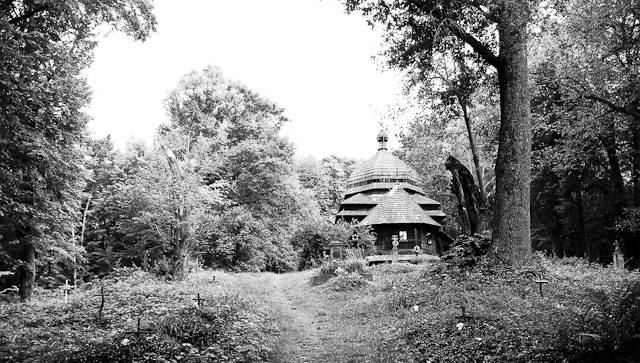
In Sanok, my city of birth, we stayed with my aunt Barbara. She got one of her friends to guide us by car through the countryside to show some of the more interesting Eastern Orthodox churches left, and the oldest one we saw was also the most spectacular, or at least it’s location; it was a good ten minute climb to get up there, and just imagining how people hundred years ago would have had to make the trek up there in the dark of winter for christmas mass, or on any rainy Sunday, painted a very vivid image.
Beksiński also had the good taste of being born in Sanok, and we visited the new wing of the museum dedicated to the works donated after his murder. For the first time I also spent some time with the orthodox icons and iconostasis at display, learning the difference between Hodigitrian and Eleusan icons of Mary and the child Christ.
Along with the museum, a lot of the infrastructure has been improved in the city. The main square has been dolled up, and each evening we’d see wedding photographers shooting one bridal couple after another by the colourful fountains and lit façades.
We visited Polańczyk for one night and it was far less lively than it used to be. Perhaps it was a question of timing, or perhaps the small village at the foot of the Carpathians has seen a shift towards family vacationing, but bars started closing around eleven. We stayed in one of the multi-storied sanitaria which were the original tourist trade, and what ten years ago was slightly warmed over communist brutalism, now had been restored into something between kitch and living museum. They are sanataria in the classic sense, offering a multitude of treatments, diets, analyses and soothing walks in the forest. One of them even offered cryotherapy chamber therapy, which means you spend a couple of minutes in a room at -150°C. It’s supposed to have rejuvenating qualities, but unfortunately they only do it once a day and we were too late to join the group.
The sanatoria are immensely popular, and while we were trying to get a room walking in off the street, one of the places had no vacancies for the next six months. So I’m proposing to get a bunch of people together next summer, book a two week stint at one of these sanatoria, and freeze our balls off in the beautiful Carpathians.
My first vacation as an adult went swimmingly. Now that I know that I can do it, I want to go again.
With only three weeks left of the math course, I gave up on it. And five minutes later I thought I’d give it a shot anyway. Shortly after which I threw up my hands in disgust at my indecision and decided to put away the calculator. A minute later I picked it up again with a “fuck it all to fuck, let’s do this thing and take it to the next level” etc. And what do you know, in ten days time I managed to scrape through. This was done with the smallest of margins, and with the pitter-patter of a TI-82 haunting my dreams, but I passed Math C. So with a “yay me” I applied to the introductory course to natural sciences, and ended up way back in the reserve line — apparently because I’d forgotten to send in the grades from high-school. So two steps forward and a stumble backwards. Regardless, I’m glad I got it done, as I now can apply for computer courses and other such things which my mom is hopeful will “perhaps one day land you a job — a real one, I mean”.
Seeing as I need to make more money than I am, and that what little ambition I have is spread very thinly over too many half-assed ideas and projects, I’ve made a resolution not to have more than four things running at the same time. It’s time to reassess if what I’m doing is out of habit or if it’s actually moving a “career” in a “direction.” As so many other “previously ambitious” people, I’m way under-stimulated and seem to lack the drive to do anything specific. It’s people in my position who I imagine are snatched up by cults and set to typeset Glorious Masters Bowel Cleansing Guide to sell at the airport.
I used to say that I was interested in communication, in how meaning is created and in turn creates more communication. Driving that interest is the hope that it’s not all arbitrary – that there’s actually something developing, evolving, in this collective exchange – but my lack of communication, and actually lack of interest in doing art work lately, might stem from me not having anything important to say at the moment and not trusting that the process will generate something. For all the talk of the wonderful things happening online, I haven’t found new homes there to replace those that I’ve lost; old KDX servers and homepages which didn’t tie into a Facebook infrastructure of likes and accessibility. Also, I don’t hang out with as many artists as I used to, so there’s that as well – I’m a wide object with little mass, so the friction of everyday life slows me down tremendously and I come to rest at the shallowest of indentations.
This is a roundabout way of saying that I’m bored and need to get a project of the ground, into the air, and either crash it spectacularly into a mountainside or land it successfully, applauded by relieved passengers.
In J.G. Ballards Millennium People a neighbourhood rebells as a response to the trappings of middle class life and their inability to afford more than the image of it. Their grievances are not political to begin with but relate to maintenance and parking space, and only later turn to structures of indoctrination and politics. I’m not sure that the story applies to actual mass psychology of how revolutions start, but it’s a classical Marxist notion and interesting to see it artfully applied in fiction.
At some point, a critical mass of disillusioned middle class might set themselves to start a revolution, and it might even start over something trivial.
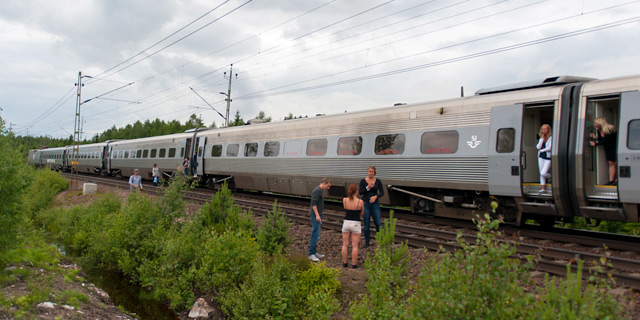
Unrelated to politics, but related to the trappings of comfort and our societies coating of polished civility, came to my mind when I was stranded on a train recently. I was on my way to Stockholm for work when there was a loud bang and we came to a halt. Both pantographs on the train set had snagged on something and had torn, leaving us without power in the middle of nowhere. The PA doesn’t work without power, leaving the crew to rush between trying to fix whatever had broken and walking from cart to cart shouting out what little they knew. They soon gave that up though, perhaps figuring that leaving 400 passengers steaming in a train with no articulated windows or ventilation or flushable toilets would pass for “a plan.”
The cafeteria kept selling food and drink until the power went out, after which they started writing IOUs instead. They gave this up after five minutes, seeing that the queue was growing in length and annoyance, allowing people to take food and drink (“–No alcohol!”) for free. Later, in the papers, SJ’s spokesperson put it in terms of that they “distributed food and drink to the passengers” which is an odd way of saying “allowed a disorganized free-for-all once the till didn’t work.” Apparently stuff got heated once people started looting the booze. There’s a tradeoff between offering disgruntled people alcohol to placate them, and the risk of suffering their poorer impulse control afterwards.
Once the diesel locomotive had arrived and hooked up, we were off again. disembarking an hour later at Hallsberg. Parents with kids, older folks with clumsy luggage, all dragging their charges and parcels in every which way, looking for bathrooms, someone to give them information on trains or missed connections. In the hustle for soda and pork sandwiches, the din drowned out any announcement coming over the PA for how to get to Stockholm, and mostly by chance I managed to get on a train heading in the right direction. When I finally arrive it’s night, and I’m more than six hours late on a three hour journey.
What has been lost now that we are constantly being treated as customers instead of individuals with agency, is that we’re reduced to objects with demands and criteria of contentment. We’re Sims in a very boring game of TrainVille which have to be clicked on every once in a while until the workday is over. We have demands and rights, but outside of the guidebook for consumer interaction there is no way to talk or meet in a shared interest or humanity. Which leads to four anxious crew members stressing out because they have four-hundred annoyed consumers who are not getting their moneys worth of travel experience, and no way to garner sympathy once they’ve “distributed food and drink for free.” Also, some of them were impolite asshats.
Things to remember:
* Keep people informed, even if you have nothing new to say.
* Don’t be an entitled customer asshole.
* Always bring extra water and energy dense food when you’re travelling with SJ.
* Acknowledge that people have the option of ignoring what you want them to do — offer arguments as to why they shouldn’t instead of getting indignant.
I’ve never thought much about the practical applications of fluid dynamics as much as now that the water in the bathroom is turned off and we’re flushing with a ten litre bucket. Where previously a steady flow along the rim of the bowl gently swirled the fear of ID away, three hand-poured buckets of water do little but break yesterdays dinner into its constituent parts. Let’s celebrate the ability of modern science and engineering to deal with shit!
Summer is supposedly already here, but you wouldn’t know it without looking at the calendar. It’s wet, windy and I’ve been able to show of my calves in shorts for only two days — to the disappointment of the public at large. Work has petered out and is almost non-existent at the moment, which I understand is known as “vacation time” for those with jobs, and once I’ve managed to get the math studies out of the way I’ll have time to catch up on all those projects scattered about the place.
I’ve badly neglected my and Olle’s garden. Partly due to it being so cold there was little sense in planting anything earlier, partly due to low ambitions. You’d be forgiven if you believed, as did I, that Olle wouldn’t be able to dedicate as much time to the garden what with a new kid to cuddle and coo at, but you’d be mistaken. He’s very serious about his schedule and so has weeded and tended the garden despite the weather and having more to do than I. This makes me feel bad, and I’m thinking to make up for it by building a totally badass perimeter enclosure for our lot. In my head, it will be beautiful. Also in my head, the sun is fucking shining.
Over at feber.se I stumbled over the project Google. The work, created by Ben West and Felix Heyes, is based on taking 21000 common English words and parse them through Google image search, and then printing it all and binding it.
“Conceptually it’s whatever you make of it,” writes Ben. The sad reality of shrinking attention spans, collective media fatigue or how an expert reference book is no match for the convenience of Google, for example. “It’s really an unfiltered, uncritical record of the state of human culture in 2012,” concludes Ben. So, how are we faring? “I would estimate about half of the book is revolting medical photos, porn, racism or bad cartoons.”
The second video above is from a work I did at Valand back in 2006: The uncontested order of things: A slideshow curated by google. It’s in the same vein, although it used the letters of the alphabet to search for images. I downloaded the top 40 or so pictures of every letter, picked one at random and arranged them alphabetically in the video. The idea being pretty similar to Ben and Felix — how is our language and concept of images shaped by that which we take for granted or don’t reflect over.
In the introduction to the work I wrote:
The motivation for this process, of which the resulting slideshow is but one possible combination (let alone one possible way to present the combinations) is:
1) To see how many apparently random images we can fit into a narrative, and
2) Given the omnipresence of google, how easily received/understood/accepted the images are when
3) A qualitative analysis of the images (and search results in general) shows an (apparently) unproportional US/EU presence, which in turn should
4) Kick us in the nuts for too easily accepting the perceived “freedom of the internet”, and not reflecting enough on what our online behavior tells of ourselves, but also what actual and very manifest power we are supporting by our actions.
Which actually still holds I think. Google is as omnipresent as it’s ever been, and apart from occasionally switching to Duck Duck Go as my main search engine, I don’t actively thing about how I navigate the Internet as much as I used to, or how that shapes our collective understanding of what the world looks like.
I’ve finally signed up for math-class, and am struggling with the “Matematik C” curriculum. I need it to get into any course related to computers or natural sciences, but I’m not putting near enough effort into it. It’s been fifteen years since I last took math, and back then my antipathy to math was so strong I was actively trying to forget what little I learned.
Actually, the course is officially over but I’ve asked for a month extension to allow me to catch up, so we’ll see how that’ll go. I need to do the test the 18th at the latest to be sure that my uni application for fall goes through, but this requires a couple of hours of daily practice. And I’m out of practice.
I might be doing the same mistake I did when studying philosophy, assuming that as long as you put your mind to it you ought to be able to figure things out from first principles. So you start with an intuitive understanding of 1+1 and build on that. But at this level math is mostly about learning by rote, and because I’ve been out to the loop for so long, half the time I don’t even know what problem I’m tasked with answering. “Describe a function” is not an invitation to write an essay, but something with an actual answer, and as always when you’re learning something new, the glossary seems arbitrary and made up by a stupid-poopy-head.
The TI-82 graphing calculator Zenobia lent me has a 150 page manual, and having been spoiled by GUIs for so long it feels as if I’m learning Dwarf Fortress. But it’s fun in a PRESS SHIFT+Ln+min/max way and I’m scouring the second hand market for a calculator of my own. SMBC sums up my findings quite well so far.
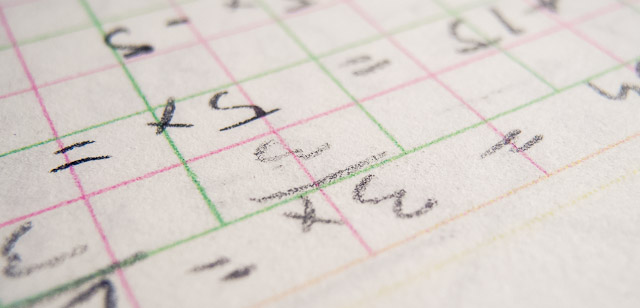
On the upside, I designed and printed my own graphing paper, and had it bound. Each page has different colours, and the paper is watermarked and really nice to write on using the extra soft pencil leds I found in the third store I asked. My priorities are not what they ought to be, but at least my notebook is perty.
As a small vacation, I and Sara took a weekend in Malmö. I haven’t spent much time there, so we had three days walking about, taking pictures of her old haunts and apartments, gorging ourselves on vegan cake and whatnots. Nice city, and it would have been even better if we’d gotten ourselves bikes. Speaking of which, the Malmö initiative Cykelköket has a branch in Göteborg. They seem nice!