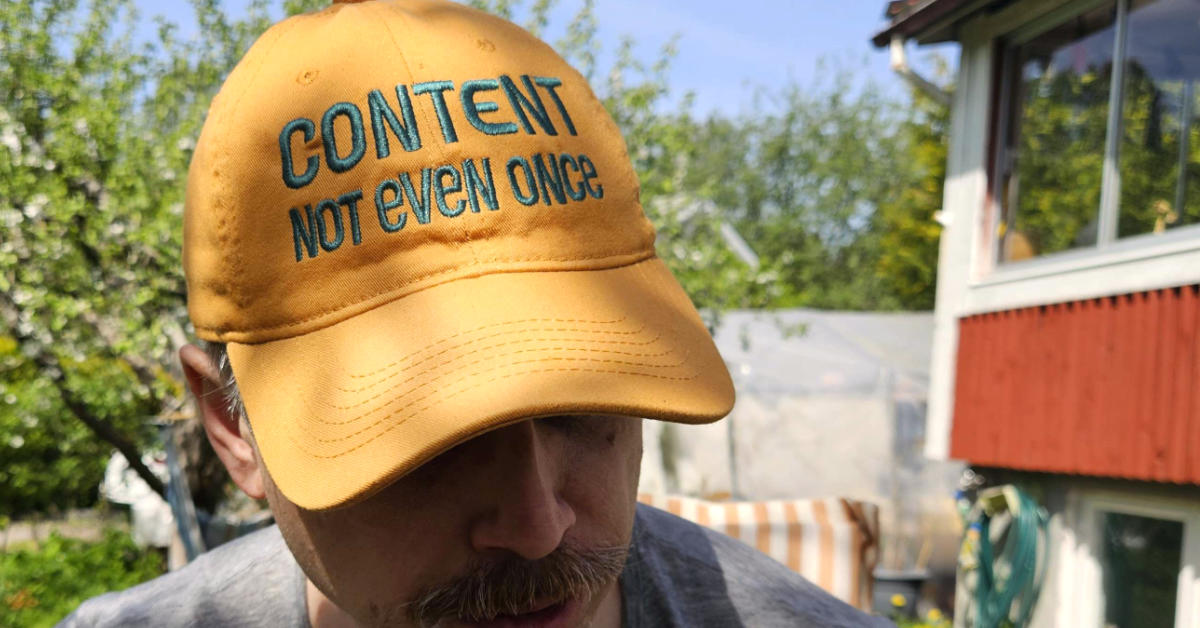
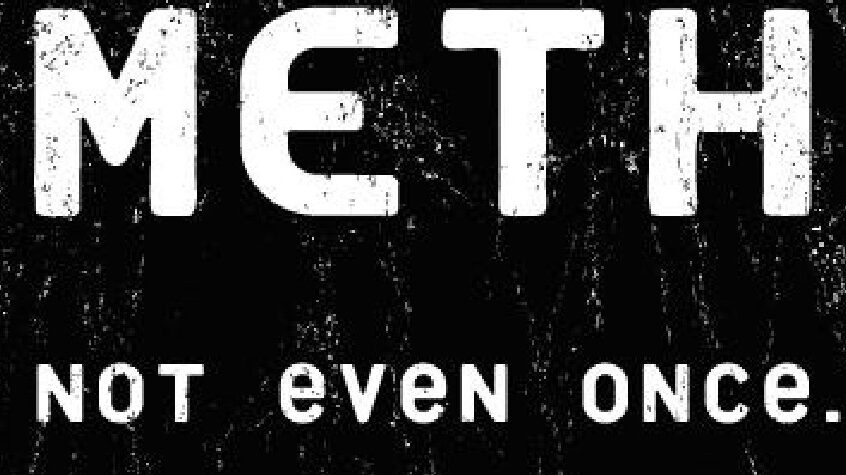
I never thought I’d be sentimental about the auteuric vision of creativity, but here we are. Behold my latest creation: A hat with “Content Not Even Once” embroidered. It’s a pastiche on the Montana anti-Meth slogan (“Meth Not Even Once”) suggesting, with only slight hyperbole, that engaging in content creation is as ruinous as meth. The moment you start feeding the social media beast — Instagram, TikTok, or the like — you’re at the mercy of algorithms that change your intrinsically motivated action to an extreinsically measured worth. Likes. Shares. Comments.
The trap is subtle. What begins as an earnest attempt to share a piece of yourself is hijacked by the craving for digital validation. Your art, your thoughts, transformed into fodder for the algorithm. It’s no longer about the joy of creation and finding connection with others, but about appeasing the insatiable hunger for engagement. This digital validation, as fleeting as it is, shapes our perceptions, guiding us to tailor our creativity to suit the blunt instruments of social media metrics.
I’m not deriding those who identify as content creators — whether you’re capturing video, sketching, or doodling on the piano, the label itself isn’t the issue — the problem lies in how it shifts our mindset. Instead of taking pride in becoming slightly better by the day, learning tools of whatever hobby or trade you’re pursuing, all value of what you’re doing is measured by clicks and views. You’re competing with “AI artists” who are making chumbox content, and that’s an unwinnable race – “never wrestle a pig”, etc.
(If you’re a content manager using media to fulfill some KPI, this doesn’t apply to you. Content to your hearts content)
So, I made a hat about it because it seemed fun (four hats in different colours, to be precise). It’s a statement equating content creation’s addictive cycle with meth. Perhaps a bit tasteless, but subtlety has never been my strong suit. It’s a call to remind myself of who I am beyond the algorithms — lord knows that I have self esteem issues enough without having to compete on the social media stage.
If this resonates with you and you’d like a hat – get in touch. If enough people want one I might get a dropship option going. Above all, remember not to do content. Not even once.
Forced to adapt their sleeping patterns to meet the needs of firms on the other side of the planet and in different time zones, the largely Syrian population of Lebanon’s Shatila camp forgo their dreams to serve those of distant capitalists. Their nights are spent labeling footage of urban areas — house,” “shop,” “car” — labels that, in a grim twist of fate, map the streets where the labelers once lived, perhaps for automated drone systems that will later drop their payloads on those very same streets.
Beyond the somewhat on-the-nose writing, holy hell this is bleak. In the 80’s I read about this in Gibsons novels, and here we are. Gibson did say that his sci-fi was only about five minutes into the future – how right he was.
Aaron credits the Psychologist bot with helping him through a rough patch. But the real joy of Character.AI has come from having a safe space where he can joke around or experiment without feeling judged.
I remember as a kid first time I tried Eliza – an extremely simple chat bot developed more than 50 years ago – spending hours typing broken English and having long conversations about whatever. I never thought that I was talking to a person, and I had to make allowances in how I phrased my writing to accomodate the limited capabilities of the program, but it felt good to be able to pretend-talk with someone who wouldn’t judge me (nor would remember what I said once I’d turn the computer off). The kids using Character.AI in the article have a similar experience, but the AI is many orders of magnitude more convincing than Eliza ever was, and I’m curious how prevalent the AI breed of hikikomori will become.
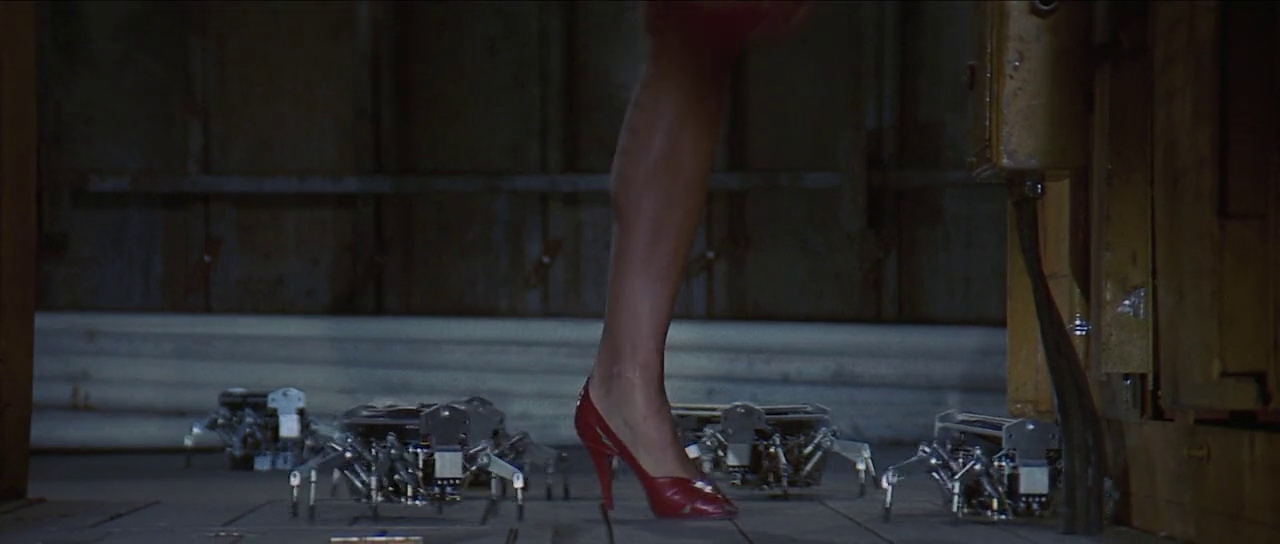
The venomous robot spiders want to interact with your leg. Runaway (1984)
Using Ezra’s example, a birthday planning agent, or team of agents, could be given a chain of 30 steps to follow in planning a birthday—from running an analysis of Brooklyn trends to conducting a competitive audit of cake vendors to checking their work along the way. The system of steps creates the grounding an LLM needs to accurately and sophisticatedly tackle tasks—rather than today’s “zero-shot” prompts.
On the face of it, this sounds like a good thing. It’s delivery on the promise of virtual agents that Ask Jeeves and Clippy made 25 years ago, when clever natural language processing would help us squishy humans by interpreting our questions and wants and adapting them to suit the world of computers.
It looks like you’re styling a headline, do you want to make it bigger?
But the todays AI services are more than virtual agents of yore, intent on making your life easier – they’re a wholly AI-mediated interaction with reality. Just as you will never have to manually look through hotel listings and compare prices (yay!) you will never have to form your own opinion on anything, only optimise yourself according the metrics that the AI can measure and that benefits the relationship.
Not only are your interactions and wants fed back into the algo, the algo can now gaslight you into fitting their particular silo better – should they want to. And economics will make it want to.
This is the same argument that has been made about the adverserial Adsense / SEO relationship (and algo-driven interactions, Tiktok, Insta, et.al) where human wellfare becomes merely an externality.
If I could have a personal, combative and sociopathic AI that aggressively acts on my behalf against dumb systems, that I could live with. My own Matrix Sentinel that scours the web and orders cheap socks at discount because it’s on my todo-list. But the version of AI-mediated Internet that is being delivered is one where the Sentinel is a loaner from Google (Or Meta, or OpenAI, or Apple) and preferentially will herd me into their silo.
A brief history of where we are now, as I understand it
Web 2.0 was built on cheap money and promise of Adsense revenue.
The SEO and Adsense have a Red Queen Race and as a result advertising becomes the dominant financial model of everything online, all mediated by Google
As with all advertising, users become the product
Angry, atomized and confused users are better suited for the web, therefor the web becomes better suited for those emotions, and in turn makes people more angry, atomized and confused, etc
This is the enshittification of the Web that Cory Doctorow coined but which has been ongoing for the last 15-odd years
AI and virtual assistants are presented as a way to no longer have to interact with the messy, bloated and enshittified Internet.
This also makes Internet a wasteland where the promise of self-expression and ownership of your digital self (“Welcome to my homepage!”) means either catering to what the AI:s care about or not reaching humans.
All Web interactions become AI-mediated – this is the agentic AI era – mined for metrics and manipulated for clicks.
This is painting with very broad strokes, and there will always be outliers and upsides – but I can’t get rid of the feeling that just like any power multiplier, AI will be used as a leverage for entrenched powers, or those who will come to supplant them – and that is never a progressive turn of events.
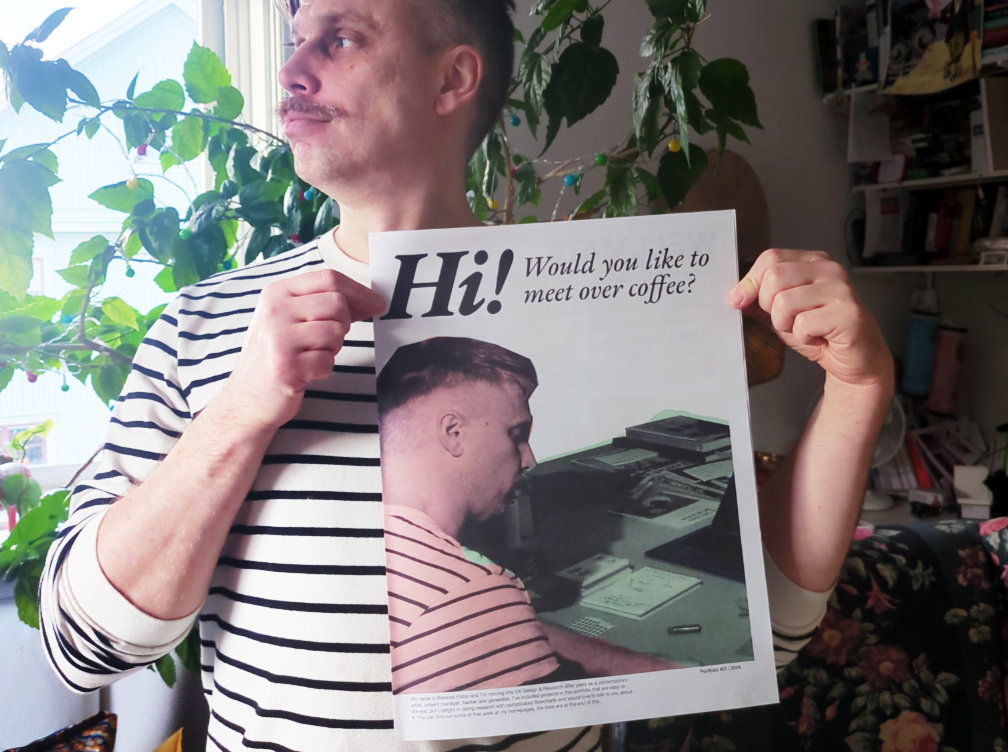
I’m trying to dip my toes, get a foot in, dunk my head and generally jump bodily into the sea of UX careers, and beyond the obvious stuff – practice the craft, do good work, go to meetups – I’m trying out a gimmick to get some conversations going: A limited run printed portfolio!
I love gimmicks, and ever since I heard Hiroshi Sugimoto (who does serious high-art photography) describe some of his techniques as “gimmicks” I’m no longer afraid to use the word myself, even though it’s often thought of as derogatory.
Because I’m without income right now I’ve had to think twice before splurging on this, but I figure it’s worth a gamble, and for anyone who is interested I’ve done a short writeup.
The gimmick
I’ve printed a small run of an eight page tabloid portfolio which contains one UX case, one rebrand, and a few examples of my art practice. You can download the PDF here: Mateusz_Tabloid_portfolio.pdf
The aim is to get people to book a meeting with me through a Calendly link.
The portfolio took me 40 hours to put together over three months sporadic work, using Affinity Publisher for the design. None of the content is AI generated, except the pastiche of the riflemans creed at the last page, for which I used Perplexity.ai.
When the portfolio was more or less done I solicited feedback from Petter Baggeryd, Nina Mujdzic, Thijs Keesenberg, Jenny Riksén, Åsa Gillberg and Cindy Sjöblom – great many thanks to them for their time and input. Of course, my first critic and supporter is as ever my darling Sara Henriksson ❤︎.
Since the portfolio is intended to grab attention rather than be exhaustive, I’ve had to put the hours in to create a proper portfolio that people can visit. So an added benefit was that I finally got three sites done: pozar.se for the UX work, hintlab.org for the more speculative work I’m hoping to do, and monocultured.com to document all the art and media projects I’ve done over the years. All three are works-in-progress and look kinda generic right now, but at least they’re up. I used blocs to put it together, and self-host the sites.
Cost cost
Newspaperclub printing of 70 copies digital tabloid: 2200kr
Import duties & tax: 200kr
Transparent C4 polyethylene envelopes: 200kr
Stickers for my thermoprinter: 150kr (although I have plenty left)
Postage for out-of-town companies: 400kr
City courier: 1800kr
Total≈ 5000kr
Target audience
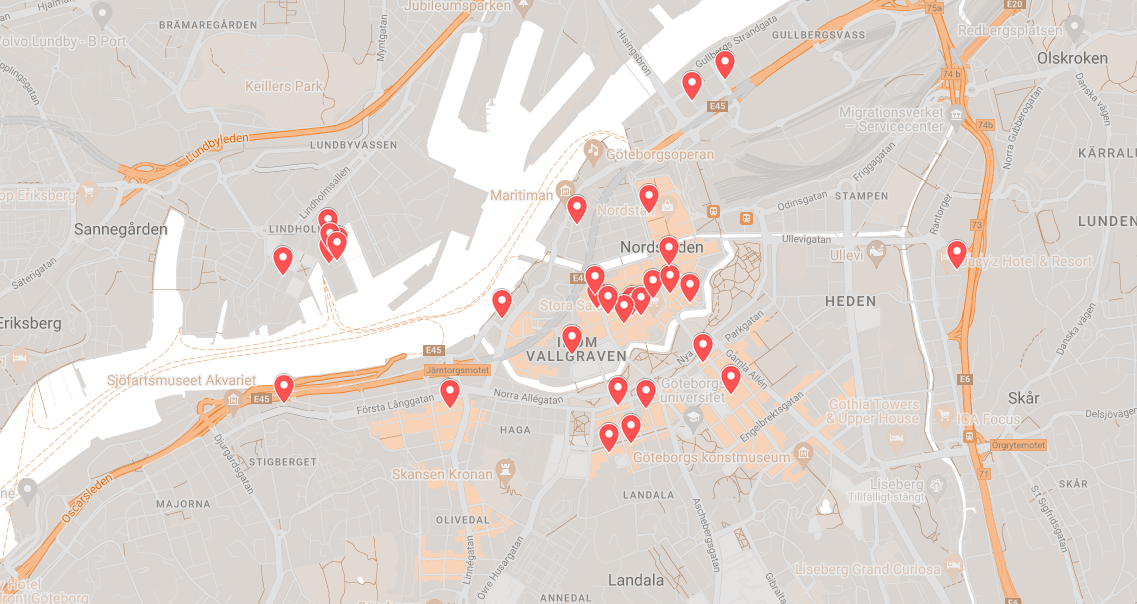
I put together a list of 45 companies that I’m interested in, and 50 people at those companies whose attention I’m hoping to grab. The goal isn’t necessarity to land a job with one of these companies – although that would be sweeeeeet – but to start conversations about where I fit in. Even though I’m junior in the UX field I have 25 years of related experience, so I know that I have a lot offer in the design space – but I also need to find a good cultural fit, so I’ve targeted companies and people senior enough that they know what they want and can tell me if I would be a good match. You want to know if you can make people smile and appreciate your company, y’know?
In order to reach the right person I’ve scoured Linkedin and homepages to decide on whom I ought to contact – I’ve built the list over the last six months or so, putting ≈30 hours into it. Most companies have offices in Gothenburg, but a few allow remote work or had design leads living elsewhere – for those I’m sending the portfolio by post.
In-person delivery
In order to make sure to reach the intended recipients, I’ve hired Tura to act curier and make sure to give it directly to the right person. It’s like being served a court summons, only friendlier! The goal is to get most of them delivered in the beginning of May.
Some companies have obscured their locations so I’ve had to guess at the correct address. Perhaps it’s an indication that offices are less important these days of hybrid and full remote, or maybe they just don’t want people to show up unannounced.
In a time of full remote and flexible hours it’s proven difficult to reach the individuals using courier. It was worth trying, but my ambition to have all of these delivered to the correct person in two days was unrealistic – I would have needed to find out the working hours of everyone and adjust the delivery based on that. That would have been too much effort for too uncertain payoff though, so I probably just would have sent all by post today.
The outcome [updated 15th May]
I’ll keep tabs of who has reached out to me, who has booked a meeting, and if anything else came of a particular delivery. In a business where the competition is fierce and networking is how stuff gets done, I’m curious to see how this experiment will turn out.
Companies I reached out to: 45 People I wanted to reach: 50 Successful in-person deliveries by Tura: 7 out of 29 Sent by post: 21 Coffee-dates: 1 Promised coffee-dates: 4
Other feedback, communication, etc: • Great idea and nice portfolio, we’re just not hiring at the moment. • Love the idea • The portfolio ought to show more of your process and what you want to do.
Final thoughts
The last two years I’ve been cultivating my Linkedin network and it’s going pretty well, but even though Linkedin clout might make you feel connected to other professionals, the platform’s exuberant cheerfulness doesn’t easily translate into anything useful. And for an introvert like myself who really sucks at networking, finding a way to reach others is important – let’s see if this portfolio is a good way.