And he spake onto them: Readeth this!

In Grand Theft Auto, no misbehavior is so grievous that it can’t be washed away after a quick trip to the police station or the hospital. That conceit works well for gameplay, but it hinders the narrative by suggesting a world in which even the gravest actions have no meaning. How could we buy Lady Macbeth’s “Out, damn’d spot! Out, I say!” if she could have just headed to the nearest Pay’n’Spray?

→ Escapist magazine, Brendan Main: Fall of the house Bellic

We’re pleased to announce a new addition to our shop, in the shape of If Drawings Were photographs – the first ever zine published by It’s Nice That. The brainchild of designer Rob Matthews and Illustrator Tom Edwards, put simply – “Tom gave drawings to Rob and Rob tried to make them into photographs.”

→ It’s Nice That, Alex: If drawings were photographs Via Wakaba

Avatar Machine is a wearable system which replicates the aesthetics and visuals of third person gaming, allowing the user to view themselves as a virtual character in real space via a head mounted interface. The system potentially allows for a diminished sense of social responsibility, and could lead the user to demonstrate behaviors normally reserved for the gaming environment. Via Jonas

This product was originally designed to be: Impossible for child to suck the thumb while wearing, Unrestrictive and fun to wear, Extremely difficult for child to remove. The function of the Thumb Guard is to prevent the seal made around the thumb with the child’s lips. Without this seal, there can be no suction, which is the main source of pleasure in sucking the thumb.

→ Amazon.com: Stop Thumb Sucking with Thumb Guard Kit for One Hand

Fabbing, contd.

Desktop Factory might be the LaserWriter of additive manufacturing. Priced at under $5000 it’s cheaper than the LaserWriter was, and would allow individuals to buy it for themselves or collectives to scrounge funds together. I would love to play around with it; Barring too high running costs (think of the ink in printers) you could do limited edition runs of stuff.

Maybe the RapMan would be good starting kit for a workshop on building and using 3D printers? I’m actually more interested in building the kits than I am using them, but I guess that the practical applications will reveal themselves once I know what can be done. Or whenever I need a new filterholder for a on-camera-flash or something such.

In the end, I’d probably do what everyone does when confronted with a creative outlet with endless possibilities and print genitalia. But it would be a rapidly prototyped genitalia how cool wouldn’t that be!

The link to Desktop Factory came via Fabbaloo, an excellent fabbing blog with a silly name. Then again, once the 3D printing revolution happens and your ten year old kids will print the latest manga characters, they might very well shout “Faa-baa-loooo!” so perhaps it’s just good brand positioning on their part.
Barn_pa_garden_med_svard

copenhagen_art_fair_hund

Over at blog.ponoko.com there’s a debate in the comments section about how object models will be pirated, and what effects this will have on the designers and manufacturers of stuff. It’s odd how similar the discussion is to the one about music and movie piracy.

Morals don’t always dictate if we pirate or don’t, but rather convenience. What is considered ethical will be adjusted to the technological lowest common denominator, just as will the job market. It’s not a fair way of going about it, but I don’t know how designers of stuff will make a living in a post-fab world, nor how they can hope to stem the tide of obsolescence. Sitting back with some popcorn and watch the slowly dawning realisation on the faces of panicked designers might become the new spectator sport.

Fabb it all and let the added value sort the back end, maybe? This approach hasn’t prevailed among the more litigious media companies, nor curbed their enthusiasm of that business model. I don’t see the future of fabbing to be any different.

In Neal Stephensons book The Diamond Age nano-manufacturing is a reality. People use matter compilers (MC) to make food or clothes or anything else that they might need or want. (Similar to the cornucopia machines of Charles Stross Singularity Sky, the acronym of which is CM, curiously enough) As long as they have the blueprints for something, they can build it. As long as you have access to a feed line you can use it to make stuff. (This is part of what fabbing might offer, even though we’re far off from nano-assembly)

In the book there’s talk of the seed, a concept where you’ll have self-contained seeds that can grow into whatever you’d like. The difference being that their energy stores are self-contained and wouldn’t have to rely on a centrally controlled feed, much like a seed draws upon the earth and surrounding nutrients when growing. One variation on this theme is presented on by Sascha Pohflepp in the work Growth Assembly, a series of drawings reminiscent of the Codex Seraphinianus but with real-world application instead of high fantasy.
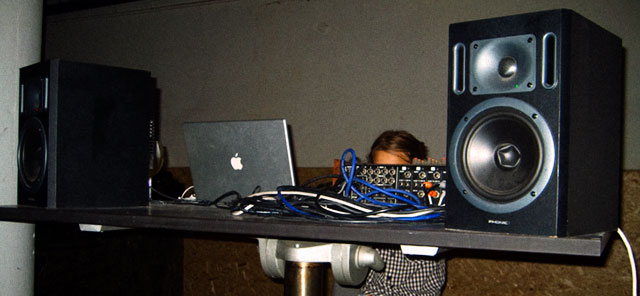
eskil_pallazzo_dj

As for fabbing in art, I still haven’t found much worth mentioning. I might be looking in all the wrong places though.

Peter Jansen did a sculpture series, Strange Attractors, using 3D printing to create molds which are then cast in bronze. the shapes themselves are created using the Chaoscope software, which itself is used to generate representations of strange attractors (something I’m wholly unqualified to tell you anything about except that it’s related to chaos theory) examples of which you can see in their gallery. They make for pretty pictures, and to someone who understands the math involved I’m sure there’s an theoretically beautiful part that is unknowable to the rest of us, but it’s just not very interesting. Casting them in bronze doesn’t add much conceptual value to them, neat though it might be.

A better beginning would perhaps be Peters Human Motion series, but I’m not certain if they’re fabbed or traditionally sculpted and cast. As a comment of a technology on its relationship to space and previous art — Nude Descending and Muybridges studies of motion — it might be an interesting statement of intent. But halting there, making the object itself the work of art, would be dull. As it stands I don’t even know if the motion series was fabbed, but one would hope that there will be more to the tech than mere convenience for sculptors. Not that I begrudge them that, mind.

The link to Peter Jansen came via Metafilter: Human Motions
Reporting the hand that gives you cellphones to the proper authorities.

Samsung, or their ad agency rather, threw a competition where you call a number of a phone to make it vibrate off of a plexiglas platform, onto concrete or into a tank with goldfish. The phones are of the rugged kind, so the competition killed two birds with one stone, providing both a neat online interactive experiment, as well as making the proof of the phones ruggedness conditional of winning it.

Naturally, I reported them to the animal rights people, as well as contacting Samsung directly. Had those fish instead been kittens — or if the phones literally were aimed for the previously mentioned birds — you wouldn’t have had to argue much before getting the animals removed from a stressful sitiation, but seeing as it’s much harder to sympathise with fish, it took a call from the department of agriculture for the fish to be removed.

I think it’s awesome that there are enough resources, and laws to direct said resources, to care even for the rights of really boring creatures. Having said that, I realise those fish might have been flushed down the crapper.

[flv:https://monocultured.com/blog/blog_video/Samsungshakedown.flv https://monocultured.com/blog/blog_video/Samsungshakedown.jpg 640 360]

The other part of the story is concerned with the cellphone marked “00” in the video above — barely missing the tank — which is the one I won by ringing frantically, shouting excitedly in front of my computer. I’m only half expecting a dead fish in the mail. I’m sure there is a moral to be learned here, and perhaps there’s even a suitable biblical parable, but I think Petter put it best using the ancient art of rhetorical questioning:

“You won a cellphone and reported them using your own name? You did not win a cellphone.”

Required reading, doing, being: Everyware.

We are now a predominantly urban species, with over 50% of humanity living in a city. The overwhelming majority of these are not old post-industrial world cities such as London or New York, but large chaotic sprawls of the industrialising world such as the “maximum cities” of Mumbai or Guangzhou. Here the infrastructures are layered, ad-hoc, adaptive and personal – people there really are walking architecture, as Archigram said.

→ Future Metro, Matt Jones: The city is a battlesuit for surviving the future

Lalvani is anxious that his work not be portrayed as the development of trendy shapes; this is an entire system for generating infinitely variable form. Like Fuller before him, he cleaves to the idea that when science begins to mimic nature at a molecular level, it moves into a realm outside of fashion.

→ Core.form.ula, Peter Hall: Bending the Rules of Structure originally published in Metropolis 2004

In everyware, the garment, the room and the street become sites of processing and mediation. Household objects from shower stalls to coffee pots are reimagined as places where facts about the world can be gathered, considered, and acted upon. And all the familiar rituals of daily life, things as fundamental as the way we wake up in the morning, get to work, or shop for our groceries, are remade as an intricate dance of information about ourselves, the state of the external world, and the options available to us at any given moment.

→ Adam Greenfield: Introduction to Everware

If you wanted an allegorical portrait of modern western capitalist society, you could do a lot worse than a man alone at a shaving mirror, intent on his own reflection, while from the other side of the glass a vast global corporation is watching, recording and planning what to sell him next.

→ Guardian.co.uk, Thomas Jones: Cutting Edge

upsidedown_drawing

Yes, yours may not look exactly like the original, but it’s recognizable as a copy, right? What this exercise illustrates is a different kind of seeing. As you were drawing, you weren’t thinking about drawing the nose exactly right, because you may have not known it was a nose.

→ Kirk Bjorndahl: Learn how to draw

Filled fountain pens should always be stored nib up, as they would be in a shirt pocket. You should never store a fountain pen nib down…Gravity works. Filled fountain pens should never be stored for an extended period of time. When you fill a pen, consider it a commitment to use it.

→ Bertrams inkwell: How to care for your fountain pen

Professional dilettante: The Photoshop proletariat.

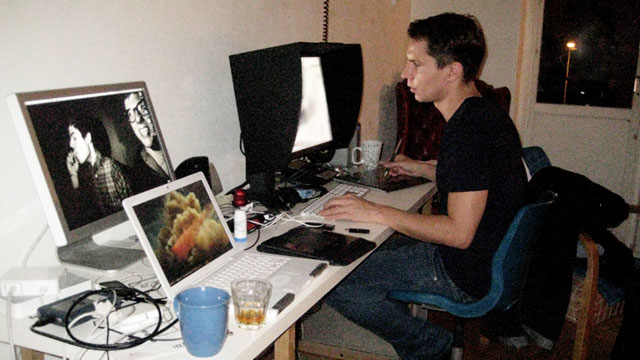
Petter had too much work last week and brought me in for some photoshopping. Confident that whatever retouching was required I would be up to it I set about poking at the material. How hard can it be, right?

Emerging four days later, having slept at his place with scant time for food or personal hygiene, I had much more respect for people who do this for a living. I’ve used Photoshop since 1995, but never worked with it full time and so have huge gaps in my knowledge of how to streamline the work. And apparently my instincts regarding geometry, colour, sharpness and common sense are lacking as well.

At one point, when phone was ringing every fifteen minutes to check on my progress, I could taste zinc in the back of my mouth. For more than one hour I was in an adrenalin buzz, laughing hysterically to myself, my hand cramping around the tablet pen and both feet describing an accelerating cadence for the neighbours below.

Petter_retuscherar

I’ve been tasked with doing two slideshows for Landstingsarkivet in Stockholm thanks to my work with the Museum of Architecture, and just got the audio for one of them. One is about a home for idiot children from the beginning of the last century; Children who were deemed to be mentally retarded or in need of special education were sent there to either get treatment and rehabilitation or to be taken care of for the rest of their lives in case they were “incurable.”

It makes for a harrowing read, where some of the diagnoses mistook poor vision for retardation, and the slideshow is supposed to tell the story of eleven kids admitted to the home for idiots, victims of circumstance and the (often well–intentioned) application of psychology, sociology and Christian morals.

So, you’ve emailed 162 job coaches. Now what?

If you plan on emailing more than a handful of people and ask for simple information, don’t include your phone number. I’ll tell you of how I learned this: The webpage listing all eligible job coaches is a pile of shit, impossible to search in any other way other than alphabetical, so I spent twenty minutes collecting all the email addresses and an evening setting up a bulk emailer to send the same email to each of the 162 addresses on my list: 1) Have they any experience working with freelance artists, and 2) Do they know the business end of the modern artworld?

To a certain degree, coaching is more about helping you find the answers to your questions and making sure that you ask the right questions, but I’d like to have the help of someone who might know something of the process for applying for grants, where to look for shows, and so on. An ideal would be a cross between a therapist and an agent, but I’ll take what can I find.

I’ve got some seventy replies, many of them using so many exclamation points you wouldn’t believe, and I’ve found a few who don’t seem completely off the mark or insane. Reading the answers, I realise that I ought to have been more specific in my email, explaining a bit more about what I’m doing — In Swedish, “art” can imply both modern art as well as crafts, and is tangental to culture in general, leaving me with a lot of emails about how they “love to knit and be creative, so let’s arrange a meeting, yes?”

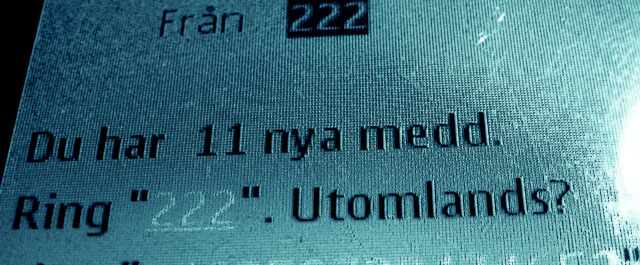
Since this coaching business is a buyers market, with many newly started companies vying for government money, I should have known better than to include my phone number with the email. It’s part of my standard signature and I didn’t think anything of it until my phone started ringing early next morning, not letting up until two days later.

11_meddelanden_bla-1

Svart_svan_svv-1

As most people know who know me, I’m bad at pickup up the phone. Most often this is because it’s on silent and I’m wearing headphones, but when I suddenly had ten people calling me before lunch I realised what it might be about. So I started screening every call, letting all strange numbers go to voicemail. Some of them sneaky bastards tried calling right back using the *31# prefix — showing up as number unknown on my phone — which I guess should give them a star in the margin for ambition. None of those who called answered yes to my questions, but were quick to point out that coaching isn’t about knowing the market but rather helping you out defining goals and guiding you to the tools necessary to reach them.

Which is all fine and dandy, but given a choice I’d go with someone who might have an inkling of why I’m fucking my grant applications up, and who doesn’t clog my phone up when a simple email with a “no, but x” would suffice. Also, I’m bloody awful over the phone and too weak to say no to persuasive people; Had I not dumped it all to voicemail I would probably be in a group session right now, telling the others what precious flower I am, practising on my networking smile. (Prejudiced? Me?)

I’ve recorded all the messages from my answering machine, but they’re not fun enough to present here and I don’t know what to do with them yet. Suggestion go in the drop box (where I notice there’s a lack of comments regarding hair cut mentioned previously. You need to get with that people, or my hair is gonna get got.)

Also, it would seem that I have a hip bursitis, which sounds sexier than it is. I can walk or stand for about half an hour before the slimebag in my hip gives out and hurts like a sonofabitch. I limp about like Warren Ellis only with much less gravitas. I make faces and scare children, but it hardly cheers me up at all…