My MFA presentation is coming up. And here’s the neat flyer for it. Everyone in Gothenburg is welcome.

Robert Frank lecture hall at Högskolan för Fotografi & Film, Chalmersgatan 5 in Gothenburg, 26/3 18:30 – 20:00
My MFA presentation is coming up. And here’s the neat flyer for it. Everyone in Gothenburg is welcome.
Robert Frank lecture hall at Högskolan för Fotografi & Film, Chalmersgatan 5 in Gothenburg, 26/3 18:30 – 20:00
i got so staggeringly drunk this past saturday that i might have had my first memory loss. last thing i recall (more or less) after getting out of the cab at 0300 is hanna breaking a plate, and that’s it.
according to sources slightly more reliable than i, we were actually up for half an hours, during which i not only was fondling petters abs and encouriging others to do the same, but also promised to make breakfast. in fact, i had promised to “get up, go to the store, and cook breakfast before any of you wake up”. i must have been the drunkest because it’s a ridiculous thing for me to promise.

i was held to my promise though, and six hours later they tear my door down, someone takes my cellphone for some reason, and then yell feed us! feeeeeeed us! like so many gollum zombies until i mooch to the store to buy baked beans. i’m drunk all day and only get the hangover in the evening. then blissful sleep. sunday more or less down the drain, when i should have been doing, i don’t know, something soberlish.
emma came by and kept my miserable self company. and i now have a bike that goes “schuech schuech” on every rotation. yay for bikes!
i don’t know if it’s related, but i stumbled upon edward bernays book “propaganda” while searching for people to interview regarding the lockpicking presentation that’s due in a weeks time. i’m not going to read it right now, but i did watch a short clip about his successful attempt to get more women smoking in the 20s:
the book is available here: www.historyisaweapon.com, and it’s prolly a good read. if nothing else it’s a classic in pr and advertising.
oh, i think that what connects the two above stories might be a flashback to the party – a sea of amused faces when i with much bravado describe the priciple of how i’m going to take over gothenburg. it’s a sound principle, but my eagerness to inform these poor people about its genious might have been overly enthusiastic.
i was looking for the artists behind a track i liked, and it turns out that “danny rhymes” is the name of a very popular young man who does gay porn. i ended up on a review site and just love this:
Coming back to reality, Barrett Long heads for the john to drain his hose (and yes it is a hose). Locking himself in the stall, he decides to have a full-on wank. This is our first real glimpse of Long’s snake of a cock – an uncut beauty with low-hangers. He’s interrupted when Owen Hawk, complete with 5 o’clock shadow and doing a bad-ass James Dean impression, comes in the bathroom for a smoke. But the school janitor (Jett Allen) has other plans.
i’m of thankful that my name is as original as it is – no-one is going to say “hey, you don’t look like the guy who got fisted by the rhino in looking for the retentive vol 3.”
i found the other danny rhymes’ website a few clicks later, and he’s got an utterly useless myspace page which you shouldn’t visit, but you can get the band cd from cdbaby.com, a very nice independent music store. it’s just the first track that i like so far (brilliant voice-work), but still. haven’t looked actively for music in a while, so it’s a start.
i was looking for the artists behind a track i liked, and it turns out that “danny rhymes” is the name of a very popular young man who does gay porn. i ended up on a review site and just love this:
Coming back to reality, Barrett Long heads for the john to drain his hose (and yes it is a hose). Locking himself in the stall, he decides to have a full-on wank. This is our first real glimpse of Long’s snake of a cock – an uncut beauty with low-hangers. He’s interrupted when Owen Hawk, complete with 5 o’clock shadow and doing a bad-ass James Dean impression, comes in the bathroom for a smoke. But the school janitor (Jett Allen) has other plans.
i’m of thankful that my name is as original as it is – no-one is going to say “hey, you don’t look like the guy who got fisted by the rhino in looking for the retentive vol 3.”
i found the other danny rhymes’ website a few clicks later, and he’s got an utterly useless myspace page which you shouldn’t visit, but you can get the band cd from cdbaby.com, a very nice independent music store. it’s just the first track that i like so far (brilliant voice-work), but still. haven’t looked actively for music in a while, so it’s a start.
i was looking for the artists behind a track i liked, and it turns out that “danny rhymes” is the name of a very popular young man who does gay porn. i ended up on a review site and just love this:
Coming back to reality, Barrett Long heads for the john to drain his hose (and yes it is a hose). Locking himself in the stall, he decides to have a full-on wank. This is our first real glimpse of Long’s snake of a cock – an uncut beauty with low-hangers. He’s interrupted when Owen Hawk, complete with 5 o’clock shadow and doing a bad-ass James Dean impression, comes in the bathroom for a smoke. But the school janitor (Jett Allen) has other plans.
i’m of thankful that my name is as original as it is – no-one is going to say “hey, you don’t look like the guy who got fisted by the rhino in looking for the retentive vol 3.”
i found the other danny rhymes’ website a few clicks later, and he’s got an utterly useless myspace page which you shouldn’t visit, but you can get the band cd from cdbaby.com, a very nice independent music store. it’s just the first track that i like so far (brilliant voice-work), but still. haven’t looked actively for music in a while, so it’s a start.
i was looking for the artists behind a track i liked, and it turns out that “danny rhymes” is the name of a very popular young man who does gay porn. i ended up on a review site and just love this:
Coming back to reality, Barrett Long heads for the john to drain his hose (and yes it is a hose). Locking himself in the stall, he decides to have a full-on wank. This is our first real glimpse of Long’s snake of a cock – an uncut beauty with low-hangers. He’s interrupted when Owen Hawk, complete with 5 o’clock shadow and doing a bad-ass James Dean impression, comes in the bathroom for a smoke. But the school janitor (Jett Allen) has other plans.
i’m of thankful that my name is as original as it is – no-one is going to say “hey, you don’t look like the guy who got fisted by the rhino in looking for the retentive vol 3.”
i found the other danny rhymes’ website a few clicks later, and he’s got an utterly useless myspace page which you shouldn’t visit, but you can get the band cd from cdbaby.com, a very nice independent music store. it’s just the first track that i like so far (brilliant voice-work), but still. haven’t looked actively for music in a while, so it’s a start.
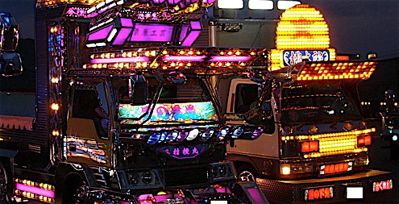
1) i have never imagined japanese “decotora” trucks, but they exist. there’s hope for humanity after all.
2) recursive images of cats. just click “next”: infinitecat.com
3) long list of blogs that deal in/with music: zimbio.com
4) here’s a guy who’s doing virtual photography!
i’m not certain what this will be used for, but stephen hurrel send along a link to javamuseum.com which outlined a request for submissions. there are tons of these requests out there, all interesting and somehow pertaining to your life in one way or another.
this request is about “blogs as art”. i’m treating this blog as a manifestation of a process, so i’m trying to put that into words. apart for submissions for something-or-other that is upcoming (i’m not sure if it’s an exhibition. i’ll check it out tomorrow when i’m less coffee-fueled) they have ten question about net art that they would like me (me!) to answer.
so for the past two hours i’ve been pressing random keys on the computer, hoping that some semblance of reason shines through. i’ve pasted the Q&A below, in it’s unedited and raw form, and if you decide to read it you might as well post comments, right?
Question 1.
Since a reasonable time, digital media entered the field of art and extended the traditional definition of art through some new, but very essential components.
Do you think it is like that and if yes, tell me more about these components and how they changed the perception of art?
A: “all is the same, everything is new”. the modality of communication was added to – the speed with which we communicate, as well as with whom we can and do communicate has changed. This hasn’t changed the perception of art as far as i can tell, but it has shifted focus slightly to encompass issues that computers and computer networks are highlighting. (value of text, telepresence, identity and representation, the “digital divide”, perceptions of democracy, and so on)
Question 2.
A relevant section of digital art represents Internet based art. The Internet was hardly existing, but artists conquered already this new field for their artistic activities.
Can the work of these early artists be compared with those who work with advanced technologies nowadays? What changed until these days ? What might be the perspectives for future developments?
A:
Question 3.
The education in the field of New Media art, including Internet based art, started late compared with the general speed of technological development and acceptance.
So, generations of artists who used the Internet as their artistic working field were not educated in this new discipline(s) and technologies, but had rather an interdisciplinary approach.
What Do you think, would be the best way to teach young people how to deal with the Internet as an environment of art?
A: Any education should focus on the goals rather than the tools. Regardless of ones view of art, what defines an artist and so on, the tools are always secondary to that view – first comes direction, then comes motion.
As always, the tools we use feed back into our concepts and changes our realities – in the case of internet as an emerging social and technological phenomena we start to take certain things for granted, (email, www, IM) and other as emerging. (Second Life, VR, telepresence)
This notions change our focus, and obviously the direction we take in our artistic practices; but the benefit of an art education is always (or rather should be) in that we try to get into a position where we try to analyse our actions and position in relationship to everything else – after we’ve done that, the role of the educational institutions is to facilitate our interests and curiosity. (this latter point is what often fails because of the inherent inertia of universities takes a while to counteract, and the difficulty of properly evaluating the emerging technologies requires more resources than are at disposal)
That said, I would say that the speed of our uptake on new media must be considered astounding compared to historical adaptations of technology for art purposes. How long time did it take for mail art to appear? or telegraph art? or tv art? It is true that the artistic climate of those days wasn’t conducive to as broad an artistic definition as the use of those technologies would require, but it’s still telling that the language of the net was so readily adapted.
Question 4.
What kind of meaning have the new technologies and the Internet to you in concern of art, are they just tools for expressing artistic intentions, or have they rather an ideological character, as it can be found with many “netartists”, or what else do they mean to you?
Many “Internet based artists†work on “engaged†themes and subjects, for instance, in social, political, cultural etc concern.
Which contents are you particularly interested in, personally and from an artcritical point of view.
A: Since the www & email has introduced a seemingly flat(ter) hierarchy it is interesting to both see what has actually changed and what merely appears new.
As an early adopter of computers and MUDs/MOOs i was fascinated by how radically limiting the technology was. But those areas that were not limited were full of possibilities that irl might not exist. Maily this concerned the total focus on text as communication, but the fluid social groups that appeared appealed to me as well – it was like having a multitude of penpals that all could have access to the same messages, and where the arbitrary whims of admins or other alfa-users could have consequenses that set policy, and not only the mood of one evening as the case might have been in an analogous irl situation.
time changed – in some areas it expanded tremendously (usenet discussions on one topic that mutated over the course of one year), in other areas it compressed into a point (the extreme result of which would be the death of ping for overloaded servers, and the self-annihilation of the social space as a result of the social interaction).
but we all numb to these things. i spend five hours a day on a computer, more online than not, and the areas that i’ve focused on lately are the possibilities of social inclusion and desctrution of specialisation and localisation of ones person.
Question 5.
The term “netart” is widely used for anything posted on the net, there are dozens of definitions which mostly are even contradictory.
How do you define “netart” or if you like the description “Internet based art” better?
Do you think “netart” is art, at all, if yes, what are the criteria?
Are there any aesthetic criteria for an Internet based artwork?
A: One always has to take into account the medium in which one is showing any art – being context and site specific in relationship to the net often excludes purely documentational or promotional art sites from being considered “net art” (imho), although it doesn not exclude material that has not originated on the computer, the network or as a result of both.
If the venue in which you primarly chose to present and discuss your work is the net, or if it exists exclusively in the network, i’d consider it net art because you’re obviously targeting other computers (and most often their users).
the distinction between net art and “other” art seems to have outgrown it’s use though – i’d be hard pressed to label myself a net artist even though most of what i do is only ever presented online; maybe there’s still a value in differentiating between “art about the net” and “art based on the net”?
Question 6.
“Art on the net†has the advantage and the disadvantage to be located on the virtual space in Internet which defines also its right to exist.
Do you think, that “art based on the Internet”, can be called still like that, even if it is just used offline?
A: depends on the artwork. if the work you’re showing relies on actually being located on a network, just like a painting relies on having the qualities of a such, showing a simulation of such a piece might well convey the meaning and setup, but is non-the-less a simulation and in the end a copy of the original created for other purposes than the original intention. (thus becoming possibly a new art work, and at least documentation or a replay of a live event)
Question 7.
Dealing with this new, and interactive type of art demands an active viewer or user, and needs the audience much more and in different ways than any other art discipline before. How do you think would be good ways to stimulate the user to dive into this new world of art?
What do you think represents an appropriate environment to present net based art to an audience, is it the context of the lonesome user sitting in front of his personal computer, is it any public context, or is it rather the context of art in general or media art in particular, or anything else.?
If you would be in the position to create an environment for presenting this type of art in physical space, how would you do it?
A: i don’t agree with the assumption made here. the art you create will be context-based one way or another, and if what your work requires is heavy user interaction you will take a course in interface design: user interaction is not the goal in itself, and is not the point of interactive art.
if you create a work that you’d like people to interact with, and then are disappointed when they don’t (for whatever reason), you’re missing the point that such behaviour is an interaction as valid as any other.
if this is a question about how you educate an art public, the ‘problem’ seems easier to quantify than the corresponding complaint heard everywhere that the public ‘just doesn’t get it’. if you want to have ‘proper’ reactions to an art piece, there is little to do but to either cater to the people familiar with the subject, or push for extending the art debate to include more net art and propagate the ideas of interaction furher.
Question 8.
As Internet based art, as well as other art forms using new technologies are (globally seen) still not widely accepted, yet, as serious art forms, what do you think could be an appropriate solution to change this situation?
A: it’s the same as always; if you like it, support it, debate it, show it.
anyone in a position to promote the category, if we still find it valid, could lobby for it’s inclusion in shows and so on.
the interesting feature of net art is that it contains both itself as well as its possibility of dissemination – you can propagate the work and information about the work without necessarly changing it. perfect copies are not only possible but mandatory – and even though the setting of your work might change (“i created a virus for computers only on our own network”), it’s easily adaptable without changing in essence.
Question 9.
The Internet is sometimes called a kind of “democratic” environment,
The conventional art practice is anything else than that, but selective by using filters of different kind.
The audience is mostly only able to make up its mind on second hand. Art on the net might potentially be different. Do you think the current practice of dealing with Internet based art is such different or rather the described conventional way through (also curatorial) filtering?
Do you think, that speaking in the terms of Joseph Beuys, anybody who publishes anything on the net would be also an artist?
Question 10.
Do you think, the curators dealing with net based art should have any technological knowledge in order to understand such an art work from its roots? And what about the users of Internet based art?
A: users, no, since they’re you’re audience you are the one responsible for what you want to convey. curators might benefit though, especially with the advent of purely software-based art, where the code itself is the work and where there has to be an understanding of the programming to see the point of this (any education that you’d want the audience to have would be facilitated by the curator)
before falling asleep yesterday i was dreaming of dragons. and when i woke up the download of eragon had finished with a ping curtesy of transmission. watched half of it blearyeyed over two cups of coffee this morning after four hours of sleep. wonderful weather outdoors, and thanks to my genious money-saving scheme (i’m skimping on the tram fair and walk the hour it takes me to get to uni) i got exposed to the sun for the first time in two days (i shit you not. this is also a result of me saving money, since everyone knows that you cannot walk out the door without someone trying to tax you for needing to take a piss).
my semi-voluntary seclusion from civil society did bring a good thing or two. the forever vaporware that is a new, brilliant, shining-like-a-radiant-star, homepage got a few tentative first drafts in photoshop (after which i despared at all the css i don’t know but need to learn), some doodles have been doodled on a web-service involving video in an original way (i’ll let you know when that project is available up on cambrianhouse.com), i’ve baked bread three times in a short time, and i have with all my blackened little heart avoided thinking about the examination in 14 days on masters degree.
or rather, i haven’t stopped thinking about it for a moment, but i have this worrying feeling that “everything is going to be fine”. i am not certain if i am convinced about this myself, or if the correct image associated with that thought is one where i sit on the ground, rocking back and forth and gently weeping into the crumpled up pages of “Ten steps to a more organized you!”
this is the drawback of trying to focus on a process oriented artistic practice. i’ve been mulling this over, and it’s hard to distinguish purely process-ish driven work from general slackery or lazyness. i was talking this over with anna, and she wholeheartely agreed with the sentiment: if what you are doing is not driven by an actual presentation of an artistic work, you will more likely than not come over as full of hot air and methane gasses rather than the spunk and vigour you’d like to be associated with.
this blog and talking about my ideas are the closest thing to a presentation that i get to something that is of artistic interest to me. whenever i’m told to do any particular work i freeze up. this might make me a poor artist (in both senses of the word), but still. truth to be told though, i have this same block whenever i feel pressured to perform (erectile dysfuntion jokes aside). this pressure is of course of my own making – people in general don’t give a toss if you can perform to your standards or not, they just want to know if you’re interesting to them and their interests. i’m always doing the don kitzott thingy where every position i take has to be defended against every imaginable foe, and where this defense becomes the thing that you are defending.
in the end i’m left standing on a small hill, waving a stick around and shouting “i have a right to defend my right to defend whatever i’d like to defend!” and since offence is best defence i might as well attack my own position since that will show ’em how it’s done, that’ll show ’em good.
basically it breaks down into meta more than it creates anything intelligible. (neither does it easily allow the activity itself to be understood as proper artistic practice)
a while ago i wrote an artist statement: the fun of failing. what the title implies is that everything you do ends up being a failure in the most strict sense that wherever you end up is not where you thought you were going. it’s all learning, it’s all experience, it’s all last-minute judgement calls on what your work is about, what you are about and how you think you fit in; “whatever you do, you fail to do”. i’m sure there’s a zen koan on the subject.
plus, “fun of failing” sounds good – the alliteration slides gently off your tounge and into the bucket labelled “aren’t you clever”.
here’s a link to the essay: The Fun of Failing [1.2 MB pdf]